News
State-owned bank buyback talk sparks rally, structural risks remain
Tenggara Strategics June 24, 2026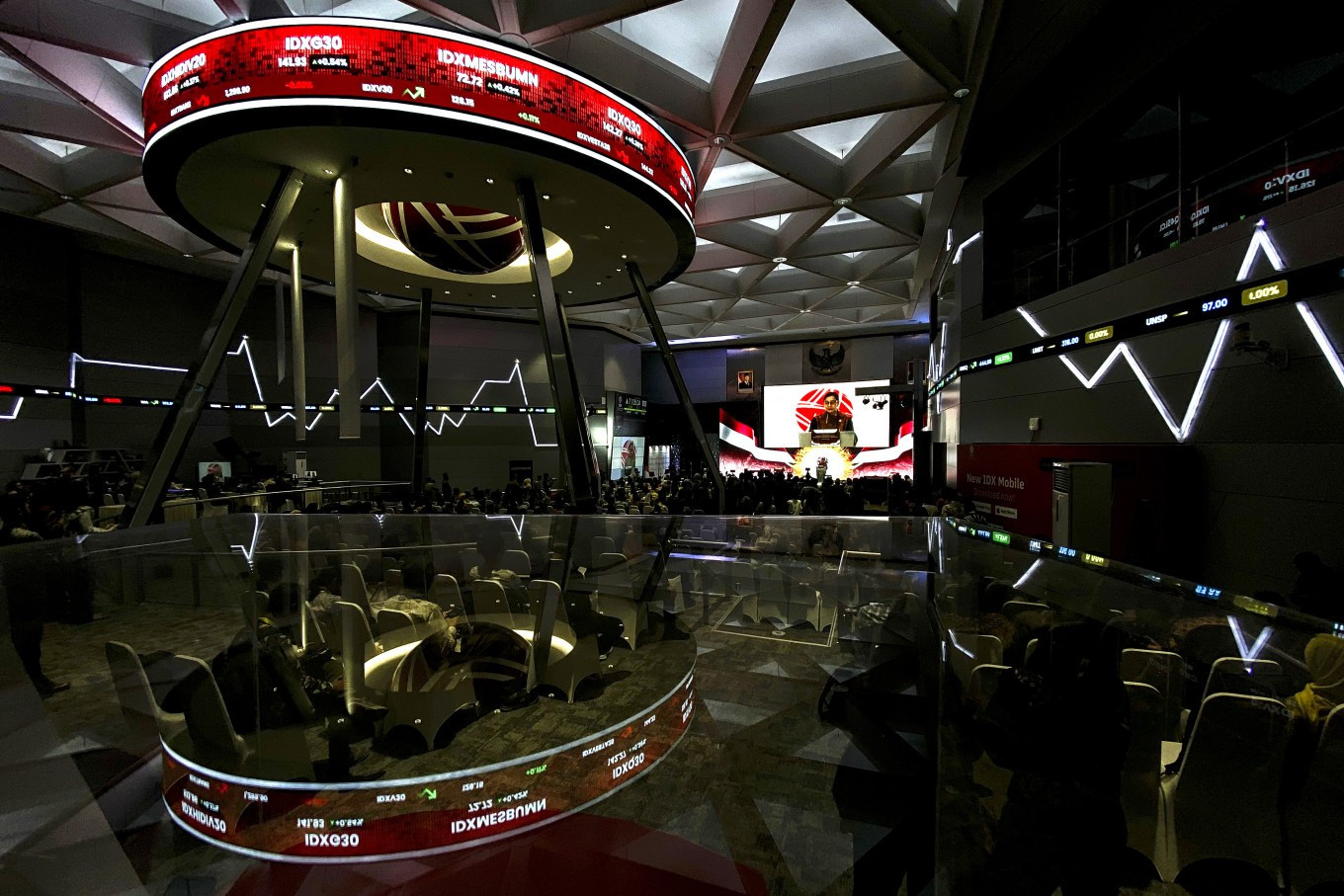 A screen at the Indonesia Stock Exchange (IDX) in Jakarta shows stock quotes on Jan. 2, 2025. (Antara Foto/Hafidz Mubarak A) (Antara Foto/Hafidz Mubarak A)
Indonesia's stock market staged an impressive rebound after Deputy House Speaker Sufmi Dasco Ahmad floated the possibility of a buyback involving state-owned banks and major domestic financial institutions. The proposal came after the Indonesia Stock Exchange (IDX) Composite index had come under sustained pressure since late May, falling to a low of 5,342.14 on June 8 amid concerns over Indonesia's economic outlook and continued foreign capital outflows. Following Dasco's remarks on June 9, the IDX surged 7.57 percent and extended its gains the next day, suggesting that investors were eager for signs that policymakers were prepared to support the market.
According to media reports, Dasco convened a closed-door meeting on June 9 with senior executives from state-owned banks, sovereign investment entities, and state social security institutions. Participants reportedly included representatives from Bank Mandiri, Bank Rakyat Indonesia (BRI), Bank Negara Indonesia (BNI), the Indonesia Investment Authority (INA) and BPJS Kesehatan. Accompanied by State Secretary Prasetyo Hadi and Danantara chief operating officer Dony Oskaria, Dasco publicly suggested that fundamentally strong stocks could be purchased to support the market during the downturn.
The meeting was reportedly prompted by growing pressure on the Presidential Palace as major investors, particularly those transacting through state-owned securities firms, expressed concern over the prolonged decline in the IDX and the erosion of their portfolio values. In this context, the buyback narrative served not only as a potential market-stabilization measure but also as a signal to reassure investors that policymakers were prepared to act.
However, translating the rhetoric into policy is far from straightforward. Share buybacks are commonly used to correct market dislocations when stock prices fail to reflect underlying fundamentals. Yet implementing such a strategy through state-linked institutions carries significant risks. If market sentiment fails to improve, these institutions could be left holding depreciating assets while facing accusations of politically motivated intervention. Consequently, any formal buyback program would require careful evaluation of the potential financial costs, execution risks and implications for market integrity.
One of the longstanding challenges facing Indonesia's capital market is concern over ownership concentration and market integrity, particularly in the equity market. These issues prompted MSCI in January to warn that Indonesia could face a downgrade from “emerging” to “frontier” status in its June review.
In response, regulators introduced a series of reforms aimed at improving market accessibility and transparency. These included doubling the minimum free-float requirement for listed companies to 15 percent from 7.5 percent, lowering the shareholder disclosure threshold from 5 percent to 1 percent, and introducing special monitoring measures for companies with highly concentrated ownership structures.
Despite these efforts, MSCI excluded 18 Indonesian stocks from its Emerging Markets indices during the May rebalancing. In its subsequent market accessibility review, MSCI downgraded Indonesia's assessment for information flow while continuing to highlight concerns over ownership transparency and coordinated trading behavior. Although Indonesia appears likely to retain its “emerging” market status, significant challenges remain in restoring investor confidence in the transparency and integrity of the country's capital market.
The persistence of these concerns helps explain why foreign investors continued to sell Indonesian equities despite the sharp market rebound. According to IDX data, foreign investors recorded a net sell of Rp 3.13 trillion (US$175.39 million) on June 10, followed by another Rp 252.65 billion on June 11, even as the Composite index rallied.
This trend raises questions about the effectiveness of any eventual buyback program. While Dasco's proposal successfully lifted sentiment in the short term, it did little to address the structural issues that have driven foreign investors away from Indonesian equities in recent weeks. The rally therefore appeared to be driven more by expectations of government support than by a genuine improvement in investor confidence. As a result, policymakers are increasingly caught between two competing objectives: preserving market confidence after raising expectations of intervention, and avoiding the deployment of public or state-linked funds into a strategy whose long-term effectiveness remains uncertain.
What we've heard
Several sources said that the meeting between Deputy House Speaker Sufmi Dasco Ahmad and senior executives from state-owned banks and state investment institutions was closely tied to the significant decline in the value of investment funds owned by politicians following the stock market downturn. These politicians’ investment portfolios are spread across various stocks, including shares of state-owned banks. As one of President Prabowo Subianto ’s closest confidants, Dasco took the initiative to “intervene” in the market to prevent losses from deepening further.