
News
P2SK revision rekindles debate over BI, Patriot bonds
Tenggara Strategics June 17, 2026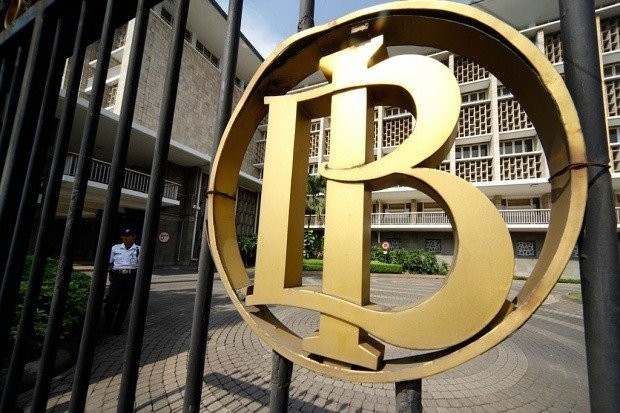 The Bank Indonesia logo adorns the gate of the central bank's headquarters in Jakarta in this undated photograph. (Antara/File)
The House of Representatives has approved the Bill on Amendments to Law No. 4/2023 on Financial Sector Development and Strengthening (UU P2SK). According to Finance Minister Purbaya Yudhi Sadewa, the amendments cover 17 key areas, including a provision that would authorize state asset fund Danantara to issue special bonds. The proposed changes have also reignited concerns about a potential erosion of central bank independence.
Purbaya further explained the amended law would create a stronger legal framework for the issuance of bonds like the Patriot Bond and the Red and White Bond. The inclusion of these instruments in the amendments to the P2SK Law is particularly notable, given the controversy surrounding the Patriot Bond on its introduction. To recap briefly, the bond drew scrutiny when it was offered with a coupon rate significantly below prevailing market yields, yet it still managed to attract overwhelming investor interest. Many believe this was indicative of government pressure on investors. The controversy intensified following a revelation that the bond was marketed through a private placement scheme heavily targeting the largest Indonesian conglomerates, despite its framing as a voluntary instrument. Unsurprisingly, the Patriot Bond saga has dominated public attention in recent months, turning what was initially a technical discussion on financial sector regulation into a broader debate about the relationship between the government and the country’s largest business groups. Yet despite the headlines generated by the bond issuance, it is far from the only contentious element in the amended P2SK Law. Long before the bill’s approval, concerns had emerged over reports that the government intended to significantly expand the mandate of Bank Indonesia (BI). Among the most controversial proposals was the addition of economic growth and employment creation to BI's statutory objectives, alongside its traditional mandate of maintaining monetary and financial stability. Critics warned that such a move could blur the line between monetary policy and the government’s economic policy, exposing the central bank to greater political pressure. For decades, Indonesia's financial architecture since the post-reform era has been built around the principle that BI should remain insulated from short-term political objectives, with price stability as its primary anchor.
These concerns have been compounded by complaints regarding the opacity of the legislative process. Some officials reportedly encountered difficulty accessing the bill’s latest version, fueling speculation that significant provisions were being negotiated behind closed doors. While the government has emphasized the need to strengthen the country’s financial architecture, critics argue the bill has also served as a vehicle for introducing broader institutional changes that might have faced greater resistance if pursued through stand-alone legislation. In particular, some observers see the proposed expansion of BI's mandate as an attempt to align the central bank more closely with the government's development agenda. This is especially notable because amending the P2SK Law was, in many respects, unavoidable. The Constitutional Court's 2025 ruling on the governance and budget approval mechanism of the Deposit Insurance Corporation (LPS) effectively required that the existing law be amended. The original rationale for reviewing the law was therefore relatively narrow: ensuring compliance with the court ruling and strengthening the operational independence of the LPS. The irony, critics argue, is that the proposed amendment was initially justified on the grounds that reinforcing the autonomy of one financial sector institution may ultimately result in a significant reduction in the independence of another. If the amendments concerning BI's objectives and governance have the effect that opponents fear, the final outcome could be a stronger and more independent LPS and a central bank that is increasingly expected to serve the government's broader economic priorities.
17 key changes in the amended P2SK Law
- Strengthens the institutional framework of the LPS;
- Strengthens the institutional framework of the Financial Services Authority (OJK);
- Strengthens the institutional framework of BI;
- Authorizes the House of Representatives to evaluate the performances of BI, the OJK and the LPS;
- Expands business activities for conventional and Islamic banking;
- Demutualizes the Indonesia Stock Exchange (IDX);
- Regulates margin transfers in financial market transactions;
- Authorizes Danantara to issue debt securities by (Patriot, Red and White bonds);
- Regulates insurance and Islamic insurance companies in resolution proceedings;
- Mandates traffic accident insurance fund;
- Mineral and strategic commodities exchange;
- Strengthens the regulation of crypto assets;
- Establishes a task force to prevent and handle online lending/gambling;
- Establishes the Indonesia International Financial Center;
- Expands nonperforming loan resolution for micro, small and medium enterprises (MSMEs);
- Stipulates investigations and prosecutions in the financial services sector, as well as restorative justice mechanisms; and
- Strengthens banking supervision and restructuring to safeguard financial system stability.
What we've heard
A source from House Commission XI, which oversees financial affairs, highlighted several irregularities in the approval process for the P2SK Law amendment, including difficulty gaining full access to the draft bill, even after it had been ratified during a plenary session. Nevertheless, several lawmakers apparently felt compelled to participate in the discussions and approve the bill, believing that their political parties had representation in the cabinet.