
News
Police secure more power, less oversight
Tenggara Strategics June 23, 2026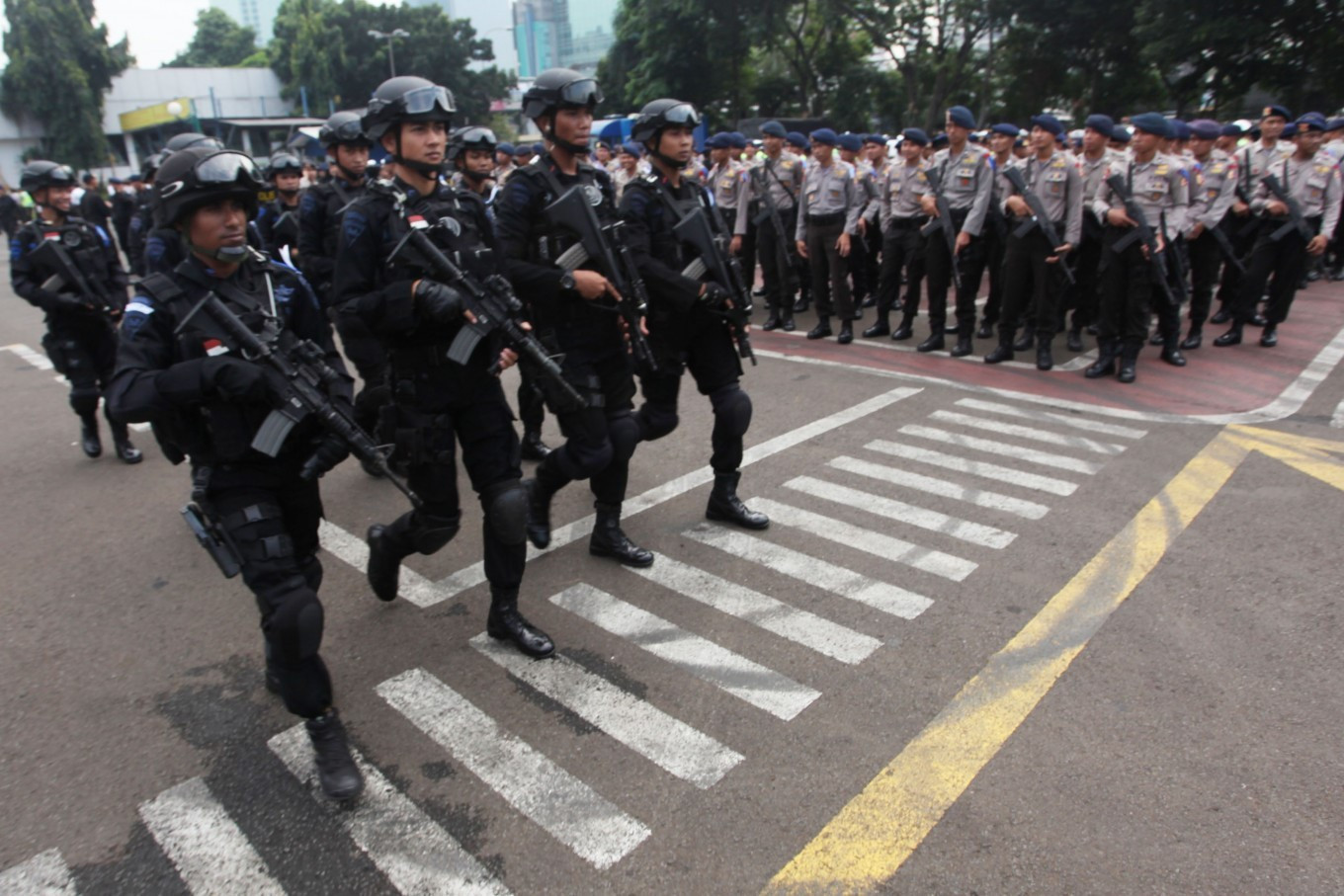 A number of police personnel participated in the 2014 Apple Ketupat Operation Force Title at Metro Jaya Regional Police Field, Jakarta, Monday (7/21/2014). The operation lasted for 16 days, from July 22 to August 6, 2014, involving 137,795 joint police and military personnel aimed at securing the implementation of Idul Fitri 1435 H. (JP/Dhoni Setiawan)
The passage of amendments to the 2002 Police Law marks a significant expansion of the National Police’s authority, renewing concerns that the institution is becoming increasingly powerful while remaining subject to limited external oversight. The House of Representatives approved the bill during a plenary session on June 9, following a few weeks of relatively smooth deliberations.
The amendments revise 10 articles and introduce seven new ones, covering issues ranging from retirement age and police appointments in civilian institutions to oversight mechanisms, human rights training and emergency powers. Three provisions have drawn particular attention.
The first concerns the retirement age of senior police officers. During the final stages of deliberation, the government submitted a last-minute proposal through Deputy Law Minister Edward Omar Sharif Hiariej to allow four-star police generals to remain in office beyond the previous retirement limit of 61 years. Under the revised law, they may remain in office for as long as the president considers their services necessary.
This change has attracted scrutiny because Indonesia currently has only one active four-star police general: National Police chief Gen. Listyo Sigit Prabowo. Critics argue that the provision gives a president greater discretion over the tenure of future police chiefs, potentially strengthening executive influence over the institution.
The second controversial provision concerns active police officers serving in civilian posts. Previously, police personnel were generally required to resign or retire before taking positions outside the force. The revised law relaxes those restrictions, allowing active officers to serve in ministries and state institutions if their roles are deemed relevant to policing functions or are filled at the request of government agencies. This amendment has revived longstanding concerns over the blurring of lines between civilian governance and security institutions.
Several legal experts have also questioned whether the provision is consistent with Constitutional Court rulings that require police officers to leave active service before assuming positions outside the institution. By creating broader exceptions, the revised law could pave the way for a greater police presence across government bodies.
The third issue concerns oversight. The revised law grants the National Police Commission (Kompolnas) two additional responsibilities: advising the incumbent president on efforts to strengthen integrity and professionalism within the police force and providing recommendations on organizational culture and institutional performance.
While the government has portrayed the changes as an effort to strengthen Kompolnas, critics argue that the new responsibilities remain largely advisory and fall short of addressing longstanding concerns about the commission's limited authority.
This criticism is all the more notable because Kompolnas itself recently called for stronger oversight powers. Last month, the government-appointed commission submitted a series of recommendations to President Prabowo Subianto, including a proposal to expand its authority to improve police accountability. Activists say the final version of the law failed to incorporate reforms that would have transformed Kompolnas into a more effective external watchdog.
Critics argue the amendments create a widening gap between authority and accountability. While the police gain greater flexibility in personnel management, broader access to civilian positions, and increased institutional influence, external oversight mechanisms remain largely unchanged.
Civil society groups have strongly opposed the law's passage. The Coalition of Civil Society for Police Reform, comprising Kontras, the YLBHI, ICJR, PSHK, LBH Jakarta, LBH Masyarakat, SAFEnet, ICW, AJI Indonesia, Yayasan Kurawal, PBHI and various journalists' associations, condemned the revision as rushed and lacking meaningful public participation. The coalition argued that several provisions run contrary to the spirit of police reform that emerged after the fall of the New Order, risking a rollback of democratic safeguards.
Questions have also been raised about the legislative process itself. Compared with other major legislative revisions, deliberations on the bill moved unusually quickly, ever since the House designated the revision as a legislative initiative on May 20. Deliberations on the substance of the bill reportedly took only two days, passing with no significant deliberation. The speed of the process stands in sharp contrast to the significance of the institution being regulated.
The new law reflects a broader trend in Indonesian governance: the growing influence of state security institutions amid continuing debates over accountability and democratic oversight. The core issue is not simply whether the police have gained more authority, but whether oversight mechanisms are keeping pace. For now, that question remains unanswered: Who watches the watchdog?
What we've heard
A cabinet member said deliberations on the bill lasted for nearly two weeks and had been discussed directly with President Prabowo Subianto. “All substantive provisions received the President’s approval,” the source said.