
News
Bond vigilantes send a warning to Indonesia
Tenggara Strategics June 15, 2026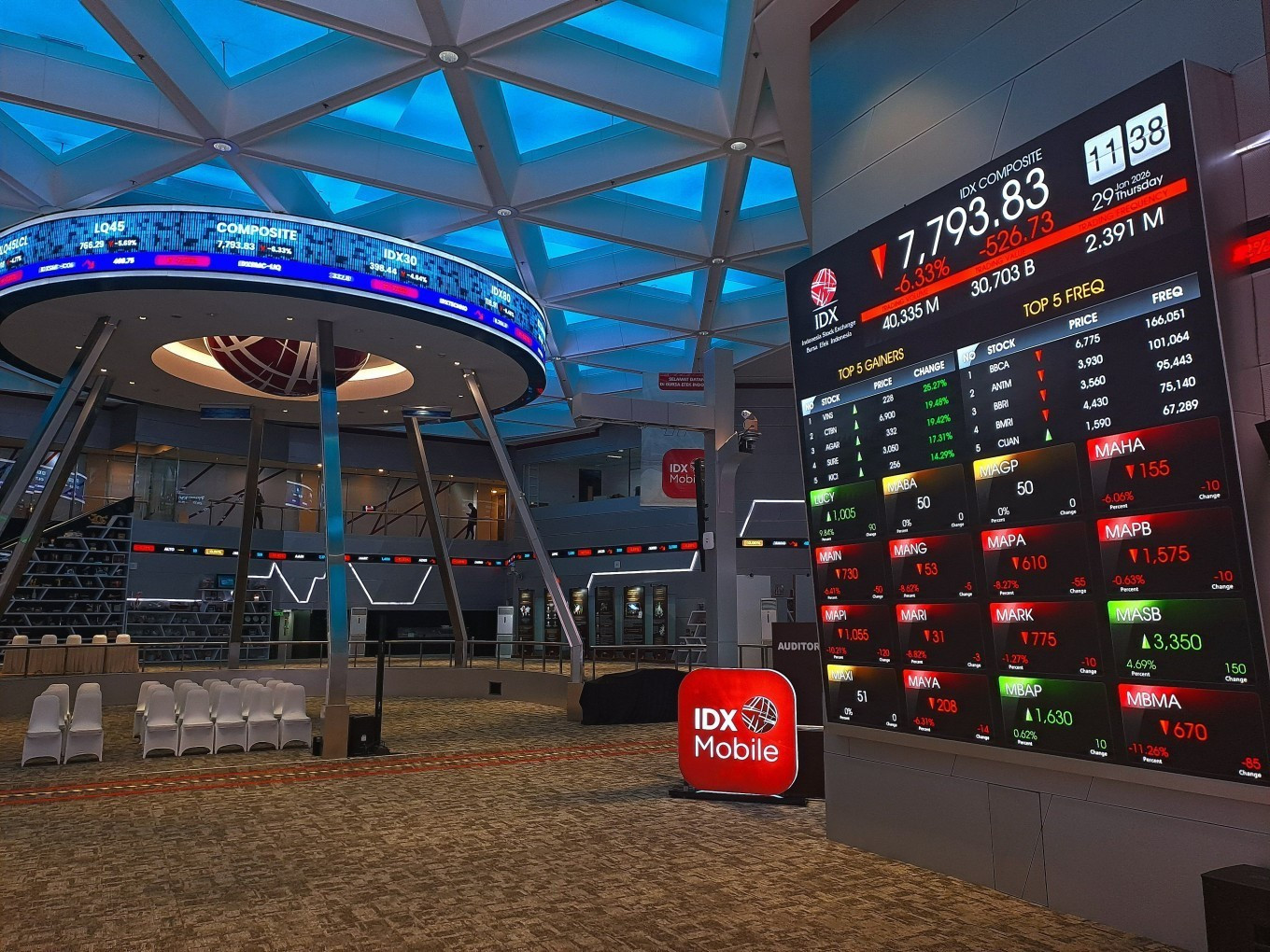 An electronic display board inside the main hall of the Indonesia Stock Exchange (IDX) in South Jakarta shows an overall downward movement across most stocks during the lunch break on Jan. 29, 2026, when the IDX Composite index fell 6.3 percent after global investment firm MSCI raised concerns about free float and trading transparency. (TJP/Deni Ghifari)
Indonesia’s financial markets have experienced significant turbulence in recent weeks, with the rupiah depreciating beyond Rp 18,000 per US dollar, the Indonesian Stock Exchange (IDX) Composite index falling by nearly half to below 6,000 points, 10-year government bond yields have climbed to 7.3 percent and the yield curve has flattened considerably amid substantial capital outflows. Together, these indicators suggest that investors are losing confidence in the government’s economic management. Yet the government has shown little indication of adjusting its policy direction.
Among financial assets, government bonds are generally considered less risky than equities because of their fixed cash flows and sovereign backing. Yet investors have been selling government bonds, pushing the yield on 10-year government securities from around 5.9 percent in October 2025 to approximately 7.3 percent on June 8, 2026. Rising yields indicate that investors are demanding higher returns to hold government debt, increasing the government's borrowing costs and making deficit financing more expensive.
For Indonesia, sovereign bonds play a particularly critical role in financing the state budget, which is facing mounting pressure as the fiscal deficit reached 0.93 percent of GDP in the first quarter, while government expenditure grew much faster than state revenue, at 31.4 percent and 10.5 percent, respectively.
The government is also managing a growing volume of maturing debt, much of it stemming from borrowing undertaken during the COVID-19 pandemic, while simultaneously financing flagship programs such as the free nutritious meal program and the red and white village cooperatives. With Indonesia’s tax ratio continuing to decline, falling into single digits in 2025, debt financing has become increasingly important, making investor confidence in government bonds a strategic priority.
This phenomenon is often associated with the concept of “bond vigilantes”, whereby investors discipline governments by selling, or threatening to sell, large amounts of sovereign debt when fiscal and economic policies are perceived as unsustainable. The influence of bond vigilantes can be substantial. In the United States, for example, Donald Trump’s administration temporarily paused its reciprocal tariff policy for 90 days after concerns emerged that the bond market was becoming increasingly unsettled.
Beyond the level of bond yields, another indicator attracting attention is the shape of Indonesia’s yield curve. Yield curves are important because they reflect monetary policy transmission, investor expectations of future interest rates, inflation and economic growth. Under normal conditions, longer-term bonds offer higher yields than shorter-term bonds to compensate investors for greater risk and uncertainty. An inverted yield curve occurs when short-term yields exceed long-term yields and is often associated with expectations of economic slowdown or recession.
In Indonesia’s case, yield curve is exhibiting a flat-to-hump-shaped structure, typically a transitional phase between a normal and an inverted yield curve. This phase is often regarded as an early warning signal of deteriorating economic expectations. Yields on government bonds with maturities of one year currently offer higher yields than longer-term securities. This suggests that investors expect weaker economic conditions in the near term and anticipate eventual monetary easing.
The equity market is also under pressure. The IDX Composite index has fallen to its lowest level in five years. Since the beginning of the year, the index has declined by almost half, or 36 percent, to 5,594 points. Typically, bond and equity markets move in opposite directions during periods of economic uncertainty as investors shift between riskier and safer assets. However, the simultaneous decline in both stock prices and government bond prices suggests a broader loss of confidence in Indonesia’s economic outlook.
Foreign investors have recorded net outflows of Rp 4.42 trillion from the equity market and Rp 15.43 trillion from government bonds on May, underscoring the challenges facing policymakers in restoring market confidence. In respond to the turmoil, Bank Indonesia held governor board meeting earlier than the schedule, increasing the BI rate by 25 bps from 5.25 percent to 5.5 percent.
These market developments are not isolated events. Rather, they reflect the cumulative impact of a series of policy decisions that have raised concerns about fiscal sustainability and economic management. Investor concerns have intensified as government spending commitments continue to expand, particularly through the free meals program, which accounted for 6.7 percent of total state budget realization in the first quarter of 2026.
Concerns have also emerged from international credit rating agencies. Earlier this year, Moody’s and Fitch revised Indonesia’s outlook from stable to negative. Market rumors have suggested that S&P Global Ratings may follow suit, although government officials have denied such reports. Finance Minister Purbaya Yudhi Sadewa has argued that Indonesia’s economic fundamentals remain resilient.
Yet several indicators suggest growing vulnerabilities. Inflation accelerated to 3.08 percent in May 2026, up from 1.6 percent a year earlier. The increase was driven primarily by higher food and beverage prices, reflecting stronger demand generated by the free meals program alongside supply constraints. The program’s impact is also evident in the economy’s growing dependence on government expenditure, which expanded by 21.81 percent year-on-year despite accounting for only 6.72 percent of GDP. Meanwhile, household consumption, the backbone of Indonesia’s economy, grew by a more modest 5.52 percent, while investment and external demand remained relatively subdued.
Ultimately, financial markets are sending a clear signal. The combination of a weakening rupiah, rising sovereign yields, an inverted yield curve and declining equity prices suggests that investors are becoming increasingly concerned about Indonesia’s fiscal trajectory and economic outlook. Ignoring these warning signs risks turning market anxiety into a broader economic challenge.