
News
Danantara’s bigger mandate, bigger questions
Tenggara Strategics June 4, 2026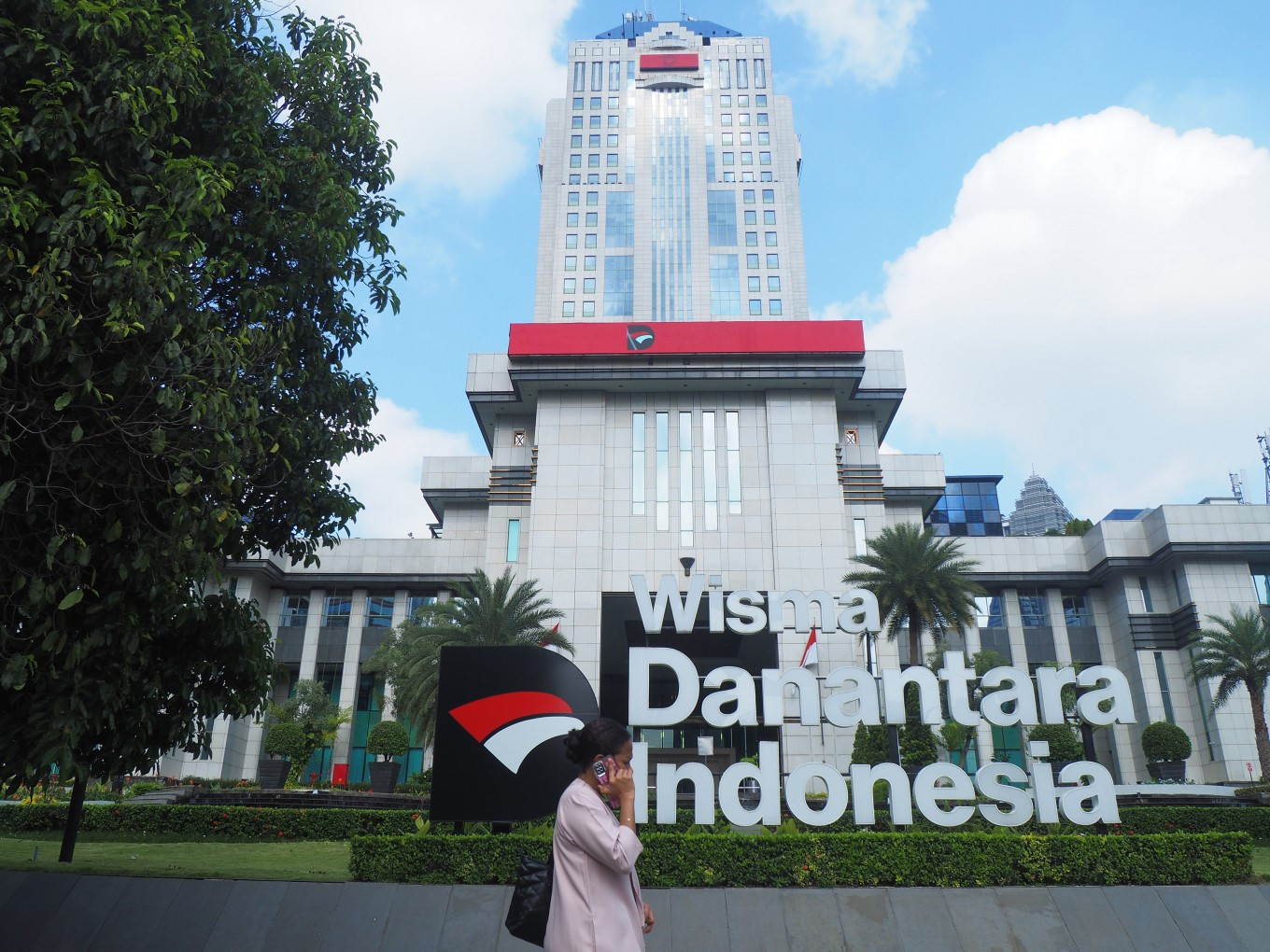 A woman walks past the Wisma Danantara Indonesia building on May 6, 2026, on Jl. Jend. Gatot Subroto in South Jakarta. (JP/Iqro Rinaldi)
More than a year after its establishment, Danantara has yet to demonstrate meaningful progress in restructuring state-owned enterprises (SOEs), despite mounting financial pressures, delayed consolidation plans and growing concerns over transparency. As Danantara expands its mandate, most recently into the management of natural resource exports, the debate is no longer merely about corporate governance, but about the broader direction of Indonesia’s economic management.
Danantara’s governance issues became increasingly apparent after the institution described itself as a sui generis entity, a special body established by law that exists outside both central government and regional administration structures, while possessing autonomous authority to carry out certain state functions. Consequently, Danantara stated that it is only required to submit its annual financial reports to state auditors, namely the Audit Board of Indonesia (BPK).
This position has raised concerns regarding Danantara’s accountability and transparency, particularly because it does not fully reflect internationally recognized governance practices adopted by other sovereign wealth funds, such as Norway’s Government Pension Fund Global and Singapore’s Temasek Holdings, both of which maintain stronger public disclosure standards to sustain broader market accountability.
The financial performance of major SOEs in 2025 also illustrates concerns over Danantara’s role as the orchestrator of SOE investments. Profitability across key sectors has weakened significantly. Among state-owned banks, the largest contributors to government dividends, only Bank Mandiri recorded positive profit growth, albeit a modest 0.9 percent, lower than the previous year. Meanwhile, Bank Rakyat Indonesia (BRI) and Bank Negara Indonesia (BNI) posted negative growth of minus 5.26 percent and minus 6.6 percent, respectively.
Despite weakening earnings, BRI raised its dividend payout ratio from 86 percent to 92 percent, pushing dividend payments from Rp 31.4 trillion to Rp 52.1 trillion. While beneficial in the short term for state revenue and Danantara funding, the higher payout ratio raises concerns over the long-term sustainability of BRI’s balance sheet.
Conditions in the real sector appear even more fragile. MIND ID saw profits decline nearly 27.9 percent amid falling commodity prices and weaker global demand. Telkom Indonesia recorded a 20.5 percent drop in profit, while profit margins fell from 14.9 percent to 12.1 percent, reflecting the global trend of margin compression in the telecommunications industry.
Other major SOEs remain under severe financial pressure. Garuda Indonesia posted another large loss in 2025 of Rp 5.4 trillion, while construction SOEs, including Wijaya Karya, Pembangunan Perumahan, Adhi Karya and Waskita Karya, recorded combined losses of roughly Rp 28 trillion.
Yet the long-promised consolidation of SOEs has barely progressed. Plans to merge construction SOEs, initially proposed during the tenure of SOE Minister Erick Thohir, remain unresolved. Similar consolidation efforts in the logistics and aviation sectors have also stalled.
Against this backdrop, Danantara has struggled to present a breakthrough strategy beyond selective project financing. One notable initiative is the waste-to-energy program managed by its subsidiary PT Daya Energi Bersih Nusantara (DENERA), which announced five tender winners earlier this year. However, broader structural reforms across SOEs remain largely absent.
Now the government is assigning Danantara an even more ambitious role. During the 19th plenary meeting of the House of Representatives, President Prabowo Subianto expressed concern over export leakages in natural resources caused by under-invoicing and transfer pricing practices. According to government estimates, these practices generated losses of around US$908 billion between 1991 and 2024.
Under-invoicing occurs when exporters deliberately report lower export values by manipulating trade data, such as prices, volumes or product quality, often through affiliated entities overseas. To address this issue, the government plans to centralize exports of strategic commodities, including coal, crude palm oil and ferroalloys, under tighter state supervision.
This policy complements earlier regulations requiring exporters to retain export proceeds (DHE) in domestic banks for up to 12 months and convert 50 percent of DHE into rupiah. While the measures are intended to improve export monitoring and strengthen Indonesia’s foreign exchange reserves amid ongoing pressure on the rupiah, they also put pressure on corporate cash flow and reflect a more command-oriented policy direction.
DSI was established as the vehicle to implement this “single gateway” export mechanism, inspired by models used in countries such as Saudi Arabia, Qatar, Russia, Malaysia and Vietnam. Danantara recently appointed Australian executive Luke Thomas Mahony as DSI chief executive officer, citing his extensive experience in the mining sector, including roles at Vale Indonesia, Vale Base Metals and BHP.
Nevertheless, the initiative has triggered both optimism and skepticism. Supporters argue that stronger state control could reduce export leakages and increase national revenue. Critics, however, worry that expanding state dominance amid weak governance could undermine investor confidence and recreate past failures.
Indonesia has experienced similar policies before. In the 1990s, the government established the Clove Buffer and Marketing Agency (BPPC), ostensibly to protect clove farmers. Over time, however, weak oversight and concentrated political power transformed the institution into a symbol of rent-seeking and market distortion during the late New Order era.
That historical memory now looms over Danantara’s expanding mandate. Without stronger transparency, clearer accountability and tangible SOE reforms, the government risks creating a powerful institution with broad authority but insufficient governance safeguards. The challenge for Danantara is therefore no longer simply about managing state assets efficiently, but about proving that greater state intervention can coexist with market credibility and institutional trust.