
News
Charges in TaniHub case sparks concern among venture capital players
Tenggara Strategics June 2, 2026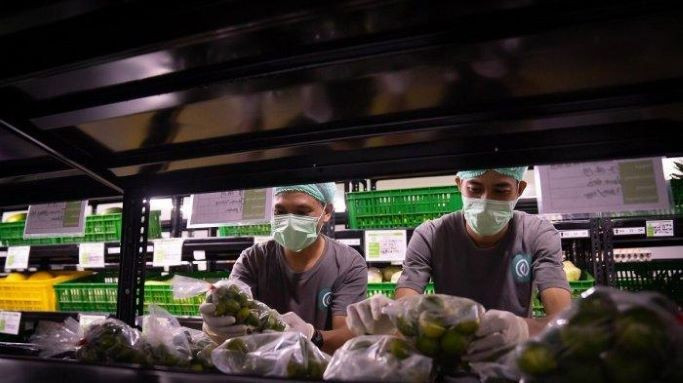 Employees arrange fruit and vegetables at the TaniHub distribution center in Kedung Halang, Bogor, West Java, on Aug. 16, 2019. (TaniGroup/Bhisma Adinaya) (TaniGroup/Bhisma Adinaya)
The trial of executives from venture capital firms that invested in agricultural technology (agritech) company TaniHub has sparked concern after prosecutors charged them with causing state losses due to their firms’ status as subsidiaries of state-owned enterprises (SOEs). Critics have questioned the charges, citing a disconnect between the nature of venture capital business and the seemingly disproportionate punishment sought compared to the accused executives’ alleged involvement in TaniHub’s wrongdoing.
In the TaniHub corruption and money laundering case at the Central Jakarta District Court’s Corruption Court, prosecutors demanded 12 years of imprisonment for Donald Wiharja, former CEO of Telkom Indonesia subsidiary MDI Ventures, and Aldi Adrian Hartanto, former vice president of investment at MDI Ventures. Nicko Widjaja, former CEO of Bank Rakyat Indonesia (BRI) subsidiary BRI Ventures, was charged with 11 years in prison, while William Gozali, former VP of investment at BRI Ventures, faces a 9-year sentence. All four were also charged Rp 1 billion (US$56,180) in fines each.
MDI Ventures was accused of causing around Rp 290.92 billion in state losses by failing to fulfill fiduciary duties in its investment in TaniHub, allegedly relying on company-provided data without sufficiently verifying its validity. Meanwhile, BRI Ventures was accused of causing losses of around Rp 73.3 billion. Nicko’s legal representatives argued that the investment process followed BRI Ventures’ due diligence procedures. They also stated that the trial had not proven any involvement in bribery, conflicts of interest, or mens rea–guilty intent.
Troubles at TaniHub began in November 2021, when 130 investors who had placed Rp 14 billion in its peer-to-peer lending unit, TaniFund, failed to receive returns on their investments. TaniHub attributed the issue to failed harvests. In February 2022, the company closed two warehouses in Bandung and Bali, stating that the reason was to sharpen its focus on business-to-business operations. TaniFund’s financing 90 days past due (TWP90) later surged to 70 percent in 2023, ultimately leading the Financial Services Authority (OJK) to revoke its license on May 3, 2024.
An alleged former TaniHub employee claimed that financial records in their department included unclear expenses linked to a “special project.” Ivan Arie Setiawan, TaniHub’s founder and former CEO, along with former director Edison Tobing, were accused of manipulating financial statements to misuse investments worth $20 million from MDI Ventures and $5 million from BRI Ventures. Another TaniHub founder, Pamitra Wineka, has so far not been implicated in the case. He was appointed as an independent commissioner at mining holding SOE Mineral Industry Indonesia (MIND ID) in 2024 before being dismissed in 2025.
Critics argue that the agritech sector inherently carries elevated risks because of agriculture’s long business cycles and its vulnerability to external factors such as weather conditions and supply chain disruptions. They contend that investment failures in high-risk sectors should not automatically be interpreted as criminal conduct, particularly in venture capital, where losses are an accepted part of the business model. Critics also argue that clearer standards are needed for investments involving state-linked venture capital firms, especially regarding due diligence expectations and the legal boundaries between commercial misjudgment and criminal liability.
Some observers further arn that the TaniHub case could discourage venture capital activity and make firms significantly more cautious in backing early-stage companies. They argue that the lack of clear distinctions between business risk and state financial losses may create uncertainty for investors, particularly those affiliated with SOEs. Several have called for clearer commercial and legal guidelines for venture capital practices, including more standardized due diligence procedures and stronger safeguards to ensure that investment decisions made in good faith are not automatically exposed to criminal prosecution.
The case highlights a potential mismatch between the nature of venture capital and the government’s expansive interpretation of state losses. Venture capital firms are designed to invest in companies with high growth potential, accepting the possibility of significant investment failures in exchange for the prospect of outsized gains from a small number of successful exits, such as public listings or acquisitions. This differs fundamentally from banking, where high levels of non-performing loans can threaten institutional stability.
Stronger due diligence standards, clearer legal boundaries for venture capital activities and more precise definitions of criminal conduct may all be necessary to support Indonesia’s still-developing venture capital industry. Such measures could also help preserve investor confidence and protect Indonesia’s broader investment climate amid increasingly cautious international assessments.