
News
With falling rupiah, economic resilience faces its toughest test
Tenggara Strategics May 6, 2026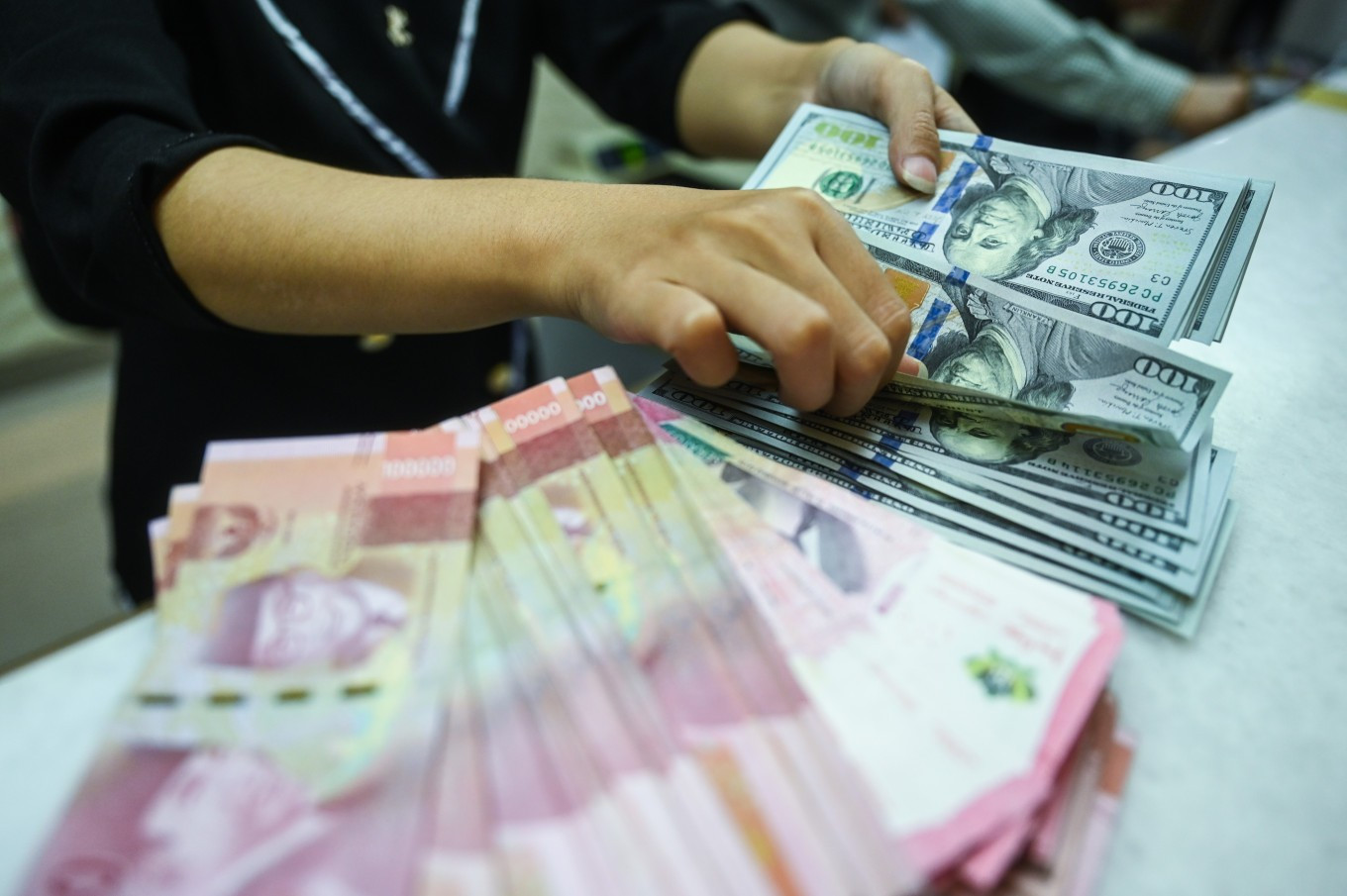 A clerk counts United States dollar banknotes on May 22, 2024, at a money changer in Jakarta. (Antara/Rivan Awal Lingga)
Indonesia’s economy is approaching a dangerous crossroads. While Finance Minister Purbaya Yudhi Sadewa projects robust 5.5 percent growth, he has also warned that the country is in “survival mode” amid escalating global tensions. Beneath the headline optimism, rising energy prices, weakening purchasing power and mounting fiscal and monetary pressures are exposing deeper structural cracks, raising a critical question: Can Indonesia withstand the shock, or is its resilience beginning to wear thin?
Global credit rating agencies Moody’s and Fitch Ratings have revised Indonesia’s outlook to negative, along with the outlooks for four major banks, Bank Mandiri, Bank Central Asia, Bank Negara Indonesia and Bank Rakyat Indonesia, despite their solid liquidity and profitability. In their assessments, both agencies highlighted rising policy uncertainty and Indonesia’s growing economic vulnerability amid the escalating conflict in the Gulf.
At the same time, MSCI has maintained its freeze on the rebalancing of Indonesian stocks in its global indices, a restriction first imposed in February due to concerns over market accessibility. Its decision to postpone the planned May review until June has further dampened sentiment in the local market.
Markets have responded harshly. The rupiah weakened from 16,641 per United States dollar on Sept. 1, 2025, to 17,324 by April 30, while the benchmark Indonesia Stock Exchange (IDX) Composite index fell from above 9,000 points in January to below 7,000 in April.
The rupiah’s deep depreciation has persisted despite a balance of payments surplus of US$6.1 billion in the fourth quarter of 2025 and $2.23 billion in the first two months of 2026, as well as relatively stable inflation of 3.48 percent in March 2026. This suggests that deeper structural pressures are at play.
One contributing factor is the rapid expansion of base money, which has grown by more than 11 percent year-on-year since December 2025 after a prolonged period of subdued growth. At the same time, Bank Indonesia’s (BI) holdings of government securities have continued to rise under the burden-sharing program, reaching 24.94 percent in March 2026, significantly higher than the sub-20 percent level seen during the COVID-19 period. While such measures were justified during crises, their continuation under more normal conditions has raised concerns over central bank independence and market confidence.
The consequences of these combined policies are becoming increasingly visible. Pressure intensified in April, when net capital outflows reached Rp 40.8 trillion ($2.36 billion), further weakening the rupiah. Risk premiums have also risen, pushing yields on 10-year government bonds close to 7 percent. This is increasing the government’s debt-servicing burden, with interest payments already accounting for 18 percent of state revenue, well above the commonly cited 15 percent warning threshold.
Despite mounting monetary pressures, BI has kept its benchmark interest rate unchanged at 4.75 percent since September 2025. The central bank now faces a difficult policy trade-off. Raising interest rates could help stabilize the currency but risks suppressing credit growth, weakening the real sector and eroding consumer purchasing power. Keeping rates unchanged, however, may allow external vulnerabilities to persist.
Finance Minister Purbaya has acknowledged that Indonesia is operating in “survival mode” as geopolitical tensions in the Middle East continue to disrupt global markets. Yet in a separate statement, Purbaya projected economic growth of 5.5 percent in the first and second quarters, supported by strong domestic demand. That optimism appears increasingly disconnected from underlying conditions.
Indonesia’s economy is already showing signs of strain. Flagship government programs such as the free nutritious meal program and the Red-and-White Cooperatives risk crowding out broader economic activity. Reliance on household consumption as the primary growth driver is also becoming less effective as purchasing power weakens.
Since mid-2025, food prices have remained elevated at around 6 percent, contributing to broader inflationary pressures. At the same time, micro and small enterprises have seen incomes decline amid the rollout of the free meals program while formal-sector job creation has slowed. More workers are shifting into informal employment, where incomes are often unstable and insufficient, further weakening economic resilience.
External pressures are compounding these challenges. Rising energy prices are feeding into broader cost-push inflation, particularly through higher prices for plastic-based goods. Essential commodities such as rice and cooking oil have already become more expensive, partly due to rising packaging costs. Meanwhile, higher energy imports are weakening the rupiah, increasing input costs for businesses and forcing price hikes despite fragile consumer demand.
Without a decisive policy reset, Indonesia risks drifting from resilience into vulnerability. The longer the gap persists between optimistic projections and underlying economic realities, the greater the cost in credibility, stability and growth. In a period defined by global shocks, maintaining confidence is not about rhetoric, but about coherent and disciplined action.
What we've heard
According to sources within the Finance Ministry, several officials believe that fiscal conditions will come under increasing pressure over the next three months. Officials who have served since the era of Sri Mulyani Indrawati are reportedly convinced that the government’s cash flow will be further eroded.