News
Govt accelerates WtE push as national waste crisis worsens
Tenggara Strategics May 22, 2026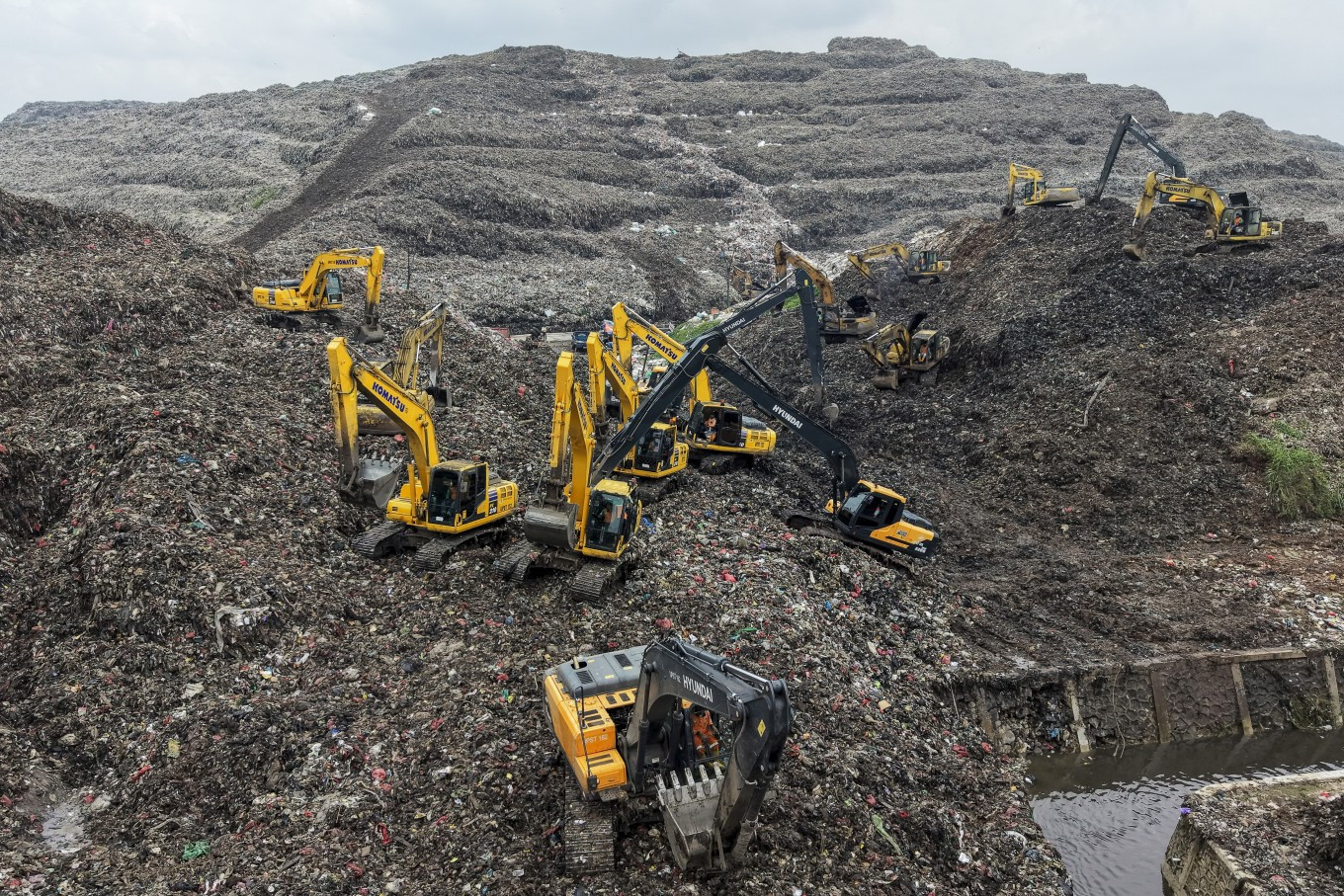 A search and rescue team uses heavy machinery on March 9, 2026, the day after a landslide at the Bantargebang landfill in Bekasi, West Java, the country’s biggest, buried garbage trucks, food stalls and 13 people, killing seven. (AFP/Bay Ismoyo)
The Bantar Gebang landfill in Bekasi, West Java, has once again come under scrutiny following a fatal landslide in March, in a new report that ranked it among the world’s largest methane-emitting landfills in 2025, highlighting the country’s mounting waste crisis. The government has since enacted Presidential Regulation (Perpres) No. 109/2025 to accelerate investment in waste-to-energy (WtE) projects, while state asset fund Danantara has stepped in to coordinate investment and operations nationwide. However, major hurdles remain, including regulatory uncertainty, high investment costs and environmental as well as public concerns.
The STOP Methane Project by the Emmet Institute at the University of California, Los Angeles (UCLA) School of Law recently published a list of 25 landfills across 18 countries with the highest methane emissions per hour. The Bantar Gebang landfill, Indonesia’s largest, ranked second globally at 6.3 tonnes of methane per hour, behind only the Campo de Mayo landfill in Argentine capital Buenos Aires at 7.6 tonnes per hour. For comparison, 1 million sport utility vehicles produce around 5 tonnes of methane per hour.
The UCLA report serves as another warning about the urgency of Indonesia’s waste crisis, which stems from years of poor waste management by the government, including local administrations.
On March 8, seven people were killed in a landslide at the Bantar Gebang landfill. The Jakarta administration says it has since stopped open dumping at the site while reiterating support for the national WtE program. To ease pressure on the landfill, on top of installing a WtE facility with a capacity of 700 kilowatt-hours (kWh), the city is also considering expanding the 8,000-hectare site as a last resort. Open dumping can be seen as contradicting the sustainability, safety and security principles outlined in Article 3 of Law No. 18/2008 on waste management.
Perpres No. 109/2025 was issued as a new legal framework for WtE development amid the growing level of waste generation, which reached 56.63 million tonnes in 2023, as well as the limited success of earlier WtE initiatives. The regulation removes tipping fees previously borne by local administrations, grants “must dispatch” status to electricity generated by WtE plants and raises the electricity tariff for purchases by state-owned electricity firm PLN to 20 US cents per kWh. It also gives PLN greater flexibility through take-or-pay rather than take-and-pay schemes in power purchase agreements with WtE operators.
In terms of national coordination, the regulation tasks the Environment Ministry with verifying proposals from local administrations seeking to join the WtE program, while mandating Danantara to secure investment partners and plant operators. Danantara estimates the development of 33 WtE plants nationwide by 2028 with investments totaling $5 billion, on an assumption that regions or regional clusters will generate at least 1,000 tonnes of waste per day.
Among the 200 participants in the phase-one auction for WtE projects, Wangneng Environment was selected to operate the WtE plant in Bekasi city, while Zhejiang Weiming Environment Protection was chosen for the Greater Bogor and Greater Denpasar projects. The auction’s second phase offers 20 other WtE projects and has reportedly attracted around 100 participants. Meanwhile, local administrations in Bekasi regency and the cities of Depok, Bogor, Lampung, Semarang and Medan have signed memorandums of understanding with the central government to join the program.
On April 1, PT Daya Energi Bersih Nusantara (Denera) was established under Danantara Investment Management (DIM) to support the state asset fund’s mandate. The DIM aims to launch an initial public offering by 2028 for Denera, which is expected to hold a 30 percent stake in each new WtE project. Beyond power generation, Denera is also expected to improve upstream waste management at the municipal waste level through the operation of reduce, reuse and recycle facilities toward eventual expansion into industrial and hazardous waste management.
Despite the new framework, uncertainty still hangs over projects that began under previous regulations. The government expects these unfinished WtE projects to transition to the new framework, which removes several obligations for local administrations under earlier schemes. This has raised concern for companies such as PT Sarana Utama Energy in Makassar, South Sulawesi, which has spent funds on acquiring land for a planned WtE facility.
At the same time, other projects appear to be progressing. The WtE plant in Palembang, South Sumatra, developed by PT Indonesia Green Power under Perpres No. 35/2018, has reportedly reached 83 percent completion as of May 1 and is expected to begin operations this October under the new framework.
The Makassar WtE plant has also met with protests from local residents who are demanding that it be relocated away from populated areas. The residents emphasized that they were not objecting to the project, but that they were simply concerned about its location. The controversy underscores the importance of meaningful public consultation and local approval, which are explicitly required under Perpres No. 109/2025.
The government has also acknowledged that even if all regional WtE plants were completed, they would only accommodate around 22.5 percent of national waste production.
Indonesia’s waste crisis is an urgent challenge that requires immediate and consistent action. Many countries have demonstrated that WtE plants can significantly reduce landfill dependence and waste accumulation. To ensure that the new program succeeds, the government must consistently implement the provisions of Perpres No. 109/2025, including obtaining informed consent from communities affected by WtE development. The success of this latest initiative and Denera’s broader mission to transform the country’s waste management culture will depend on the government’s ability to balance these ambitions with competing national priorities as well as the reduced amount of regional transfers in the 2026 state budget.