News
The Prabowo-Gibran government is clearly falling short
Tenggara Strategics November 3, 2026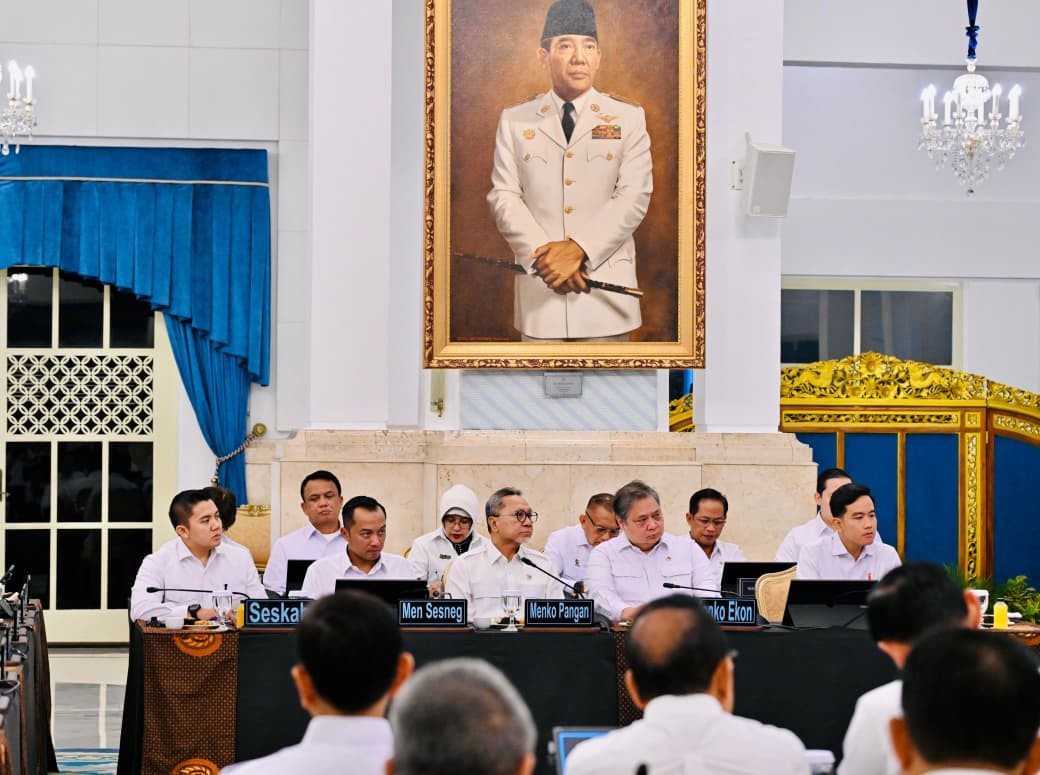 Vice President Gibran Rakabuming Raka (right), sits with coordinating ministers and cabinet ministers on Monday during a plenary cabinet meeting at the State Palace in Jakarta. ( Presidential Secretariat/Laily Rachev) ( Presidential Secretariat/Laily Rachev)
Two years into their five-year mandate, President Prabowo Subianto and Vice President Gibran Rakabuming Raka face mounting public dissatisfaction. Widespread protests and falling survey indicators point to deepening frustration over the administration’s performance.
At a plenary cabinet meeting on Oct. 21 titled “Two Years of the First Term: Delivering Tangible Results for the Nation,” ministers and officials confidently presented what they framed as key government achievements. Prabowo declared that the administration had accomplished a great deal and remained on the right track, singling out the free nutritious meal program as a flagship strategic initiative while acknowledging that its rollout was not yet flawless.
Public sentiment, however, paints a far less reassuring picture. Discontent spilled onto the streets on Oct. 20 when Greenpeace Indonesia activists unfurled a big banner at the Welcome Monument in Jakarta’s Hotel Indonesia roundabout, drawing immediate traction across social media and catalyzing broader public action.
That initial protest sparked a sustained wave of demonstrations through Oct. 28, mobilizing students, labor unions and civil society nationwide. Protests took place at Tugu Tani in Jakarta, as well as in Bandung, Yogyakarta and Makassar on Oct. 20. The following day, hundreds gathered for a peaceful demonstration in Malang, followed by thousands taking to the streets in Semarang on Oct. 22. In Bandung, the Indonesian Student Executive Bodies Alliance (BEM SI) organized another major rally on Oct. 26. The latest wave culminated on Oct. 28, coinciding with Youth Pledge Day commemorations in Jakarta, Lampung and Malang.
Protesters called for stronger forest and land fire management, including the declaration of a national disaster status, alongside targeted measures to address soaring living costs. Other key demands included robust protections for free expression, decisive enforcement against corruption, collusion and nepotism (KKN) and reliable access to affordable public services. Demonstrators also urged the military and police to return strictly to their core constitutional functions and demanded a comprehensive audit of ongoing national strategic projects (PSN).
An October 2026 survey by Poltracking Indonesia found that public trust in the Prabowo-Gibran administration stood at 64.8 percent while public satisfaction fell to 55.3 percent - down sharply from 78.1 percent a year prior. A separate poll by Saiful Mujani Research and Consulting (SMRC) recorded government satisfaction at 44.5 percent in October 2026, dropping precipitously from 81.2 percent in November 2025.
Popular support for Prabowo eroded significantly over the same timeframe: in a semi-open presidential preference simulation, his numbers slid from 34.9 percent in November 2025 to just 9.8 percent in October 2026. Meanwhile, an assessment by the Center of Economic and Law Studies (CELIOS) assigned the Red and White Cabinet an average performance rating of 4.7 out of 10 among the public and 2.9 out of 10 among policy experts. These low marks reflect widespread anxiety over heavy tax burdens, strained household budgets, persistent underemployment, escalating basic commodity prices and fragile labor protections.
Political opposition figures have likewise seized on the protests as undeniable evidence of voter frustration. On Oct. 21, Indonesian Democratic Party of Struggle (PDI-P) central executive board member Komarudin Watubun stated that public dissatisfaction was already self-evident on the streets across the archipelago, leaving little need for further political commentary.
Beyond economic strain and contested flagship policies, developments across legal and electoral institutions warrant serious scrutiny. The World Justice Project’s Rule of Law Index 2026 scored Indonesia at 0.51 - a 0.01-point decline from 2025 - ranking the nation 75th out of 143 countries surveyed. Indonesia was also counted among 10 nations experiencing a notable regression in scores, reflecting a broader global trend of encroaching executive overreach where the rule of law risks being instrumentalized for political advantage.
Compounding these institutional challenges is the delay in establishing the selection committee for national election organizers. This delay cannot be dismissed as a minor administrative oversight or scheduling hiccup; the integrity of electoral administration is foundational to public confidence in democratic governance.
The 2024 general election exposed vulnerabilities regarding the operational neutrality and ethical standards of election administrators, marked by contested verification procedures, documented ethical breaches and critical rulings from the Election Organizers Ethics Council (DKPP). These precedents should have spurred the administration to reinforce vetting and selection protocols early - from the committee members themselves to the candidates forwarded to the House of Representatives (DPR). Lingering controversies regarding institutional checks and verification standards further erode public confidence in the bodies tasked with upholding electoral rules.
No government is perfect, and two years do not represent a definitive verdict on an administration's full five-year term. Yet the widening gap between official narratives of triumph and public sentiment on the ground cannot be ignored. In a constitutional democracy, public trust cannot be sustained on declarations of achievement alone; it requires a leadership willing to listen, recalibrate policy and remain accountable to the citizens from whom all governing authority originates.
What we've heard
An SMRC survey conducted from Oct. 1 to 10 found that public satisfaction with President Prabowo Subianto ’s administration had plunged to 44.5 percent. According to a Gerindra Party politician, the finding aligned with the ruling party’s internal survey indicating broad public disapproval of the government’s leadership style and policy agenda. “It’s dropping by 3 to 4 percentage points a month,” the politician noted.
Related Articles