
News
Incentives vs. free meals: Regions compete for fiscal relief
Tenggara Strategics November 16, 2026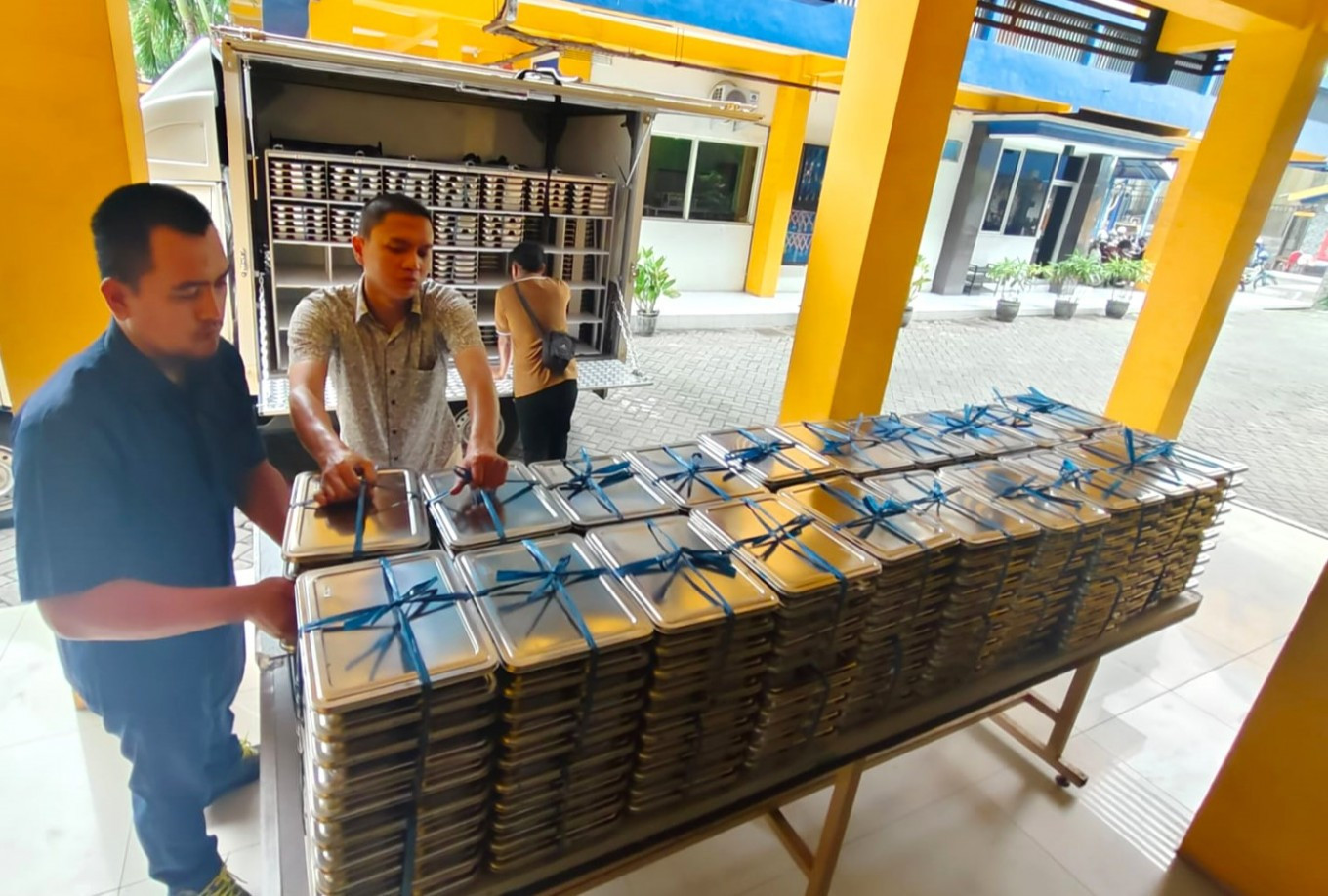 Ready-to-eat: Workers unload lunch boxes from a van on Jan. 6, 2025, the first day of the free meals program, at a high school in Sidoarjo Regency, East Java. (JP/Wahyoe Boediwardhana)
The government’s decision to incorporate implementation of the free nutritious meal (MBG) program into the performance criteria for the regional incentive fund (DID) has raised eyebrows. While the fund’s framework is accompanied by plans for additional regional assistance, whether these measures can meaningfully ease regional fiscal pressures amid austerity remains uncertain.
The Finance Ministry has earmarked Rp 1 trillion (US$55.36 million) for the DID under the 2027 state budget, to be distributed conditionally to high-performing regional administrations. In place since 2010, the annual incentive scheme assesses regions against indicators including inflation control, environmental quality and budget execution, according to Finance Minister Suahasil Nazara, and regional administrations are expected to prepare accordingly. The government has also allocated another Rp 1 trillion for regional assistance, although the technical details are still being discussed.
Home Minister Tito Karnavian had announced that Rp 1 trillion in incentives would be allocated to regions based on their implementation of the free meals program as assessed through a competition. However, Deputy Home Minister Bima Arya Sugiarto clarified later that the feeding program was only one of several performance indicators for regional administrations.
The other criteria include transparency, stunting reduction, health, unemployment, poverty, education and alternative financing. Bima's clarification is consistent with the broader framework of the Regional Administration Achievement Award (APPA) 2026, which involved six regional groupings across three waves throughout the year.
According to Tito, the first wave covered four categories: inflation control, unemployment reduction, poverty alleviation and stunting reduction and finally, creative financing. For each category, the top three regency, municipal and provincial administrations received prize funds of Rp 3 billion, Rp 2 billion and Rp 1 billion, respectively.
Bima’s clarification came amid mounting controversy surrounding the free meals program. The Health Ministry recorded 560 food poisoning outbreaks linked to the program affecting 50,059 schoolchildren across 36 provinces as of Sept. 2, more than double the 240 incidents and 21,262 victims recorded in late November last year.
Civil society groups have called for a nationwide moratorium and an independent safety audit. Yet President Prabowo Subianto 's administration continues to treat the free meals program as a defining political legacy. Coordinating Food Minister Zulkifli Hasan has acknowledged shortcomings in its implementation even while insisting that the program must continue.
Meanwhile, regional administrations are struggling to meet their payroll obligations to civil servants and government contractors (PPPK) following cuts to regional transfer funds (TKD) as part of the President’s austerity drive. Some have been forced to lay off employees, triggering protests. Regions with limited locally generated revenue (PAD) have been hit particularly hard, their fiscal vulnerability compounded by regulations mandating a budget allocation of up to 30 percent to employee expenditure.
The Home Ministry identified 79 financially critical regions that required Rp 3.7 trillion to cover salaries or Rp 14 trillion to restore overall fiscal health. The Finance Ministry, however, estimated that the actual requirement was nearly Rp 20 trillion.
While Tito argued that some regions could improve spending efficiency, he noted on Aug. 5 that the Finance Ministry had Rp 70 trillion in outstanding revenue sharing funds (DBH) owed to regional administrations. Then-finance minister Purbaya Yudhi Sadewa said separately that the ministry had allocated Rp 20.5 trillion from non-ministerial spending to 490 regions while emphasizing the need to safeguard fiscal stability.
These difficulties reflect deeper vertical and horizontal fiscal imbalances in the intergovernmental financing system. The central government controls major progressive revenue sources, including income tax and value-added tax, while regional administrations bear substantial responsibility for delivering public services.
On average, PAD accounts for only around 20 percent of regional budgets, while the TKD disbursed by the central government make up the remaining 80 percent. Delays or reductions in these transfers can therefore disrupt regional development and service delivery to varying degrees depending on local geography, economic structure and welfare conditions. Experts say the current central-regional fiscal architecture risks reducing regional administrations to executors of national priorities, undermining their autonomy.
The regional incentive mechanism itself offers limited relief. Under Government Regulation (PP) No. 73/2023 and Finance Minister Regulation (PMK) No. 91/2024, the DID remains a relatively small component of regional budgets compared with the general allocation fund (DAU), special allocation fund (DAK) and the DBH. Moreover, the incentive funds cannot be used to finance employee expenditure or allowances.
Some lawmakers have also questioned the inclusion of MBG implementation in regional assessments, pointing out that the program's benefits should be evaluated before its use as a performance indicator for regional administrations.
Incentivizing regional administrations to improve their performance is, in principle, a reasonable policy objective. However, the effectiveness of the planned 2027 regional incentive scheme will depend on whether local administrations have sufficient fiscal capacity to meet the assessment criteria. Expecting them to compete for relatively small incentives while struggling with core funding cuts risks undermining the very improvements the DID scheme is intended to encourage.
Beyond restoring regional finances to pre-austerity levels, Indonesia needs to address the structural center-region imbalance in revenue-raising authority. Without a more sustainable distribution of fiscal resources and greater regional capacity to generate revenue, development in the regions will remain heavily dependent on transfers and discretionary assistance from the central government.
Fiscal incentives alone cannot compensate for a system in which local administrations are expected to deliver more with increasingly constrained resources.