News
Wiretapping scandal exposes deepening political fault lines
Tenggara Strategics November 19, 2026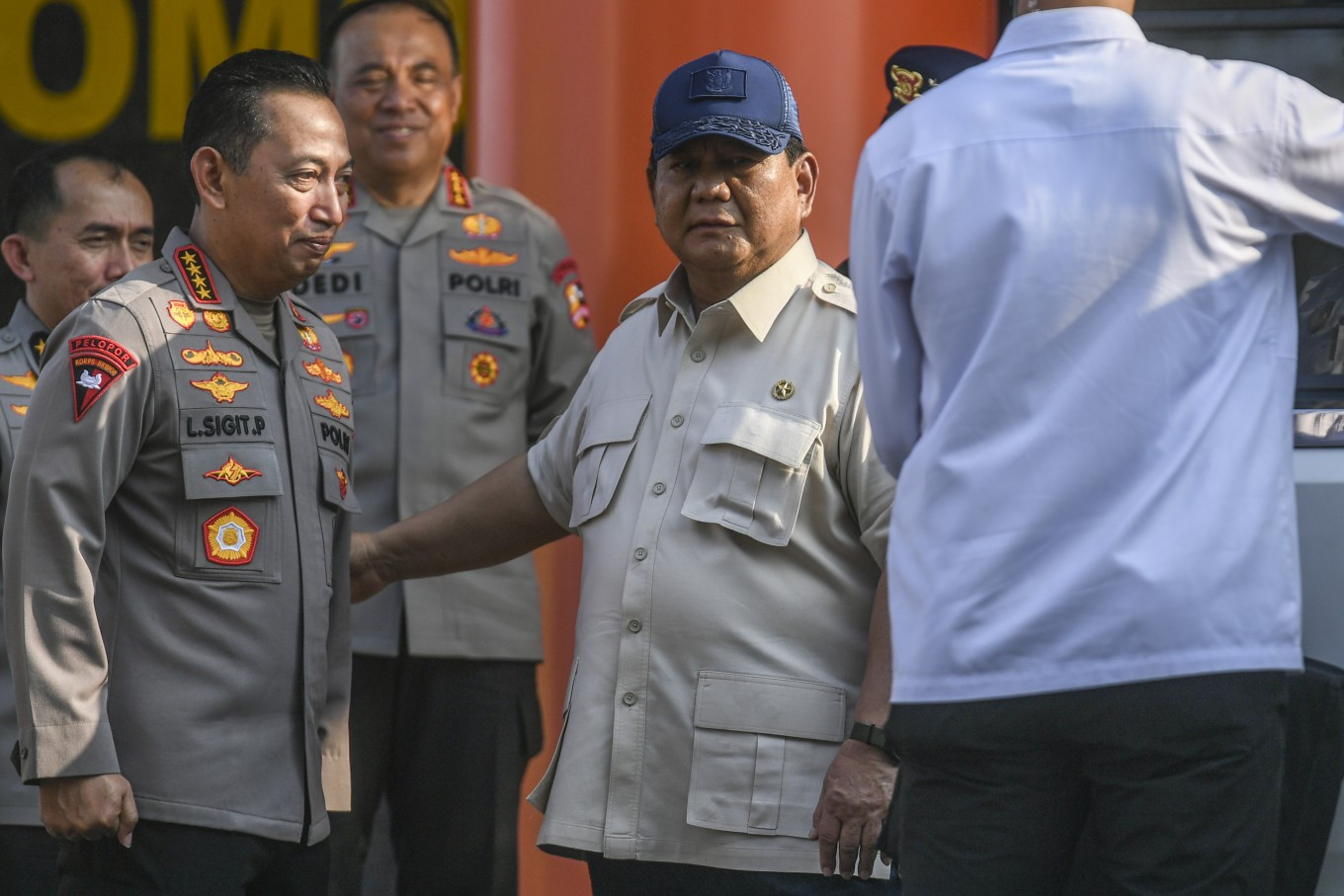 After the storm: President Prabowo Subianto (right) speaks with National Police Chief Gen. Listyo Sigit Prabowo after visiting injured police officers at the National Police Hospital in Kramat Jati, Jakarta, on Sept. 1, 2025. President Prabowo visits officers who are wounded during clashes at a protest in Jakarta and instructs the police chief to grant them extraordinary promotions. (Antara/Hafidz Mubarak A)
The alleged wiretapping of President Prabowo Subianto, senior officials, prominent politicians, journalists and business leaders has introduced another layer of instability to Indonesia’s increasingly volatile political landscape. Unfolding amid simmering tensions between Prabowo and his predecessor Joko “Jokowi” Widodo, the scandal exposes deep fissures within the national security apparatus and pointed questions about political loyalties within the ruling coalition.
The National Police named four high-ranking officers as suspects in the case: ex-police chief Gen. Listyo Sigit Prabowo, who was removed as presidential chief of staff a day after the scandal broke; former legal division head Insp. Gen. Ahrie Sonta Nasution; senior training instructor Insp. Gen. Eko Hadi Santoso; and former information and technology head Insp. Gen. Slamet Uliandi.
Listyo’s implication carries profound political weight. After leading the police force from 2021 through both the Jokowi and Prabowo administrations, he had just been appointed chief of staff last month. As noted in an earlier Tenggara Strategics analysis, this transfer likely facilitated the disclosure of the unauthorized surveillance operation, which might have continued undetected had Listyo remained the police chief.
Ahrie’s involvement has drawn equal scrutiny given his prior role as one of Prabowo’s aides. On Nov. 10, he became the first suspect to face a police ethics tribunal, which resulted in his dishonorable discharge from the force. He has appealed the ruling.
According to investigators, the unlawful surveillance occurred between 2025 and 2026. The phone numbers of the targets were entered into the National Police’s Lawful Interception Management System, and these intercepts were executed without mandatory judicial verification or any underlying law enforcement mandate. Investigators further allege that the suspects ordered the deletion of intercept records in October. A police whistleblower reported the directive on Oct.30, setting the formal criminal inquiry into motion.
The seniority of the suspects elevates this case far beyond typical procedural misconduct. Reaching the highest echelon of law enforcement, including the former police chief, the investigation transforms an administrative abuse of power into a high-stakes political crisis, exposing competing patronage networks and institutional rivalries within the security sector.
Former president Susilo Bambang Yudhoyono, once a target of surveillance by Australian intelligence in 2013, has voiced concern over the political climate, characterizing it as increasingly unchecked. In a statement on Nov. 4, Susilo lamented that the pursuit of power appeared to justify any means irrespective of ethics or legality. He urged Prabowo to restore civilized politics, cautioning that unchecked factional strife risked instilling fear and insecurity among the public.
The scandal also threatens to exacerbate mistrust within Prabowo’s expansive coalition. Analysts warn that pervasive suspicion could paralyze interparty cooperation, particularly among coalition leaders who suspect their communications were compromised. This friction arrives at a delicate juncture as Prabowo consolidates power. Another cabinet reshuffle would represent more than ministerial turnover: It would formalize a structural realignment of power within the government.
The gravity of the crisis was underscored on Nov. 8, when Prabowo convened a meeting with 10 former police chiefs and National Police chief Gen. Suyudi Ario Seto at his private residence in Hambalang, West Java. House of Representatives Deputy Speaker Sufmi Dasco Ahmad later confirmed that the wiretapping inquiry was central to the discussions.
Legislative scrutiny is set to broaden. House Commission III, which oversees law enforcement, has scheduled a meeting with Suyudi to examine the chain of command behind the wiretaps and identify the orchestrators' core motives. Coordinating Law, Human Rights, Immigration and Correctional Services Minister Yusril Ihza Mahendra has confirmed that the administration will review the legal frameworks governing electronic surveillance in coordination with relevant bodies, including the National Cyber and Encryption Agency (BSSN).
Beyond institutional reform, public discourse is increasingly linking the scandal to the deteriorating alliance between Prabowo and Jokowi. Their relations have chilled as Prabowo systematically reconfigures the state apparatus. The resignation of Vice President Gribran Rakabumingraka following renewed controversy over his academic credentials has only intensified the rift.
While Listyo’s indictment has fueled speculation that the investigation is entangled in an elite proxy battle, authorities emphasize that no evidence currently connects Jokowi to the unlawful surveillance.
While the wiretapping affair highlights an intensifying battle for dominance in Jakarta, it ultimately underscores a more fundamental issue: whether those wielding state authority remain accountable to the people they are supposed to serve.
What we've heard
A government source said the administration was expanding its investigation into the alleged wiretapping operation involving Listyo Sigit to examine a suspected coup plot. The source alleged that the plot involved labor groups and terrorist networks. The police, the source added, had detained an officer from the Counterterrorism Special Detachment suspected of involvement in the illegal wiretapping operation.