News
By the numbers: Informality nuance for unemployment statistics
Tenggara Strategics November 19, 2026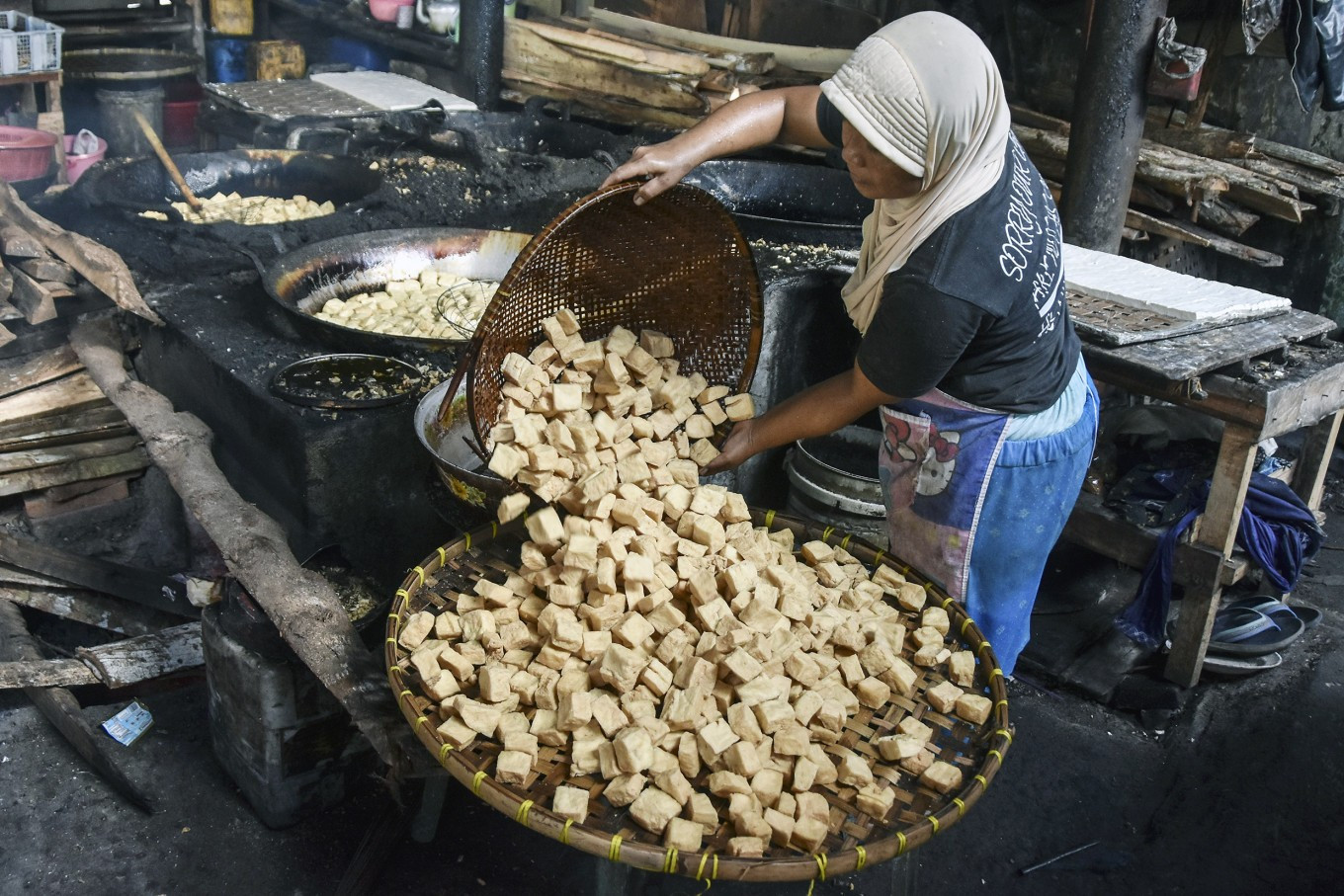 A worker fries tofu in Cisadap, Ciamis, West Java, on March 7, 2023. (Antara/Adeng Bustomi)
The Indonesian government has recently highlighted the decline of unemployment in Indonesia, ambitiously comparing the progress to have approached the best years of the Indonesian labor market. However, the announcement also created discourse regarding the parameters used to define unemployment itself and drew attention once more on the country’s long-running issue of high informal labor. Meanwhile, it remains to be seen whether the government’s record-breaking state spending for 2027 could tackle the issue.
The Office of the Coordinating Economy Ministry stated on Oct. 27, 2026, that Indonesia's open unemployment rate fell to 4.65 percent in May 2026, nearing the 1994 low of 4.36 percent. The coordinating ministry claimed that the open unemployment rate, measured under International Labor Organization (ILO) and Statistics Indonesia (BPS) standards, showed government real-sector and investment programs working amid a workforce of 155.41 million, nearly double the 1990s level.
BPS then announced on Nov. 5 that Indonesia’s open unemployment rate fell 0.1 percentage points year-on-year (yoy) to 4.75 percent in August 2026. The total workforce reached 155.37 million, with total employment up 1.44 million yoy to 147.99 million while the total unemployment was down 77,000 yoy to 7.38 million. The agriculture sector absorbed the most labor at 28.2 percent. Formal workers fell slightly to 42.07 percent despite rising by 410,000 to 62.25 million, while informal workers rose to 57.93 percent.
The definition of employment used by BPS includes people working only one hour per week. BPS clarified the definition is based on the ILO's minimum one-hour criterion, adding that such workers made up only 0.2 percent of the workforce. Full-time workers comprised 67.47 percent of the workforce, part-time 23.85 percent, while the underemployed averaging 19.7 hours of work per week reached 8.68 percent. The usage of the standard, BPS explained, enables cross-country comparison while still reflecting local conditions.
Underemployed and informal workers face low, irregular incomes, limited career progression and weak social protection. BPS recorded an average wage of Rp 3.4 million, which analysts said is low in absolute terms and shrinking in real value as prices rise. BPJS Ketenagakerjaan data show only 14.2 million active non-wage participants compared to around 85 million informal workers at the end of 2025.
Analysts attributed rising underemployment to the Job Creation Law's five-year fixed-term contracts and the scarcity of full-time jobs with decent wages. Union leaders argue that success of labor programs should be measured by fewer workers in poverty and economic insecurity. In response, Coordinating Economy Minister Airlangga Hartarto said informal employment growth matched expanding micro, small, and medium enterprises (MSMEs) activity, adding that the government is preparing programs to help businesses and workers formalize.
Indonesia’s 2027 state budget, approved on Sep. 29 could be an option to tackle the issue of underemployment and informality. The 2027 state budget targets revenue at Rp 3.43 quadrillion and expenditure at Rp 4.1 quadrillion, each raised by Rp 9.1 trillion during deliberations while keeping the deficit at 2.4 percent of GDP. The education budget received Rp 824 trillion, social protection Rp 539.7 trillion, and food security Rp 195.3 trillion.
The 2027 state budget’s 6 percent growth target is paired with job creation and worker protection programs. Internship and vocational training programs target 150,000 and 300,000 participants 300,000, respectively, while the PPh 21 income tax incentive for employees earning below Rp 10 million monthly will be expanded to all sectors, benefiting about 7.5 million workers. Social security and subsidized housing at 6 percent interest will also be extended. Unemployment is targeted to be in the 6–6.5 percent range.
However, the 2027 state budget could be pressured by energy prices, alongside a weak rupiah, if global crude remains above the US$75 assumption at more than $85 per barrel. Average Indonesian Crude Price (ICP) through September 2026 was around $91.9 per barrel. The House of Budget Committee and government allocated Rp 261.5 trillion for energy subsidies in the 2027 budget, about Rp 11.44 trillion below the initial Rp 272.94 trillion.
The government had noted the May 2026 unemployment data as a historic success, but the labor trend may have been conflated with government policy effect while glossing over the issue of underemployment and informality. The 2027 state budget is accompanied by programs aimed at tackling the country’s labor issues, but the policy package’s effectiveness is under threat from continued global energy price fluctuations’ impact on the state budget.
Ultimately, however, addressing Indonesia's labour-market challenges requires more than lowering the unemployment rate or expanding short-term employment programmes. Without addressing the dominance of informal employment and the prevalence of low-productivity jobs, Indonesia risks deepening its deindustrialisation trajectory and undermining its efforts to escape the middle-income trap.