
News
Testing Indonesia’s Mideast evacuation contingency plan
Tenggara Strategics March 25, 2026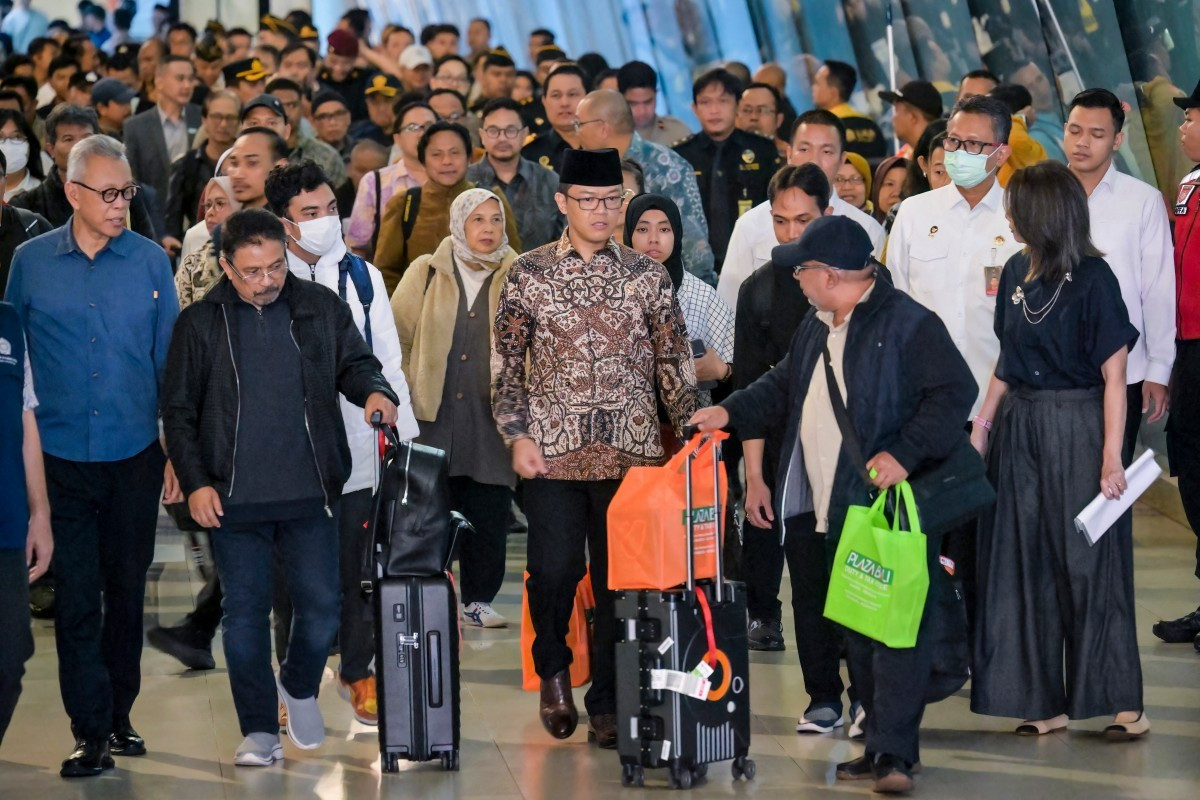 Foreign Minister Sugiono (center) walks alongside Indonesians evacuated from Iran at Soekarno-Hatta International Airport in Tangerang, Banten on March 10, 2026 amid the United States-Israeli conflict with Iran. (AFP/Bay Ismoyo)
The first batch of Indonesians evacuated from war-besieged Iran landed back home on March 11, after an overland journey that took them through Azerbaijan and Turkey before they were flown to Jakarta. Following this group of 22 people will be a few more batches in the coming days and weeks as citizens flee the ongoing United States-Israelis attacks.
This successful first evacuation attests to the government’s current plan to transport its citizens to safety from conflicts around the world.
More than 300 Indonesians, mostly university students, were living in Iran when the latest round of US-Israeli attacks began on Feb. 28. With the war not only escalating but also widening to involve more Gulf countries, the government may face its biggest test regarding its evacuation contingency plan, which is yet to be activated.
The government says more than 500,000 Indonesians live and work in Bahrain, Kuwait, Oman, Qatar, Saudi Arabia and the United Arab Emirates; countries that are being dragged into the war because they host US military bases.
The real number could be much higher, since many Indonesians don’t register with the embassies or consulates in these countries. The bulk of Indonesians who reside in the Middle East are domestic helpers or construction workers, but there are also some white-collar workers, including oil professionals.
If the government is prompted to activate its contingency plan, the scale will likely be much higher and more complicated than it has ever experienced before, given that the geography of these countries offers limited escape routes.
The Foreign Ministry, which leads the interagency team for managing evacuations, says it has formed a crisis response team to prepare for this eventuality so the government can move quickly if security conditions deteriorate further. This crisis team involves the military, including the Air Force, which in the past has deployed transport planes to evacuate citizens from troubled spots like Afghanistan, Egypt, Iraq and Ukraine.
Meanwhile, embassies in the region have been ordered to closely monitor the situation and alert the government if and when the plan needs to be activated.
Santo Darmosumarto, the ministry's director general of Asia, Pacific and Africa, said several Gulf governments had asked Indonesia not to activate its evacuation plan. While they did not provide any guarantees, they asked that expatriate Indonesians stay home to stay safe.
In the end, however, this is ultimately Indonesia’s call and not the host nations'. On the other hand, the US ordered on March 8 that nonemergency government employees and their dependents leave Saudi Arabia, and many of its travel advisories may give a clue about the scale of the danger.
The ministry says it has not received any report of Indonesian fatalities from the current war in the Middle East, though three Indonesian sailors are missing after a tugboat explosion the Strait of Hormuz. Another seaman who survived the explosion in the world’s busiest shipping corridor, which has now been crippled by war, is being treated at a hospital in Oman.
The Foreign Ministry and overseas missions in the Gulf region have also been busy arranging the repatriation of thousands of citizens stranded due to canceled or delayed flights and airport and airspace closures as the conflict escalates.
When the war began on Feb. 28, more than 50,000 Indonesians were performing umrah (minor pilgrimage) to Mecca, to which the country contributes over 1.2 million pilgrims each year. The government has been working with tour operators and airlines since to ensure their safe return, with embassies providing them temporary accommodation.
Following the issuance of a government advisory to postpone nonessential travel to the region, tens of thousands of Indonesians canceled their departure for umrah. The war is now looming large over the scheduled haj in May, in which more than 200,000 Indonesians are registered to take part.
The best-case scenario as far as Indonesian civilians are concerned is, of course, for the war to end soon. But the government has made preparations for the worst-case scenario: a full-scale war that could put more than half a million Indonesian lives in danger.
The bigger question is whether the current evacuation contingency plan will suffice.
What we've heard
A career diplomat explained that the Foreign Ministry determines evacuation protocols based on the specific threat level within the jurisdiction of each diplomatic mission. He cited the recent case of hundreds of Indonesians stranded at airports in the United Arab Emirates (UAE). In such instances, the government coordinates with airport authorities and the UAE government to arrange repatriation via commercial flights, as those routes remain operational. “All expenses are covered by the UAE government,” the diplomat noted.
Beyond temporary travelers, the Ministry has recorded more than 500,000 Indonesian citizens currently residing across the Middle East, primarily for work or study. Consequently, the Ministry continues to monitor citizens in conflict-affected countries, including Iran, while maintaining intensive communication. “We conduct hourly virtual briefings with staff at the Indonesian embassies,” a diplomat said.
Currently, commercial flights remain the primary repatriation method. While waiting for confirmed schedules, Indonesian embassies work alongside local authorities to facilitate temporary accommodation, meals and assistance in securing tickets for those wishing to return home.