News
When nutrition is crowding out education budget
Tenggara Strategics March 20, 2026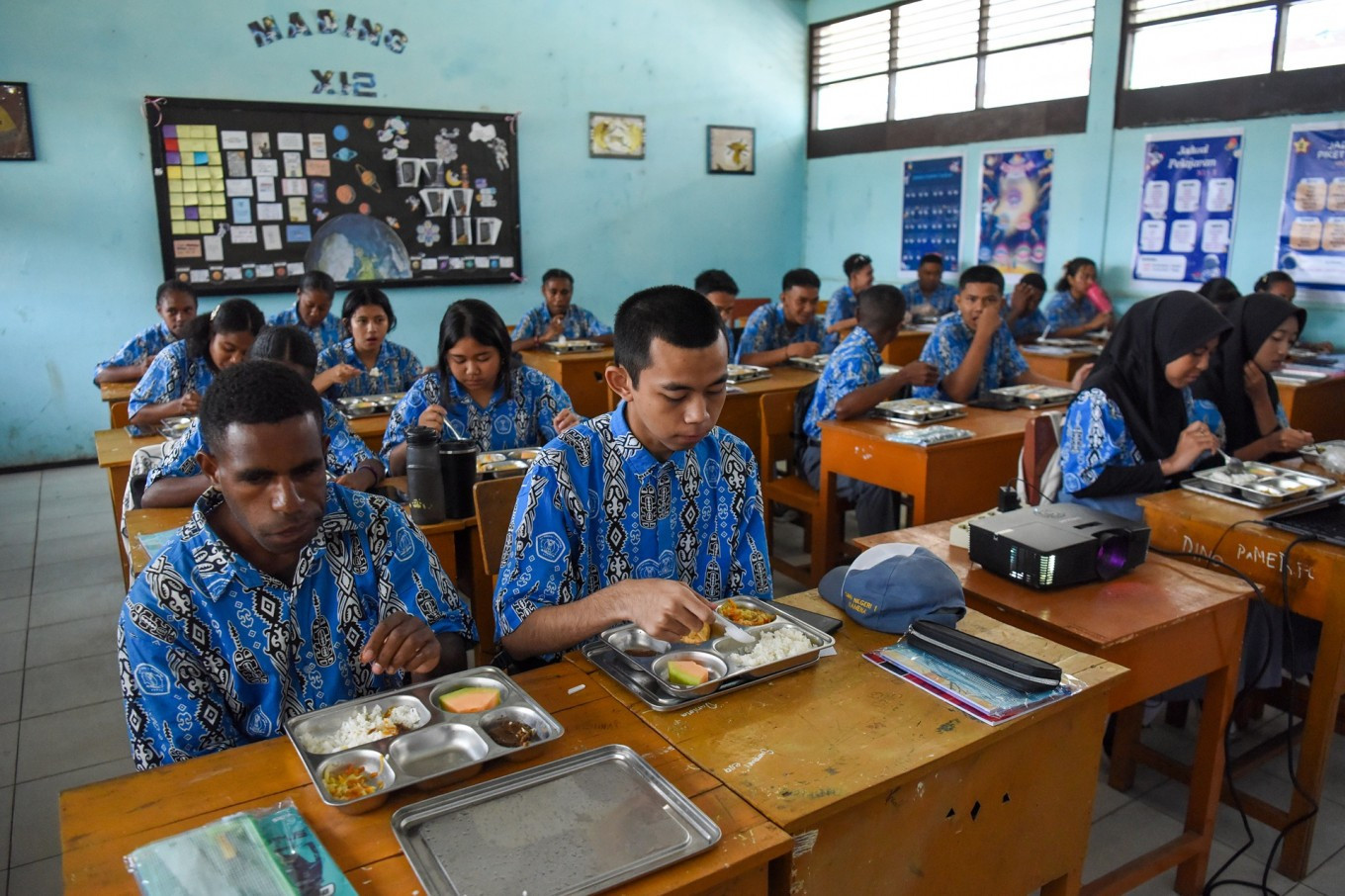 Students eat meals provided under the free nutritious meal program at SMAN 1 Wamena senior high school in Jayawijaya regency, on Jan. 14, 2026, when Vice President Gibran Rakabuming Raka inspected program rollout in Wamena district, Highland Papua. (Antara/Indrianto Eko Suwarso)
Budget allocations for the free nutritious meal (MBG) program now dominate the education budget. A school feeding program that does not fundamentally serve a core educational purpose has instead become a primary focus within the government’s education spending framework. This shift raises significant questions about fiscal priorities and the long-term health of the nation’s pedagogical infrastructure.
According to Presidential Regulation (Perpres) No. 118/2025 on details of the 2026 state budget (APBN), total education spending is set at Rp 769.1 trillion (US$45.5 billion). This budget is distributed through three main channels, with 61.2 percent allocated to central government spending, 34.4 percent designated for transfers to regional governments and 4.4 percent managed through various financing schemes.
Under this structure, the National Nutrition Agency (BGN), which oversees the free meals program, has emerged as the institution receiving the largest single allocation from the education budget. The agency is set to receive Rp 223.56 trillion, equivalent to 29.1 percent of education spending this year. This share marks a sharp increase compared with the previous year: The 2025 state budget allocated only around 7.8 percent of the education budget to the BGN, meaning that its share has more than tripled in just 12 months.
The budget structure further highlights the free meals program's current standing as the flagship program of President Prabowo Subianto’s administration, now framed as a primary driver of education outcomes. Conceptually, however, categorizing the free meals program as an education budget item remains a point of contention in international finance standards.
The Organisation for Economic Co-operation and Development (OECD), for example, clearly distinguishes between core educational purposes and other education-related expenditure. School feeding programs fall into the latter category, as they are considered supportive social programs rather than a core component of education financing.
The allocation has garnered both support and criticism. The government insists that the new budget structure does not reduce fiscal space for education, with Cabinet Secretary Teddy Indra Wijaya insisting that no education program has been cut or discontinued due to funding the free meals program. House of Representatives Budget Committee chairman Said Abdullah, who hails from the from the Indonesian Democratic Party of Struggle (PDI-P), echoed this statement when he described the allocation as a joint decision made during budget deliberations.
While the raw budgets have technically increased for the three key ministries, the religious affairs, the primary and secondary education and the higher education ministries, the overall composition of education spending tells a different story.
Several key components have experienced declining shares over the last two budget cycles. For instance, transfers to regional administrations accounted for 47.9 percent of the education budget in 2025, but this share was decreased to 34 percent for 2026. This decline could significantly weaken the fiscal capacity of local administrations to finance infrastructure and teacher quality. Similarly, allocations for financing schemes, including the Education Endowment Fund (LPDP) for research grants and academic scholarships, decreased from 11 percent in 2025 to just 4.4 percent in 2026.
Some observers argue that including the free meals program in the education budget risks violating the constitutional obligation to allocate at least 20 percent of the state budget to education, as stipulated under Article 31. Critics argue that the definition of “education” becomes dangerously stretched when nutrition programs are used to satisfy this mandate.
This controversy has now entered the legal arena, with the Constitutional Court receiving three petitions for judicial review regarding the 2026 State Budget Law. On March 11, Chief Justice Suhartoyo noted that both the House and the government requested a postponement, citing unreadiness to defend the categorization.
Political resistance is also mounting within the House. The PDI-P has taken a critical stance despite initially accepting the 2026 budget structure, issuing a circular on Feb. 24 that instructs members to avoid businesses linked to the program. The party argues that because the free meals program is financed through reallocations from the national education budget, it must be safeguarded stringently against conflicts of interest. In a broader context, using the education budget to fund the free meals program reflects a government strategy of mobilizing resources from established sectors to support new priorities.
A similar pattern is visible in the Red and White Cooperatives (KMP) program, which draws from village funds that have served as the backbone of local empowerment for a decade.
The debate surrounding the free nutritious meal program is therefore about more than just nutrition. It has opened a fundamental discussion on the government’s fiscal priorities, the legal definition of education spending and the boundary between social welfare and education policy.
What we've heard
A source familiar with the budget negotiations revealed that several key allocations were slashed to accommodate funding for the free nutritious meal program, despite those funds being traditionally reserved for education. For instance, education financing has been gutted to just Rp 34 trillion, a steep drop from the Rp 80 trillion allocated last year.
The source added that the education revenue-sharing fund also saw a massive reduction, falling to Rp 128 trillion this year. “In previous years, it consistently exceeded Rp 200 trillion,” the source noted. These funds are typically critical for upgrading school infrastructure and paying civil servants hired under the PPPK employment scheme.
Furthermore, direct transfers to regional governments for education have plummeted. The central government has allocated only approximately Rp 260 trillion for regions to manage and improve their local school systems, marking another significant decline in support.