
News
Removing the price floor: Price discovery or speculation?
Tenggara Strategics September 14, 2026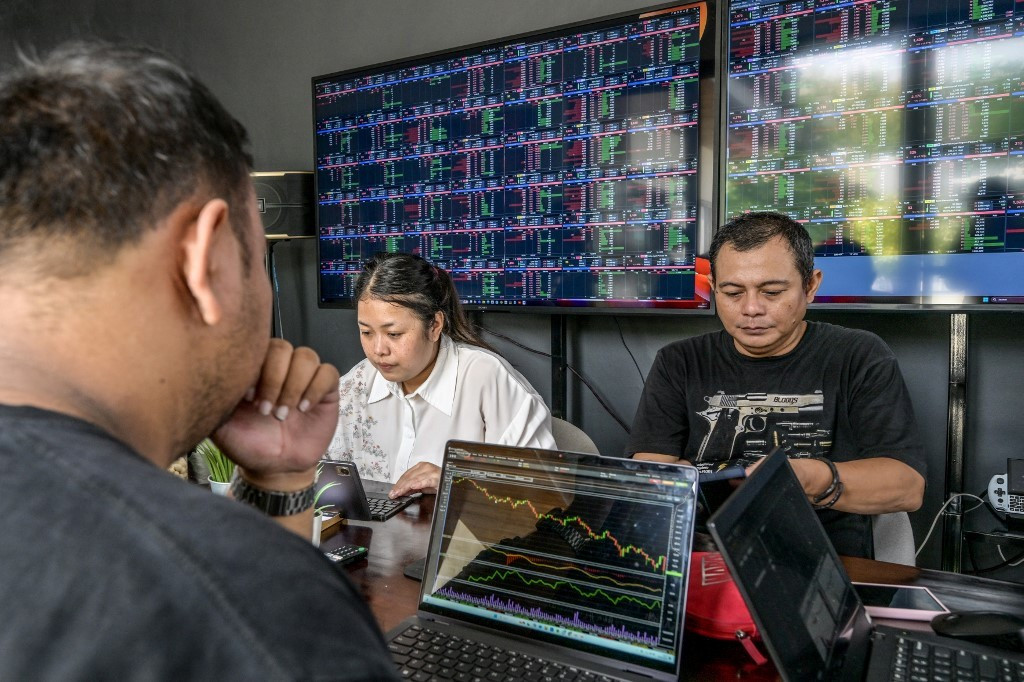 Stock traders monitor the Jakarta Composite Index (JCI) on April 8, 2025, in South Tangerang, Banten. (AFP/Bay Ismoyo)
The Indonesia Stock Exchange’s (IDX) plan to lower the minimum share price from Rp 50 (less than 1 US cent) to Rp 1 could finally allow the market to discover the true value of stocks long trapped at the price floor. But greater price flexibility comes with greater risk. As distressed “zombie companies” are exposed to market forces and stocks worth only a few rupiah become tradable, the reform could improve liquidity and price discovery while also opening the door to greater volatility and speculation.
On Aug. 20, the IDX unveiled its plan to remove the existing price floor for stocks traded on the exchange, allowing shares currently priced at Rp 50 to trade as low as Rp 1. The plan has undergone a series of tests, which IDX president director Jeffrey Hendrik said had been successfully conducted with the participation of most exchange members, with only eight yet to participate. Tests were conducted on Aug. 22 and 29 and received generally positive responses from exchange members.
The tests are part of broader efforts to reform the IDX in response to concerns raised by Morgan Stanley Capital International (MSCI) regarding ownership transparency and price formation in a report released in January 2026. The same report raised the possibility of Indonesia being downgraded from emerging-market status, which could have adverse economic consequences through capital outflows and pressure on the rupiah. The price-floor reform is also part of the IDX’s efforts to deepen the capital market and strengthen its role as a source of long-term financing.
The planned changes would introduce a new price category for stocks trading between Rp 1 and Rp 10, while expanding the existing Rp 50 - Rp 200 bracket to cover stocks priced from Rp 11 to Rp 200. These brackets determine a stock’s maximum permitted daily price movement through the upper and lower auto-rejection limits, known respectively as ARA (auto reject atas) and ARB (auto reject bawah).
Previously, the ARA and ARB limits for the Rp 50 - Rp 200 bracket were 35 percent and 15 percent, respectively, meaning trades that would push a stock up by more than 35 percent or down by more than 15 percent would automatically be rejected. Under the planned changes, these limits would also apply to stocks trading between Rp 11 and Rp 50, creating the new Rp 11–Rp 200 bracket.
The wider price range could benefit trading activity by improving liquidity and facilitating price discovery, as the market would be able to determine the value of stocks previously stuck at the Rp 50 floor. Indonesia’s stock exchange recorded a sharp increase in the proportion of distressed companies following the COVID-19 pandemic, from 11.9 percent of listed companies to 19.4 percent in 2020. A 2023 study by global consultancy Alvarez & Marsal found that the proportion had yet to return to pre-pandemic levels, remaining at 14.2 percent because of weakened balance sheets and capital structures.
This has contributed to an increase in the number of “zombie companies” on the IDX, whose shares remain stuck at Rp 50 despite persistent selling pressure. These companies would be among those most affected by the reform, as their share prices would once again be exposed to market forces. The added flexibility could also create opportunities for value investors, as it would become easier to assess the performance of potential turnaround stocks and identify undervalued shares.
How the new Rp 1–Rp 10 bracket will perform, however, is less clear, as its ARA and ARB limits will differ from those applied to other price brackets. Unlike other brackets, where ARA and ARB are determined as a percentage of a stock’s price, the limits for this new bracket would allow a maximum daily increase or decrease of Rp 1.
Such treatment could create significant volatility. A maximum daily movement of Rp 1 would translate into a permitted price change of between 10 percent and 100 percent, depending on the stock’s prevailing price. For investors, particularly retail investors, this means the removal of the price floor could bring not only greater price discovery but also considerably greater risk. At the same time, such volatility could attract short-term traders seeking to profit from sharp daily price movements.
The reform therefore represents more than a technical adjustment to the IDX’s trading rules. Removing the Rp 50 floor could improve price discovery and expose the true condition of companies whose shares have long been trapped at the minimum price. But allowing stocks to trade for only a few rupiah could also create fertile ground for volatility and speculation. The challenge for the IDX will be to ensure that greater price flexibility contributes to a deeper and more efficient capital market without turning the lowest-priced segment of the exchange into a playground for speculative trading.