
News
The power to seize, the need for safeguards
Tenggara Strategics September 8, 2026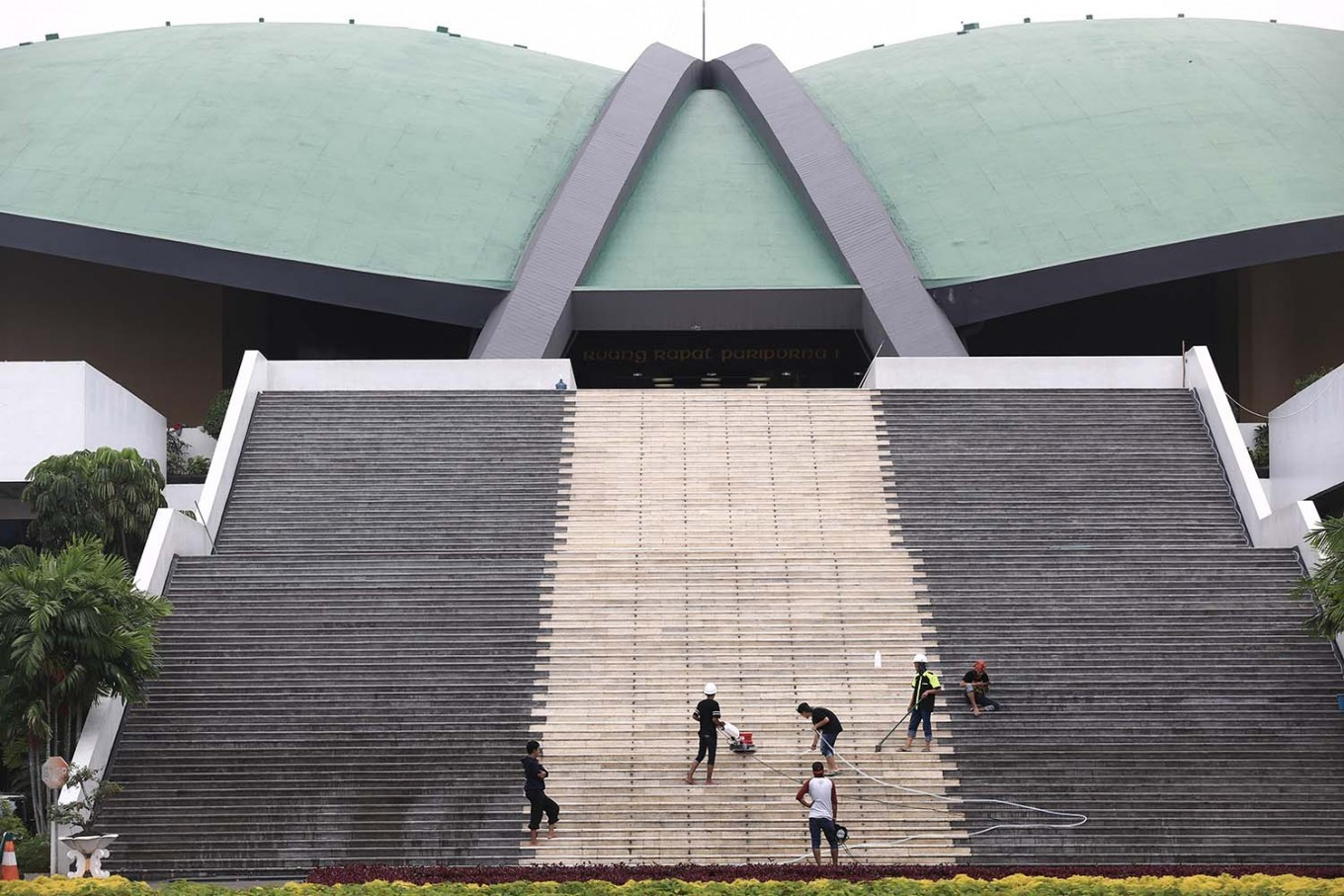 The iconic building in the People's Consultative Assembly (MPR) in Senayan, Jakarta (JP/Dhoni Setiawan)
Street protests have reignited the drive to pass the long-stalled asset forfeiture bill. Under renewed public pressure, the House of Representatives has committed to wrapping up deliberation by year-end, nearly two decades after the reform was first tabled. The real test now is whether this self-imposed deadline will finally overcome years of legislative foot-dragging, and whether lawmakers can be held accountable if it slips again.
The spark came on Aug. 27, when demonstrators from the Pati United People’s Alliance (AMPB) and allied civil groups rallied outside the parliamentary complex in Senayan, Jakarta. Protesters demanded the bill’s swift passage alongside harsher penalties for graft convicts, up to and including capital punishment. At the same time, the Yogyakarta Student Executive Boards Forum (BEM) held a parallel demonstration outside the city’s Presidential Palace.
Following talks with the rally leaders, House leaders pledged to finish deliberations by Dec. 15, reportedly offering to resign if they miss the target.
So far, however, the lawmakers have kept details under wraps. While Commission III noted that 13 categories of criminal offenses are being weighed for inclusion, the complete draft had not been made public by early September. Deputy House Speaker Cucun Ahmad Syamsurijal defended the secrecy, cautioning that an early release could invite public misinterpretation while talks remain fluid.
Part of the gridlock stems from the bill’s sheer scope. Rather than tweaking existing statutes, the legislation introduces an entirely novel legal mechanism to Indonesia’s legal landscape. Deputy House Speaker Sufmi Dasco noted that lawmakers are still balancing public input against the need to align the draft with the newly enacted Criminal Code (KUHP) and the Criminal Law Procedure Code (KUHAP).
Yet the hurdles are far from purely technical.
Asset forfeiture grants the state an extraordinary prerogative: seizing property suspected of illicit origins without waiting for a final criminal conviction. Granting such leverage demands rigorous evidentiary benchmarks, strict judicial oversight and reliable mechanisms for individuals and innocent third parties to challenge wrongful seizures.
These civil liberty concerns cut across party lines. Indonesian Democratic Party of Struggle (PDI-P) Secretary-General Hasto Kristiyanto reiterated his party’s backing for the bill’s anti-graft goals, but cautioned that handing sweeping powers to law enforcement without robust checks risks turning the measure into a political weapon.
Lawmaker Habiburokhman echoed that warning, arguing that the statute must not be weaponized to extort citizens, silence dissenters, or target political rivals. Taking a systemic view, Commission XIII member Rieke Diah Pitaloka urged lawmakers to build an end-to-end framework - covering asset tracing, freezing, confiscation, management and restitution - backed by transparent jurisdiction, firm judicial review and good-faith third-party protections.
Here lies the central political dilemma: The same legal muscle intended to strip corrupt elites of illicit fortunes also expands state interference with private property. The debate is no longer about whether to fight graft, but how much power the state should hold - and who gets to keep it in check.
The idea itself has been languishing since 2009, when the Financial Transaction Reports and Analysis Center (PPATK) submitted an initial draft to then-president Susilo Bambang Yudhoyono. The bill later drifted onto president Joko “Jokowi” Widodo’s National Legislation Program (Prolegnas), only to be pushed aside session after session.
The delay is striking given the broad consensus behind its core objective: Indonesia urgently needs an effective way to claw back stolen funds. According to Indonesia Corruption Watch (ICW), corruption cases between 2019 and 2023 caused Rp 234.8 trillion (roughly US$14.2 billion) in state losses, yet authorities recovered just Rp 32.8 trillion - a modest 13.9 percent.
External commitments haven't broken the domestic stalemate either. Indonesia secured full membership in the Financial Action Task Force (FATF) in October 2023, binding the nation to global standards for tracing and confiscating illicit gains. Yet international standing has done little to resolve domestic legislative hesitation.
While President Prabowo Subianto has framed asset recovery as a cornerstone of his anti-graft agenda, slow progress on the ground has kept public frustration on a boil.
Procedural caution may explain why lawmakers have taken their time, but it also raises the stakes: parliament must now prove that twenty years of deliberation yielded a watertight, abuse-proof law - not simply another excuse to delay.
The December deadline is more than a legislative marker; it is a litmus test for whether the House can turn rhetoric into reform without trading the rule of law for unchecked state authority.
What we've heard
According to a source, House of Representatives leaders, led by Deputy Speaker Sufmi Dasco Ahmad, met inside the legislative complex on Aug. 26 with Supriyono, also known as Botok, leader of the United Pati People’s Alliance (AMPB). The meeting took place one day ahead of the planned Aug. 27 rally.