
News
When a disaster-prone nation cuts its safety net budget
Tenggara Strategics September 2, 2026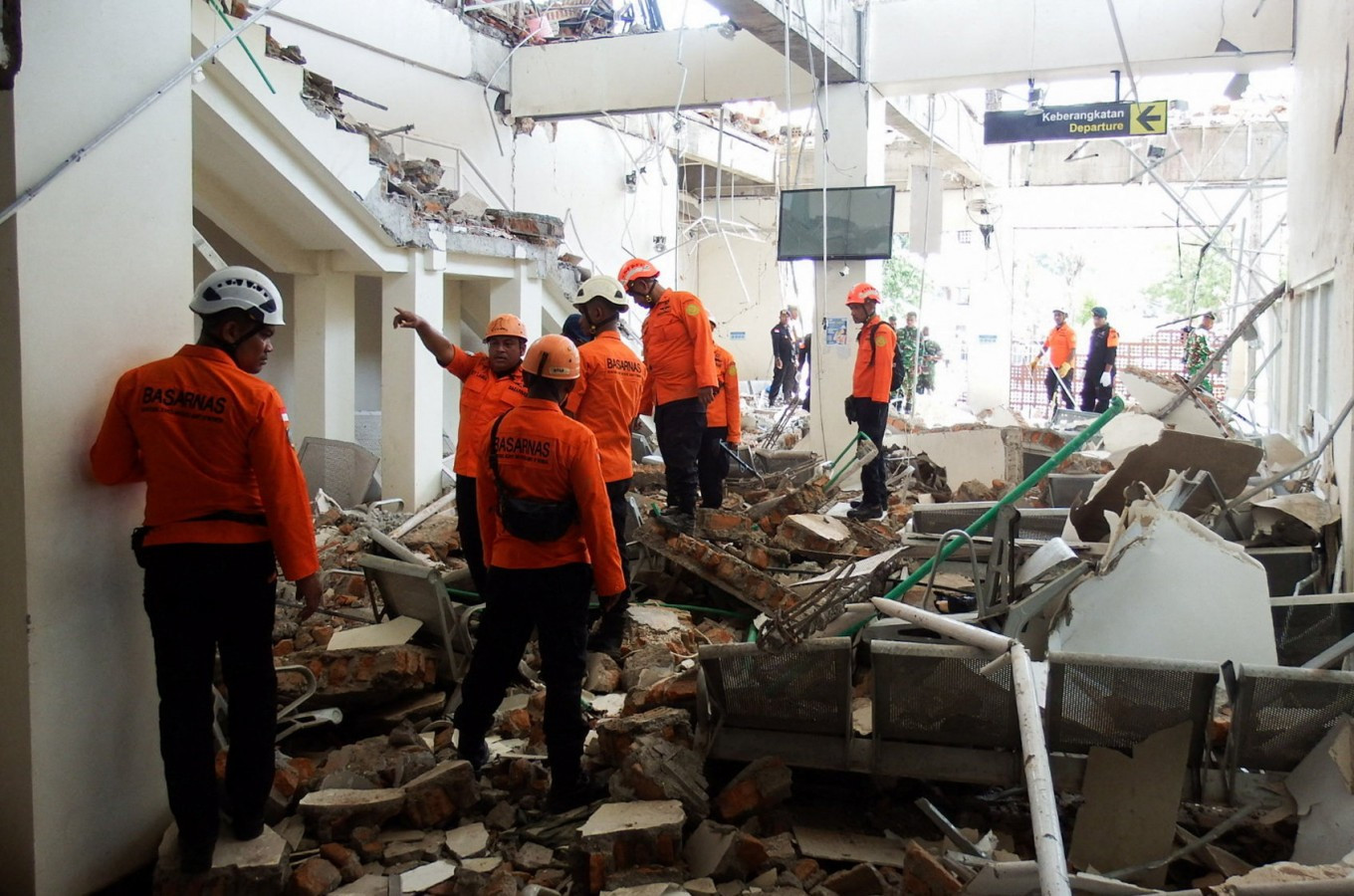 Rescuers inspect a heavily-damaged building at Laurentius Say port in Maumere, Sikka, East Nusa Tenggara (NTT) on Aug. 15, 2026 following an earthquake off the northern coast of Flores Island. (Reuters/Willy Kurniawan)
A major earthquake in East Nusa Tenggara (NTT) has once again put Indonesia’s disaster preparedness under scrutiny, raising tough questions about political will and shrinking mitigation budgets. Sitting squarely on the Pacific Ring of Fire, Indonesia faces inherent geological risks. Yet policymakers too often treat this geography as an excuse for poor outcomes rather than an urgent mandate for better preparation.
The magnitude-7.7 earthquake struck off Flores Island near Nagekeo on Aug. 15. By Aug. 26, the Meteorology, Climatology and Geophysics Agency (BMKG) had recorded 7,492 aftershocks, the strongest reaching magnitude 6.2, with no clear sign of tapering off.
The human and material toll has been severe. As of Aug. 25, the National Disaster Mitigation Agency (BNPB) reported 105 deaths, 1,678 injuries and 179,037 displaced residents. The tremor damaged nearly 78,000 homes, alongside 118 health facilities, 1,378 educational buildings, 483 government offices, 402 houses of worship and 156 road sections.
Beyond the immediate devastation, the disaster exposes three fundamental issues.
First is the symbolic weight of the government's response. President Prabowo Subianto did not visit Nagekeo until Aug. 26, or 11 days after the disaster struck, and only after attending his private secretary’s wedding reception. Prabowo defended the delay as deliberate, arguing that high-profile visits risk distracting frontline agencies from urgent rescue operations.
Yet a head of state’s presence carries significant psychological value. For survivors who have lost loved ones, homes and livelihoods, seeing their leader on the ground offers an emotional reassurance that administrative protocols cannot match. It serves as an essential gesture of solidarity, proof that the state recognizes their grief and grants it the highest priority. That reassurance matters even more in distant, less developed regions like NTT, where geographic isolation can quickly breed feelings of political neglect.
This delayed response mirrors the government's handling of the devastating floods and landslides across Aceh, North Sumatra and West Sumatra in late November 2025. Though Prabowo eventually visited the affected areas, his administration drew sharp criticism for a sluggish response and an apparent reluctance to declare a national emergency. Officials later conceded that earlier budget cuts had left key agencies financially strapped, while national leadership hesitated to accept foreign aid out of concern that it might project institutional weakness.
This fiscal strain highlights the second core issue: a sharply shrinking disaster management budget.
The BNPB's funding has cratered in recent years. After peaking at Rp 11.76 trillion (US$664 million) during the height of the COVID-19 pandemic in 2020, allocations consistently held above Rp 4.9 trillion annually from 2021 through 2024 (Rp 7.14 trillion in 2021, Rp 5.05 trillion in 2022, Rp 5.44 trillion in 2023 and Rp 4.92 trillion in 2024). Under the Prabowo administration, however, the budget dropped to Rp 2.01 trillion in 2025 and fell further to just Rp 491 billion in 2026, at a time when the government spent big on Prabowo’s signature programs like the free nutritious meal program and Red and White Cooperatives.
For a country hit by regular natural disasters, such steep cuts severely curtail the BNPB’s operational agility and readiness. While Finance Minister Purbaya Yudhi Sadewa has maintained that the central government can release emergency reserves upon request, reactive funding is no substitute for steady preparedness. In Sumatra, where recovery efforts leaned on depleted regional coffers and ad-hoc central aid, affected communities are still struggling eight months later amid sustained calls from civil society for meaningful support.
In NTT, the cracks in the safety net appeared immediately. BNPB chief Lt. Gen. Suharyanto acknowledged widespread shortages of clean water and electricity at evacuation hubs, including in Reo, Manggarai. Several local administrations lacked basic logistical reserves and financial cushions, which, combined with difficult terrain, severely delayed relief deliveries.
Rugged topography cannot serve as an excuse for sluggish aid; it should be the very premise of robust logistical planning. Predictable necessities, potable water, backup generators, emergency clinics, supply corridors and clear evacuation paths, must be secured long before the ground moves.
This failure shifts the spotlight to the third and most decisive issue: long-term mitigation.
Suharyanto noted that the BNPB's annual allocation for disaster prevention has lingered at a modest Rp 17 billion to Rp 19 billion over the past five years, a fraction of what effective risk reduction requires. NTT is no stranger to seismic trauma; on Dec. 14, 2021, a magnitude-7.4 earthquake devastated communities near Maumere. The latest disaster is not an anomaly, but part of an ongoing pattern of regional vulnerability.
Earthquakes are natural events, but the destruction they leave behind is shaped by human decisions. Public awareness matters, but genuine mitigation remains a state responsibility. Protecting Flores and other vulnerable regions demands resilient spatial planning, strictly enforced earthquake-resistant building codes, sensible coastal zoning and fail-safe emergency infrastructure.
Indonesia cannot stop earthquakes from happening. It can, however, control how much destruction they cause. Ultimately, the true measure of the state’s presence is not whether leaders show up days after a catastrophe, but whether protective infrastructure was built long before the disaster hit.
What we've heard
Prabowo visited earthquake-affected areas in NTT over a week after the disaster struck the region.
Related Articles