
News
Pertamax price hike highlights Indonesia’s costly fuel subsidies
Tenggara Strategics June 29, 2026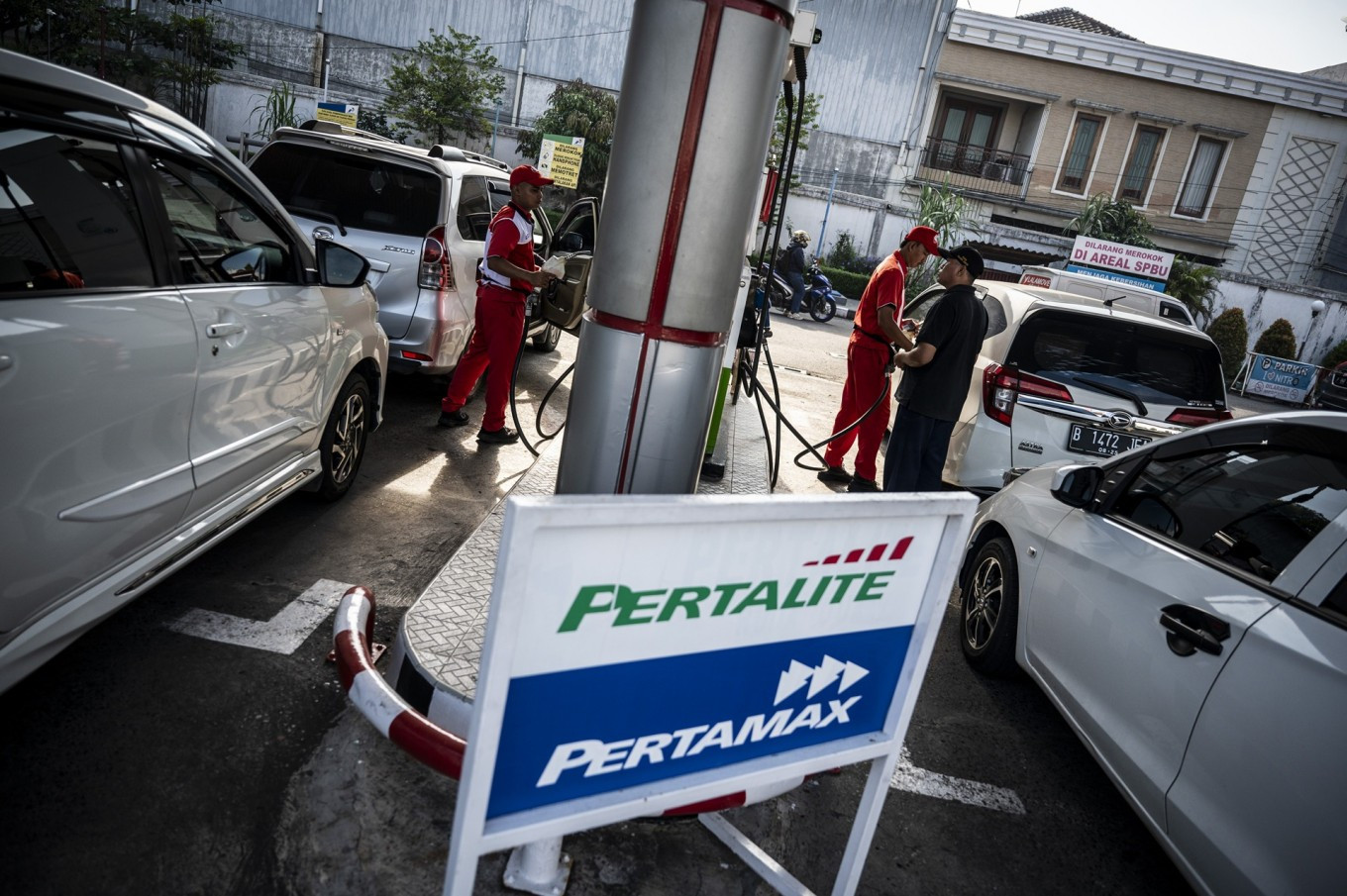 Attendants of a gas station owned by state-owned energy holding company Pertamina serves customers on Feb. 27, 2025, in Semarang, Central Java (Antara/Aprillio Akbar). (Antara/Aprillio Akbar)
The government has finally green-lit the price increase for Pertamax, the widely used nonsubsidized gasoline with research octane number (RON) 92, after months of attempting to shield consumers from rising global oil prices triggered by the United States-Israeli war on Iran, particularly disruptions due to closure of the Strait of Hormuz. While the move is expected to ease pressure on public finances, it also creates new risks such as consumers shifting to subsidized fuels, increasing the government's subsidy burden.
The episode has, once again, highlighted the long-standing issue of poorly targeted fuel subsidies that often fail to protect vulnerable groups.
PT Pertamina Patra Niaga, the commercial trading subsidiary of state-owned energy holding company Pertamina, announced on June 10 that it had raised the price of Pertamax from Rp 12,300 (69 US cents) per liter to Rp 16,250 per liter. It also increased the price of Pertamax Green, a RON 95 biofuel blend, from Rp 12,900 to Rp 17,000 per liter.
The prices of other nonsubsidized fuel brands remained unchanged from earlier adjustments: Pertamax Turbo (RON 98) at Rp 20,750 per liter, Pertamina Dex diesel with cetane number (CN) 53 at Rp 24,800 per liter and Pertamina Dexlite (CN51) at Rp 23,000 per liter.
According to the Finance Ministry, the price hikes for Pertamax and Pertamax Green will have a limited impact on inflation because these products were not widely used by public transportation or freight operators. Meanwhile, National Energy Council (DEN) member Satya Widya Yudha said the adjustment was intended to reduce the government's fiscal burden after months of absorbing higher energy costs as well as to restore the market-based pricing mechanism for nonsubsidized fuels.
However, the policy may ultimately create new fiscal pressures rather than alleviate them.
Following the price hike, motorists began switching from Pertamax to subsidized Pertalite (RON 90), which remains at an affordable Rp 10,000 per liter. The surge in demand has strained supplies in several regions, leading to long lines and temporary shortages at some gas stations.
Economists estimate that a broad shift to Pertalite could add as much as Rp 19.5 trillion to the government's subsidy bill, at a time when the fuel subsidies had absorbed 45.6 percent of the 2026 budget allocation by May.
Recognizing the potential impact on consumers, the government has signaled a readiness to strengthen social assistance programs. Social Affairs Minister Saifullah Yusuf said he was awaiting a presidential instruction regarding a possible midyear increase in aid or beneficiary coverage.
Economists have urged the government to focus on mitigation measures for vulnerable households, informal workers and micro, small and medium enterprises (MSMEs) through targeted cash transfers, food price stabilization measures and temporary support for public transportation and small logistics businesses.
The price hike also underscores the structural weaknesses of Indonesia's fuel subsidy regime. According to the World Bank, the wealthiest 20 percent of households receive more than half of all fuel subsidy benefits because they own more vehicles and consume more fuel.
Despite costing around 1.6 percent of GDP, the subsidy provides only limited support to low-income households. The World Bank has therefore recommended a gradual adjustment of fuel prices accompanied by targeted cash transfers to the poorest 40 percent of households to mitigate the impacts of subsidy reform.
Meanwhile, the energy shock appears to be easing.
At the peak of the crisis, disruptions to shipping through the Strait of Hormuz affected daily shipments comprising roughly 14 million barrels of oil, compared with around 20 million barrels per day that normally transit the waterway, according to the International Energy Agency.
Market sentiment has improved since the signing on June 17 of a memorandum of understanding (MoU) between Washington and Tehran, which extended the ceasefire and established a 60-day timeframe for negotiating a final agreement. Following the announcement, Brent Crude futures settled at $79.55 per barrel, while West Texas Intermediate (WTI) closed at $76.79 per barrel.
The Pertamax price hike has exposed deep structural flaws in Indonesia's fuel subsidy system. While easing global oil prices following the US-Iran MoU may provide a window for reform, the widening price gap between subsidized and nonsubsidized fuels risks encouraging further shifts in consumer behavior and eroding potential fiscal savings.
This reinforces the World Bank's long-standing recommendation that Indonesia gradually phase out regressive fuel subsidies while expanding targeted cash assistance, a strategy that could improve both fiscal sustainability and social equity.
What we've heard
A source at Pertamina said the state energy giant had long planned price hikes for its fuels, in particular Pertamax, whose pricing was intended to follow market conditions. However, the source said the government had instructed the company to postpone any adjustments despite the surge in global oil prices.