
News
Overflight dilemma: Between sovereignty and security
Tenggara Strategics April 28, 2026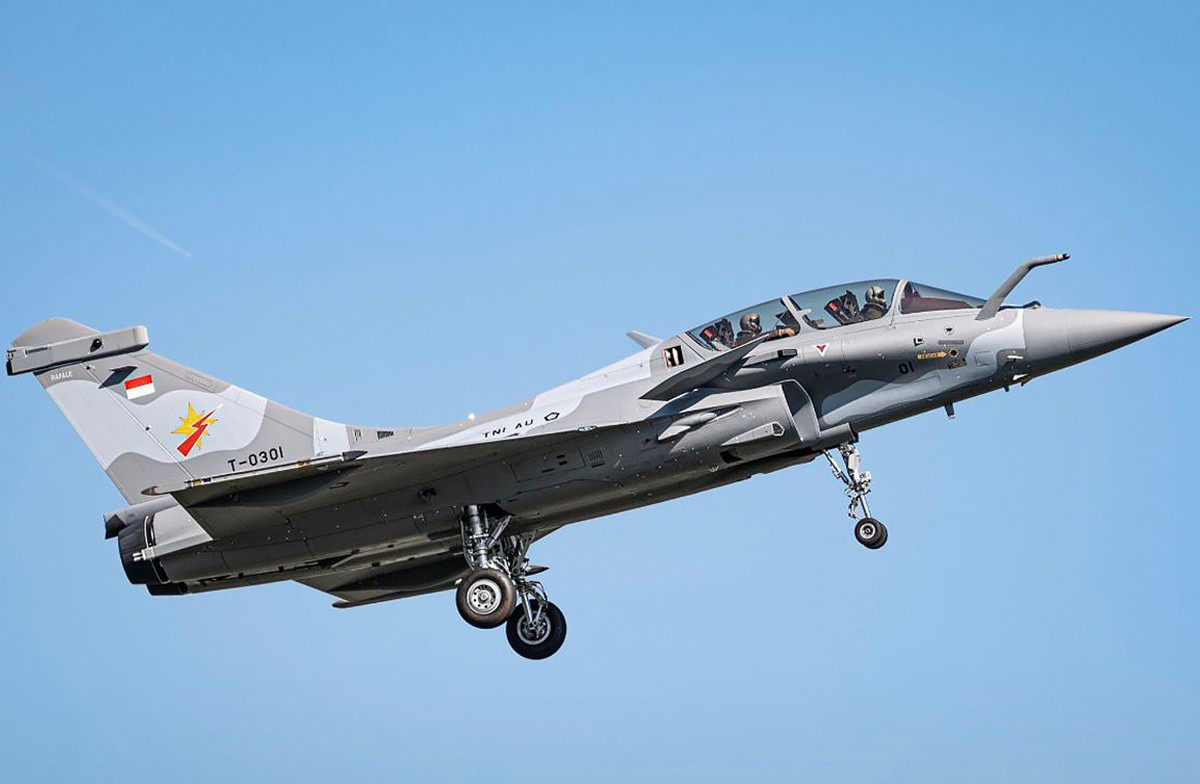 The first flight of the Indonesian Air Force’s Rafale B, registration number T-0301, took place in Mérignac, Bordeaux, France, on Saturday, Sep. 19, 2025. (Courtesy of the Indonesian Air Force)
Indonesia is facing mounting scrutiny over a United States proposal to introduce a notification-based overflight arrangement. As policymakers weigh strategic cooperation against legal consistency and long-standing non-alignment, the decision may ultimately redefine Indonesia’s position within an increasingly contested Indo-Pacific security landscape.
The Defense Ministry has confirmed the existence of a draft letter of intent (LoI) proposed by the US Department of Defense dated Feb. 26, titled “Operationalizing U.S. Overflight.” This non-binding document outlines a blanket overflight scheme, proposing that both countries transition from a case-by-case approval system toward a notification-based mechanism. Such a shift would significantly reduce procedural barriers to US military mobility.
This development has drawn widespread attention since Defense Minister Sjafrie Sjamsoeddin and US Secretary of Defense Pete Hegseth announced the Major Defense Cooperation Partnership (MDCP) at the Pentagon on April 13. The agreement rests on three pillars: military organization and capacity building, professional military education and training, and operational cooperation.
Consequently, media and public scrutiny have continued to intensify. The issue is particularly sensitive as it coincides with the implementation of a new legal regime, Law No. 21/2025 on National Airspace Management (UU PRUN), which came into force in December 2025. The law explicitly affirms that Indonesia’s airspace falls under the country’s full and exclusive sovereignty.
This overlap between a strengthened legal assertion of sovereignty and a proposal to ease foreign military access creates a structural policy tension that may test the consistency of Indonesia’s regulatory framework. A number of analysts have warned that granting blanket overflight clearance to the US risks undermining Indonesia’s legal sovereignty, contradicting the UU PRUN and weakening national control. Such a policy could erode Indonesia’s geopolitical neutrality and expose the country to broader strategic risks. As such, they argue, the proposal should either be rejected or, at minimum, strictly limited with robust regulatory safeguards. Beyond legal contradictions, the proposal raises concerns about a gradual shift in Indonesia’s long-standing “free and active” foreign policy toward implicit strategic alignment.
Domestically, competing views have emerged among stakeholders. House of Representatives Commission I has emphasized that any decision to grant comprehensive overflight access must undergo a parliamentary ratification process. Meanwhile, the Foreign Ministry has urged the Defense Ministry to adopt policies that do not carry adverse implications for regional stability. These differing positions highlight an institutional divide between defense-driven pragmatism and diplomatic risk sensitivity, potentially complicating policy coherence.
The Foreign Ministry further warned that opening Indonesian airspace to Washington could expose Jakarta to potential retaliation in the event of a broader conflict involving the US and Israel against Iran, citing recent Iranian attacks on Middle Eastern countries hosting US military assets. The ministry also cautioned that the plan could heighten tensions in the South China Sea and risk drawing Indonesia more directly into major power rivalry in those contested waters.
At the regional level, ASEAN countries are closely monitoring developments. China, however, has responded more explicitly. On April 17, Chinese Foreign Ministry spokesperson Guo Jiakun stated that, in line with the ASEAN Charter and the Treaty of Amity and Cooperation (TAC), member states must uphold collective responsibility for regional peace, security, and prosperity.
He further urged members to refrain from actions—including the use of their territory—that could threaten the sovereignty or territorial integrity of other ASEAN members. China’s response signals potential diplomatic pressure and frames the issue as a test of ASEAN norms and Indonesia’s commitment to regional neutrality.
Indonesia is geographically surrounded by US military installations in Australia, the Philippines, Guam, Papua New Guinea, and Singapore. In the Philippines, President Ferdinand Marcos Jr. expanded the number of bases accessible to the US to nine in 2023, including locations facing Taiwan and the South China Sea.
The upcoming Balikatan joint military exercises, scheduled from April 20 to May 8, will be the largest to date, involving participants such as New Zealand, Canada, Japan, France, and Australia. Expanding US access to Indonesian airspace would further consolidate Washington’s forward military presence in the Indo-Pacific, potentially recalibrating regional deterrence dynamics.
China, meanwhile, has also expanded its military footprint in Southeast Asia. Beijing operates military bases on artificial islands in the South China Sea, equipped with airstrips, ports, air defense systems, and long-range missile capabilities. It also maintains a military presence in Cambodia.
The overflight proposal reflects a strategic trade-off between operational cooperation and sovereign control, increasingly shaped by President Prabowo Subianto’s tilt toward closer engagement with the US and Western security frameworks. While this approach may enhance defense interoperability, it risks creating legal inconsistencies and gradual strategic entanglement, potentially diluting Indonesia’s long-standing non-aligned posture.
The key policy challenge is to ensure that deeper alignment does not outpace regulatory safeguards and diplomatic balance, thereby preserving Indonesia’s strategic autonomy.
What we've heard
A source within the Defense Ministry indicated that the Major Defense Partnership agreement signed with the US Department of Defense covers collaboration in defense technology research and the maintenance of major weapons systems. “Regular troop training is one of the components included in the agreement,” the source said.