
News
Indonesia's Police-Prosecutor turf war: A fragile truce
Tenggara Strategics July 24, 2026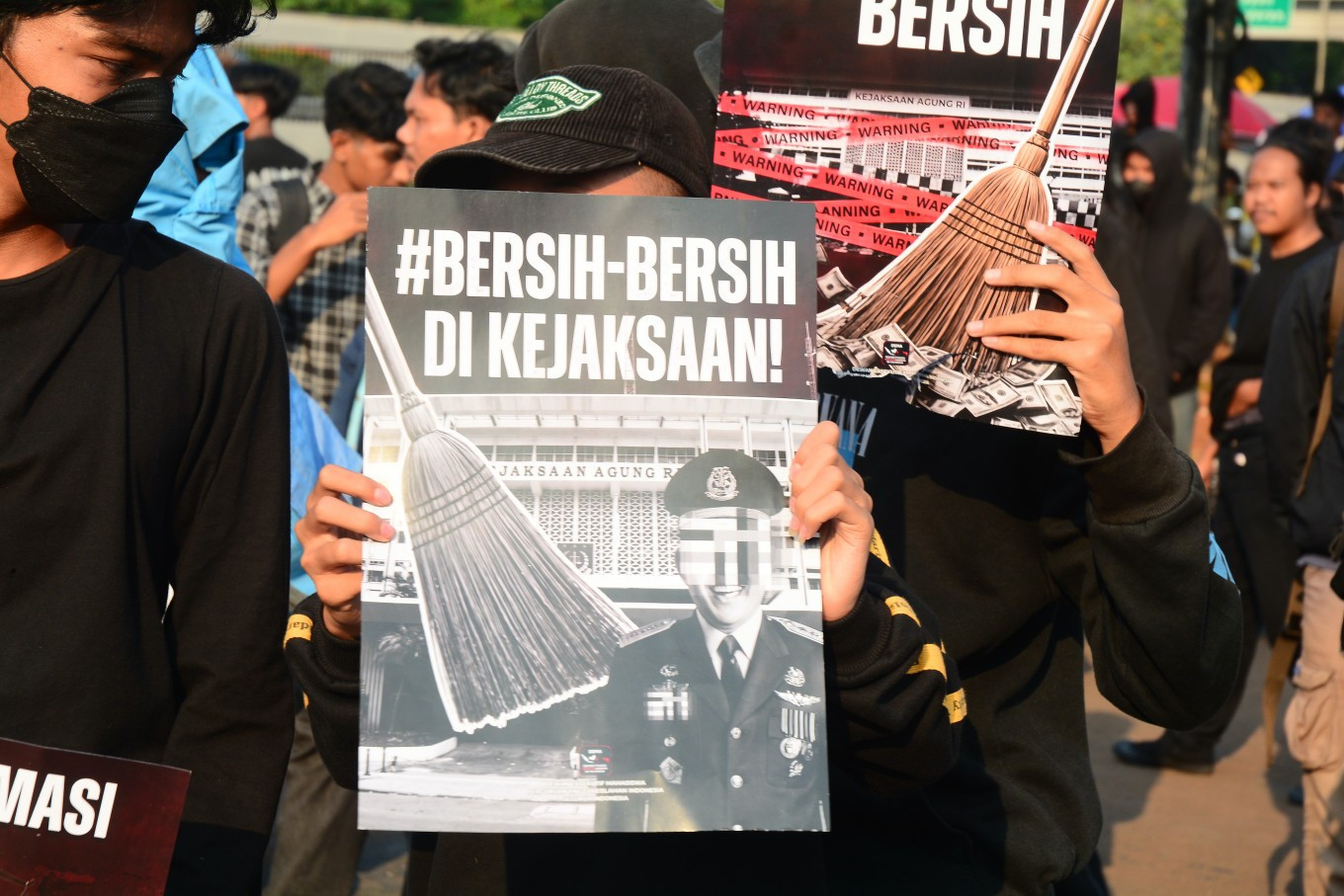 Protesters from a coalition of university students hold a banner reading “Clean Up the Attorney General's Office“ during a demonstration outside the House of Representatives complex in Jakarta on July 10, 2026. The protesters called for an investigation into alleged corruption within the Attorney General's Office. (JP/Iqro Rinaldi)
For much of the past week, Indonesia's two most powerful law enforcement institutions, the National Police and the Attorney General's Office (AGO), appeared locked in open confrontation, complete with dueling corruption probes and troops guarding a prosecutor's house. That confrontation now looks to be ending in retreat rather than resolution.
Police have now handed their corruption dossier on former deputy attorney general Febrie Adriansyah over to the AGO, while the AGO has halted a parallel push that was uncovering possible corruption links between the free nutritious meals program and police-run kitchens in the regions. The de-escalation followed a closed-door summons by President Prabowo Subianto of his police chief, attorney general, and armed forces commander, leaving critics wondering whether a rare moment of accountability is instead being managed away.
The trigger was a set of police raids on July 8–9 across Jakarta, Tangerang and Bogor. Investigators searched at least 12 locations, including a café Febrie was known to frequent, a money changer and his home in Sentul, Bogor. Estimates of the haul vary, but investigators described seizing roughly Rp 67 billion (US$4 million) in cash from Jakarta properties, plus Rp 476 billion and 74 kilograms of gold from the Sentul house, with some tallies, factoring in a locked safe holding seven suitcases of cash, putting the total closer to Rp 540 billion ($33 million), including nearly $4.8 million and S$14 million found alongside the gold.
Police initially linked the haul to three cases: a graft and bribery probe tied to coal procurement for state utility PLN, blamed for contributing to blackouts; the long-running Asabri and Jiwasraya state-insurer scandals; and a debt-restructuring case involving a Krakatau Steel subsidiary. Febrie resigned on July 11 and was named a suspect the same day.
The raids did not happen in a vacuum. Before being forced out, Febrie had said the AGO remained focused on a graft scandal in Prabowo's flagship free meals program, run by the National Nutrition Agency (BGN). That investigation had already produced an uncomfortable finding for police: prosecutors named an active-duty police brigadier general as a suspect over an alleged scheme selling food trays to nutrition-program partners at fixed, kickback-laden prices, and flagged a serving army colonel over separate procurement irregularities.
Many observers connected the dots directly, the AGO's pursuit of a serving police general, followed shortly by a raid that happened to unearth a fortune in an AGO chief's own house, looked to many like retaliation. This week, both sides stood down in parallel. Police confirmed the transfer of the three cases to the AGO, calling it a commitment to "institutional synergy", an unusual handover, since Febrie had reportedly never been formally questioned and the case file had not been declared complete. The AGO quickly changed Febrie’s status from suspect to a “witness” in the investigation.
Simultaneously, the AGO ended its own regional push: it had ordered provincial offices to inventory every nutrition-kitchen site nationwide, including police-run ones, logging some 380 sites in Yogyakarta alone before halting the exercise on July 10, a day before Febrie's resignation, with officials citing only an expired data-collection deadline.
That the settlement bears the president's fingerprints is not in dispute. Prabowo summoned senior officials to the palace on the night of July 11, including the defense minister, Indonesian Military (TNI) commander, the attorney general and the police chief.
Two days later, the police chief staged a public reconciliation, visiting TNI headquarters and then AGO headquarters for a handshake with the attorney general, who told reporters "don't think we're rivals".
That a military commander needed to be in the room points to a third leg of this story. Following the raids, armed soldiers were seen guarding Febrie's residence, a deployment the TNI confirmed came at the AGO's request; separately, soldiers reportedly visited police headquarters to accompany a witness, which the TNI denied was interference.
Former minister Mahfud MD called the deployment unlawful, since securing prosecutors is the police's job unless police themselves request help, and noted a serving army colonel's own implication in the BGN scheme underscored that all three institutions had skin in the game.
Mahfud has been the sharpest voice throughout. Before the truce, he said he'd welcome the feuding sides exposing each other's corruption without limit, "devils meeting devils," in his words. After the handover, he turned more skeptical, calling the transfer a departure from criminal procedure and a product of a proxy-war compromise among power-holders, warning it could be localized to avoid reaching up the chain of command.
That pattern, synchronized climbdowns, a presidential summons, a TNI-brokered handshake, a procedurally dubious handover, points toward containment rather than resolution. Given Mahfud's warning about cases stalling or being downgraded once public pressure fades, and Indonesia's history of high-profile graft probes losing momentum, there is a real chance both the Febrie affair and the wider MBG investigation end up managed down to a size the institutions, and the presidency, can live with.
What we've heard
Following last week's escalation of tensions between the National Police and the AGO, President Prabowo Subianto convened a series of meetings with top law enforcement and security officials. Attendees included the TNI commander, the attorney general, the head of the National Intelligence Agency (BIN), and the National Police chief. The discussions reportedly took place across multiple venues, including the State Palace and Danantara, the President's official residence in Widya Chandra.