
News
Indonesia’s market sell-off punishes poor governance
Tenggara Strategics November 3, 2026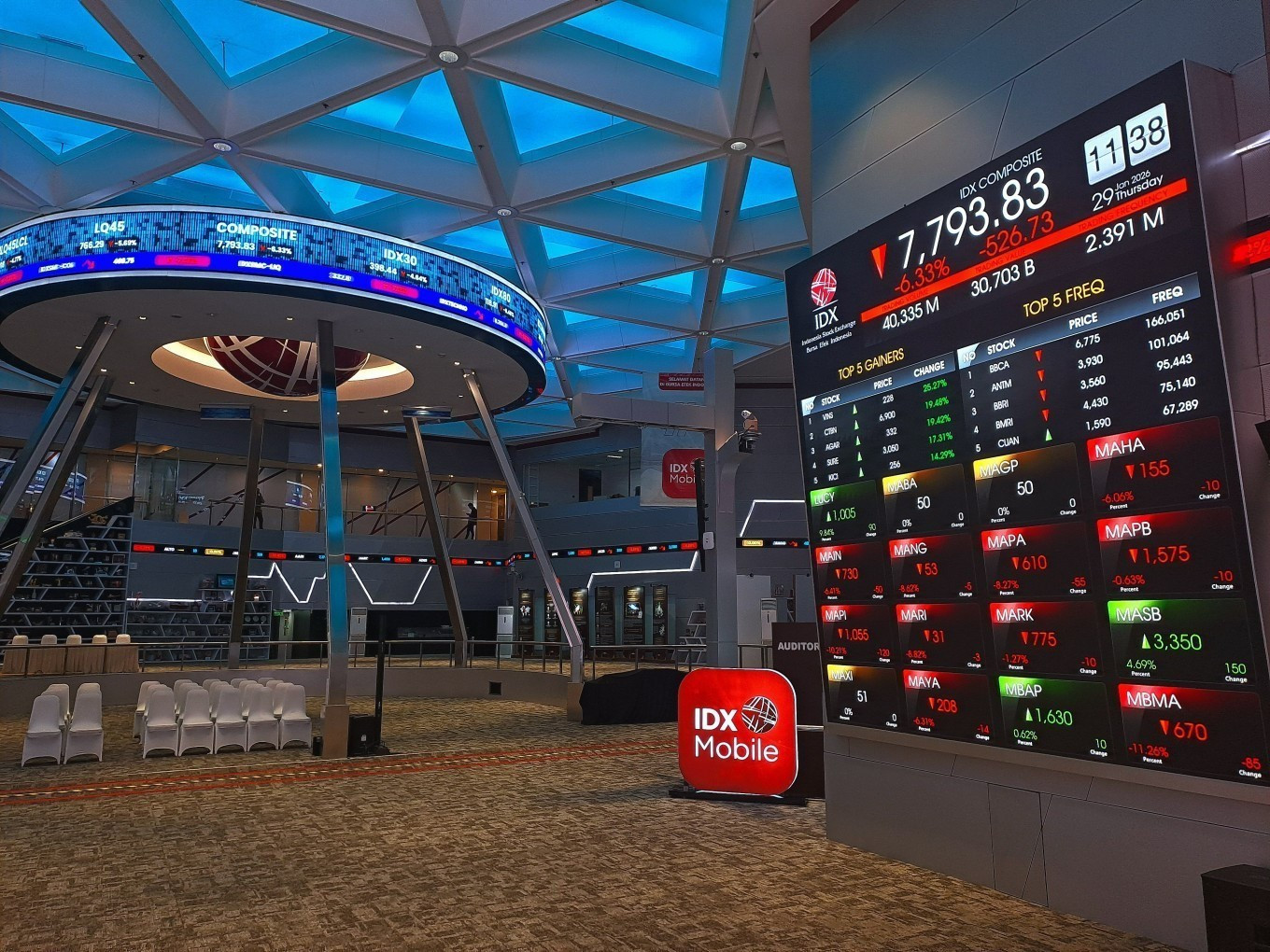 An electronic display board inside the main hall of the Indonesia Stock Exchange (IDX) in South Jakarta shows an overall downward movement across most stocks during the lunch break on Jan. 29, 2026, when the IDX Composite index fell 6.3 percent after global index provider MSCI raised concerns about Indonesia's stock market. (TJP/Deni Ghifari)
Last Friday was a Black Friday for Indonesian stocks. A market sell-off wiped out US$65 billion in value and sent the Indonesia Composite Index (IDX) plunging 11.6 percent, its steepest drop since 1998. The market did not crash because corporate fundamentals suddenly weakened, but because investors punished regulators for turning a blind eye to market abuses and acting only after MSCI forced their hand.
On Oct. 16, index provider MSCI announced that it was launching a formal consultation on whether to downgrade Indonesia from emerging-market status to a standalone market, alongside countries such as Argentina, Ukraine and Zimbabwe. This followed earlier warnings that MSCI could demote Indonesia to frontier-market status over concerns about the low free-float ratios of some listed Indonesian companies.
MSCI’s concerns about the Indonesian capital market have remained consistent throughout its announcements. Its threat in January to move Indonesia to frontier-market status, followed by its latest warning in October of a possible downgrade to standalone-market status, stemmed from concerns over opaque shareholding structures and coordinated trading.
MSCI’s June announcement raised the same issues, downgrading Indonesia’s assessment for information flow while continuing to highlight concerns about ownership transparency and coordinated trading. These concerns persisted at the time of MSCI’s latest announcement, which again cited opaque shareholding structures and coordinated trading.
Unfortunately for investors in Indonesia’s stock market, the reforms introduced in response to MSCI’s previous announcements have not been sufficient to change its assessment. The Financial Services Authority (OJK) and other market regulators have introduced several reforms, including lowering the reporting threshold for significant shareholdings to 1 percent and imposing minimum free-float requirements that apply immediately to newly listed companies. For existing listed companies, however, implementation deadlines extend from 2027 to 2029.
These reforms have largely remained on paper, and their effects have yet to be fully realized in the market. This is despite MSCI’s warning in June that Indonesia needed sustained implementation and improved market outcomes, rather than simply more regulations.
In 2024, PT Barito Renewables Energy Tbk (BREN) was expelled from the FTSE Large Cap Index over concerns about ownership concentration. The company, which conducted its initial public offering in 2023, was removed because 97 percent of its shares were held by four people. Concentrated ownership is a broader problem in Indonesia’s stock market: 63 companies with free floats of less than 10 percent account for 28.8 percent of total market capitalization on the IDX.
This has caused share prices to fluctuate in response to developments involving particular corporate groups rather than industry fundamentals, as seen recently in the movements of stocks linked to Prajogo Pangestu and Haji Isam. OJK began investigating Barito Renewables’ IPO in 2024 over suspected market manipulation, but financial penalties were imposed only shortly after MSCI’s announcement.
A few days after the MSCI announcement, OJK imposed Rp 1.5 trillion (US$85.7) in fines on parties involved in the manipulation of PT Dian Swastatika Sentosa (DSSA) shares. It also fined PT Barito Renewables Energy (BREN) Rp 500 billion and PT Petrindo Jaya Kreasi (CUAN) Rp 100 billion.
This reflects an unfortunate broader pattern of OJK taking reactive rather than proactive measures to safeguard Indonesia’s financial sector. As with the Barito case, OJK also investigated PT Petrindo Jaya Kreasi Tbk amid concerns that shares offered through its IPO had been allocated in advance to designated recipients.
The penalties were imposed only after MSCI raised its concerns. Indonesia’s financial markets need more than rules on paper; they also need effective enforcement. Laws against market manipulation predate the Asabri and Jiwasraya cases, but if they remain unenforced and the stock market remains highly concentrated and vulnerable to malpractice, they will not be enough to protect retail investors.
Nevertheless, not all is lost for Indonesia’s financial sector. FTSE Russell still classifies Indonesia as a secondary emerging market, while the country’s stock market continues to include companies with healthy fundamentals. However, one thing is clear: Indonesia’s response to MSCI’s latest warning will help determine the future of its capital market.
Indonesia has lost some of the trust of foreign investors, with net capital outflows from the stock market reaching Rp 88.19 trillion on Friday. It remains to be seen whether the measures now being taken will be enough to restore investor confidence and reverse the outflows. One thing, however, is certain: laws without enforcement are meaningless.
Related Articles