News
Djarum probes test Prabowo's business ties
Tenggara Strategics November 20, 2026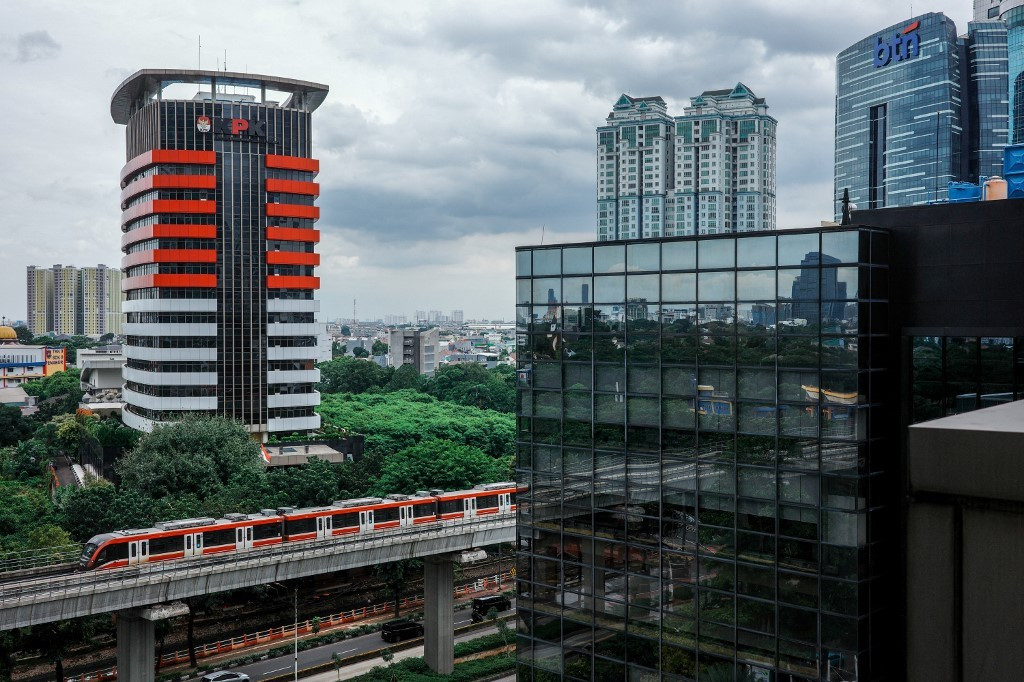 The Corruption Eradication Commission (KPK) building is pictured under overcast skies in Jakarta on Jan. 22, 2025. (AFP/Bay Ismoyo)
In October the Corruption Eradication Commission (KPK) searched PT Djarum's offices in Kudus, Central Java, over suspected administrative irregularities related to cigarette excise. Coming less than a year after a separate tax fraud investigation involving a senior Djarum executive, the new probe raises broader questions about law enforcement, shifting political-business relationships and investment certainty under the administration of President Prabowo Subianto.
The case is significant given Djarum's position as one of the country’s largest business groups. Founded by Oei Wie Gwan in 1951, the cigarette manufacturer expanded rapidly under his sons, Michael Bambang Hartono and Robert Budi Hartono, who modernized production and introduced filtered clove cigarettes in 1971.
Unlike companies that remained heavily dependent on tobacco, Djarum diversified into other industries through acquisitions and investments. Although tobacco still contributes 30 to 40 percent of its business, Djarum recognizes that the cigarette industry faces long-term decline.
The group’s most significant expansion was in 2002, when the Hartono family partnered with United States investment firm Farallon Capital to acquire a controlling stake in Bank Central Asia (BCA), which was owned by the Salim Group before its takeover by the government during the Asian financial crisis.
Today, the Hartono family controls BCA through PT Dwimuria Investama Andalan, which holds a 54.95 percent stake. The family's diversified business portfolio also includes electronics (Polytron), digital services (Halodoc, Tiket.com and Blibli), media (Visinema and IDN Media), food and beverages (Bakmi GM) and health care (Hermina Hospitals). This helped keep the Hartono brothers among the top wealthiest Indonesians for decades.
Yet even a long-standing conglomerate of Djarum's scale has faced mounting legal scrutiny. In November 2025, the Attorney General's Office imposed a travel ban on Djarum COO Victor Rachmat Hartono, along with six tax officials, during an investigation into alleged irregularities in corporate tax liabilities between 2016 and 2020. The ban was lifted after investigators said Victor had cooperated and provided the requested information.
The investigation attracted attention partly because Djarum had been recognized as a major taxpayer, ranking among the top 20 in 2023. The company was also frequently been cited by the Tax Office as an example of annual tax reporting compliance. Nevertheless, this track record does not place the company beyond scrutiny, particularly when allegations concern possible irregularities involving tax officials.
The KPK’s search of Djarum's offices and the Kudus customs office in October was part of a broader customs fraud probe that began earlier this year into alleged improper payments related to cigarette excise stamps.
While this case is ongoing, successive investigations coincided with speculation about Djarum's business interests. Rumors circulated that the company had transferred Rp 24 trillion (US$1.4 billion) in assets abroad, raising suspicions of capital flight.
Djarum denied the allegation, explaining that the funds were intended for overseas business expansion through the acquisition of cigarette paper manufacturers SWM and Tantapier. It also maintained that around 90 percent of its business portfolio remained in Indonesia.
Rumors also circulated that businessman Andi Syamsuddin Arsyad, better known as Haji Isam, planned to acquire a stake in BCA following his involvement in a major transaction involving coal producer Bayan Resources, reportedly at a 76 percent discount. Both BCA and the Financial Services Authority (OJK) firmly denied the rumored acquisition, emphasizing that no such corporate action was planned.
Beyond these developments, the more consequential question concerns Djarum's relationship with the Prabowo administration, though the Hartono brothers were not among the businesspeople identified as attending two key meetings with the President in 2025. Regardless, their absence from the publicized guest lists does not necessarily indicate a strained relationship.
Several figures from established conglomerates who reportedly attended the meetings include Sugianto Kusuma, Prajogo Pangestu, James Riady, Anthony Salim, Sri Tahir, Boy Thohir, Garibaldi Thohir, Franky Widjaja and Tomy Winata.
Questions about Djarum's political positioning also emerged around the Patriot Bonds, an investment instrument issued by state asset fund Danantara that aimed to mobilize funding from major business groups.
Speculation linked the earlier tax investigation into Djarum to its alleged reluctance to participate, while a member of the Hartono family reportedly represented the group instead. However, subsequent reports named Djarum among the major buyers of Patriot Bonds, although details on the purchases have not been disclosed.
The series of investigations do not establish that Djarum is being politically targeted. Nor should tax and excise enforcement efforts be interpreted as hostility toward business, as large conglomerates remain subject to the same legal standards as other companies.
The Prabowo administration’s real test is whether it can consistently enforce the tax rules regardless of a company's size, political connections or willingness to support government initiatives. Selective enforcement, even perceived political favoritism, could undermine business confidence and discourage long-term investment.
Ultimately, Indonesia's investment climate depends not on shielding conglomerates from investigation but on ensuring that enforcement is transparent and free from political interference. As the administration seeks greater private sector participation in its economic agenda, maintaining predictable rules will be essential to sustaining both investor confidence and economic growth.