
News
Diplomacy secures release of nine Indonesians from Israel
Tenggara Strategics June 8, 2026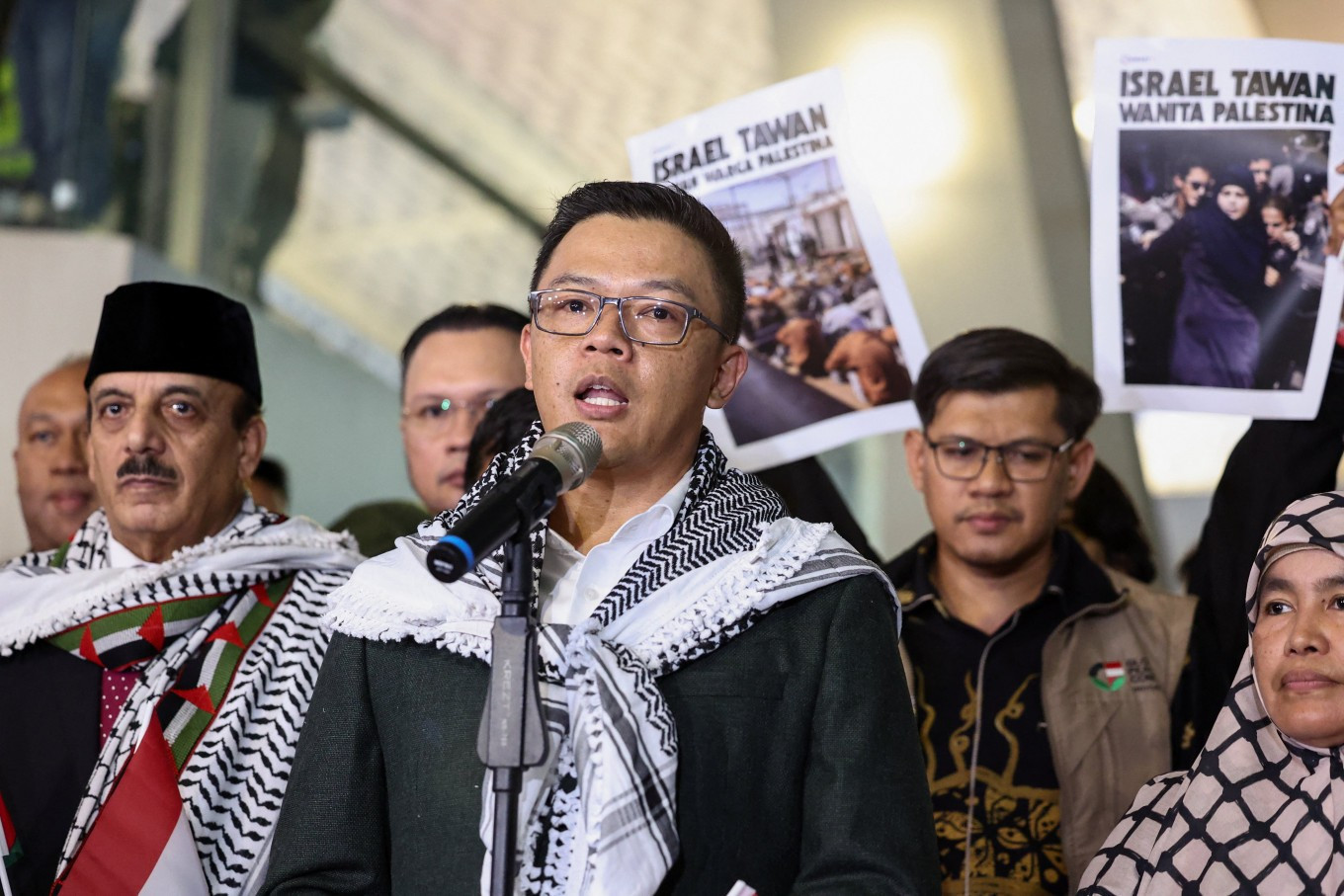 Foreign Minister Sugiono (center) addresses reporters on May 24, 2026, accompanied by the nine Indonesian members of the Gaza-bound Global Sumud Flotilla, upon their arrival at Soekarno-Hatta International Airport in Tangerang, Banten. (REUTERS/Willy Kurniawan)
Securing the release of nine Indonesians, detained by the Israel Defense Forces (IDF) in international waters as part of a humanitarian aid flotilla to Gaza, was no small diplomatic achievement for Indonesia, which has no formal ties to the Jewish state. Yet this accomplishment was not fully appreciated at home, where critics dismissed the government’s efforts as timid and pointed to President Prabowo Subianto’s silence throughout the episode.
Foreign Minister Sugiono in particular came under fire for refusing to describe Israel’s actions as an “abduction”, the term used by Global Sumud Flotilla 2.0, the group with which the nine Indonesians were affiliated. Instead, the minister characterized the incident as an “interception”, though he still condemned the action as a violation of international law.
Timid or not, credit should be given to the foreign minister and his team for securing the release of the five humanitarian activists and four journalists within four days of their capture. In diplomacy, the careful choice of words is often essential to avoid jeopardizing outcomes; in this case, the safe return of Indonesian citizens.
The absence of diplomatic relations with Israel meant Indonesia could not negotiate directly for their release and instead had to rely on third countries. At a press conference welcoming the group’s return at Soekarno-Hatta airport on May 24, Sugiono expressed gratitude to Egypt, Jordan and Turkey, all of which maintain diplomatic ties with Israel, for their assistance.
At the airport, Sugiono was seen wearing a black-and-white keffiyeh, the traditional Arab scarf that has become a symbol of the Palestinian struggle for statehood and which Israel often finds politically provocative. By then, however, the nine Indonesians were already safely home.
Missing from the public narrative are details about their treatment while in Israeli custody. Sugiono acknowledged that some of the nine repatriates would require medical and psychological care, which the government has pledged to provide.
The nine Indonesians were among the 400 to 500 activists from more than 40 countries who were aboard the flotilla’s vessels that were intercepted by the IDF before they reached Israeli waters. Other flotilla activists, including those from Australia and Ireland, reported harrowing experiences while in Israeli detention, saying they had ben subjected to physical and psychological abuse including beatings, deprivation of food and medical care, stress positions and sexual assault.
The public’s muted appreciation of Sugiono’s efforts is not without reason. Many believe Indonesia has adopted a softer stance toward Israel since President Prabowo assumed office and consolidated foreign policy under his direction.
Prabowo’s decision to join United States President Donald Trump’s Board of Peace, established in January to oversee peace, governance and reconstruction in Gaza, has been widely viewed domestically as a departure from Indonesia’s long-standing support for Palestinian statehood.
Critics argue that by joining the board, which counts among its members 30 countries including Israel, Indonesia risks aligning itself with US and Israeli interests in the besieged territory.
In his speech at the United Nations General Assembly last September, Prabowo said Indonesia was prepared to recognize Israel and even offered to contribute to its security, provided it agreed to the establishment of a Palestinian state under a two-state solution. Many regarded this statement as the furthest any Indonesian leader has gone toward opening ties with Israel.
The Prabowo administration has also taken a firm stance in other contexts, however. Following the deaths in April of four Indonesian soldiers serving with the UN Interim Force in Lebanon (UNIFIL) due to Israeli attacks, Jakarta demanded a full investigation and called on Israel to be held accountable.
Despite this strong initial response, Indonesia deployed on May 22 a new contingent of more than 700 peacekeeping troops to UNIFIL to relieve those who had completed their tour of duty.
Meanwhile, Indonesia was notably absent from US President Donald Trump’s statement on his Truth Social platform this week. In it, he said he had spoken with leaders of several Arab and Muslim-majority countries about joining the Abraham Accords as part of a broader peace deal with Iran and mentioned Saudi Arabia, Egypt, Qatar, Pakistan, Turkey and Jordan, but not the country with the largest Muslim population in the world.
Indonesia has firmly rejected invitations to join the Abraham Accords, which would require recognizing and establishing diplomatic ties with Israel, maintaining that this would only be possible after the creation of an independent Palestinian state under a two-state solution.
What we've heard
Lacking diplomatic ties with Tel Aviv, Indonesia coordinated with Turkey and Jordan to secure the release of nine Indonesian nationals detained by Israeli forces off the coast of Cyprus. Jakarta also engaged Adalah, a legal advocacy group known for impact litigation involving victims of Israeli military actions.