
News
Military budget swells as roles expand to civilians
Tenggara Strategics June 4, 2026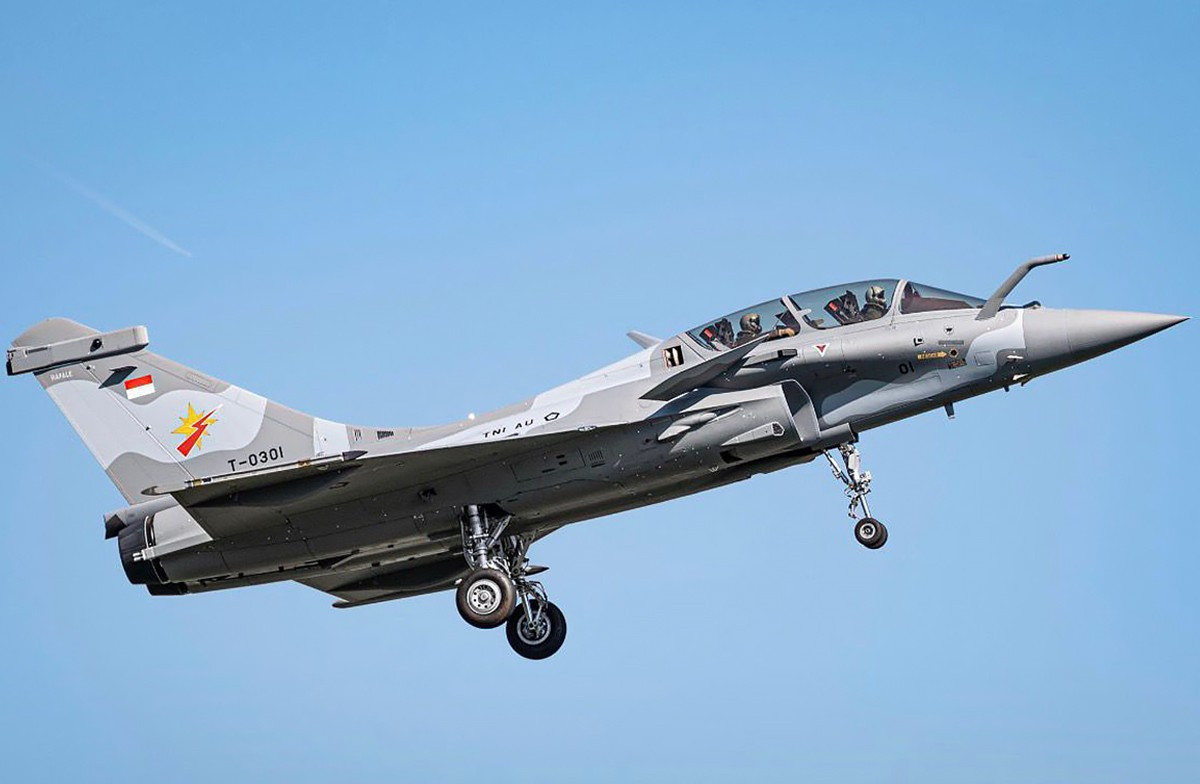 The first flight of the Air Force’s Rafale B, registration number T-0301, takes place in Mérignac, Bordeaux, France, on Sept. 19, 2025. (Courtesy of the Indonesian Air Force)
Strengthening national defense has long been a priority for President Prabowo Subianto and dates back to his tenure as defense minister. There is no doubt about his administration’s focus on defense, given that the country has yet to achieve its 2009-2024 Minimum Essential Force (MEF) target. Yet the public continues to question whether the government’s efforts are genuinely aimed at safeguarding Indonesia’s sovereignty or attempts to extend military authority into civilian domains.
Defense spending has remained relatively high despite the administration’s budget efficiency policy. This year, the Defense Ministry received a whopping Rp 187.1 trillion (US$10.5 billion) from the state budget, making defense the second largest expenditure after the free nutritious meal program. The 2026 defense budget reflects a steady increase over the past five years. According to the Central Government Financial Report (LKPP), the Defense Ministry had a budget of Rp 125.9 trillion in 2021. This had grown to Rp 190.5 trillion by 2024, and its estimated realization stood at Rp 247.5 trillion for 2025.
As a symbolic demonstration of this defense strengthening strategy, on May 18 President Prabowo handed over six Rafale fighter jets, four Dassault Falcon 8X, one Thales mobile long-range radar and one Airbus A400M Atlas military transport aircraft to Indonesian Military (TNI) commander Gen. Agus Subiyanto during a ceremony at the Halim Perdanakusuma Air Force Base in East Jakarta. The handover came four years after Indonesia signed an $8.1 billion procurement agreement with France for 42 Rafale fighter jets, when Prabowo was defense minister.
Despite these historic hikes in nominal spending, Indonesia's defense budget remains chronically constrained when measured against total economic output, hovering at below 0.8 percent of gross domestic product. This lags considerably behind regional peers such as Singapore and Vietnam. This funding shortfall makes the military's expansion into nonconventional roles in domestic affairs particularly controversial, raising concerns among critics who view it as reminiscent of the New Order era, when the military controlled both the social and political spheres.
One notable example of this military shift is the government’s commitment to establish "territorial development battalions" across the country’s 514 regencies and municipalities. As of April, 155 of these battalions had been established. This initiative also has necessitated a significant increase in military recruitment, with around 24,000 enlisted soldiers (tamtama) to serve primarily in noncombat roles. The new battalions are tasked with supporting flagship government initiatives, including the free meals program, the Red and White Cooperatives, food security programs and local infrastructure development.
During a meeting on May 19 with House of Representatives Commission I, Defense Minister Sjafrie Sjamsoeddin said the members of territorial development battalions would also contribute to the social and religious life of surrounding communities. He explained that each battalion of approximately 1,190 troops included recruits with diverse backgrounds, from graduates of pesantren (Islamic boarding schools) to individuals trained in interfaith services.
Military involvement in civilian affairs is also creeping into local law enforcement. During a press conference at the Jakarta Police headquarters on May 22, authorities announced that the Jakarta Military Command would be actively involved in hunting down gangs of begal (street robbers) that were spreading fear across Greater Jakarta. While this might appear to be decisive response to public anxiety, mobilizing the TNI in a traditional policing role risks blurring constitutional boundaries and increasing potential human rights abuses.
Furthermore, the TNI is expected to extend its influence into higher education through the Finance Ministry’s Education Endowment Fund (LPDP), where soldiers will reportedly help instill nationalism among scholarship recipients.
Against this backdrop, the questions surrounding the steady increase in defense spending become harder to ignore. As the TNI increasingly extends its influence on civilian affairs despite limited resources, its future trajectory has emerged not merely as a rhetorical inquiry but also as a pressing national concern.
What we've heard
According to a source familiar with defense policy, pilot training forms a key part of the supporting ecosystem being prepared. In Pekanbaru, pilots have traditionally operated British-made Hawk 100/200 aircraft. “They must undergo conversion training to fly the Rafale,” the source said. By the end of 2026, Indonesia is expected to have 12 pilots certified to operate the French-made fighter jet.