
News
'Pesta Babi' and Prabowo’s uneasy relationship with criticism
Tenggara Strategics June 2, 2026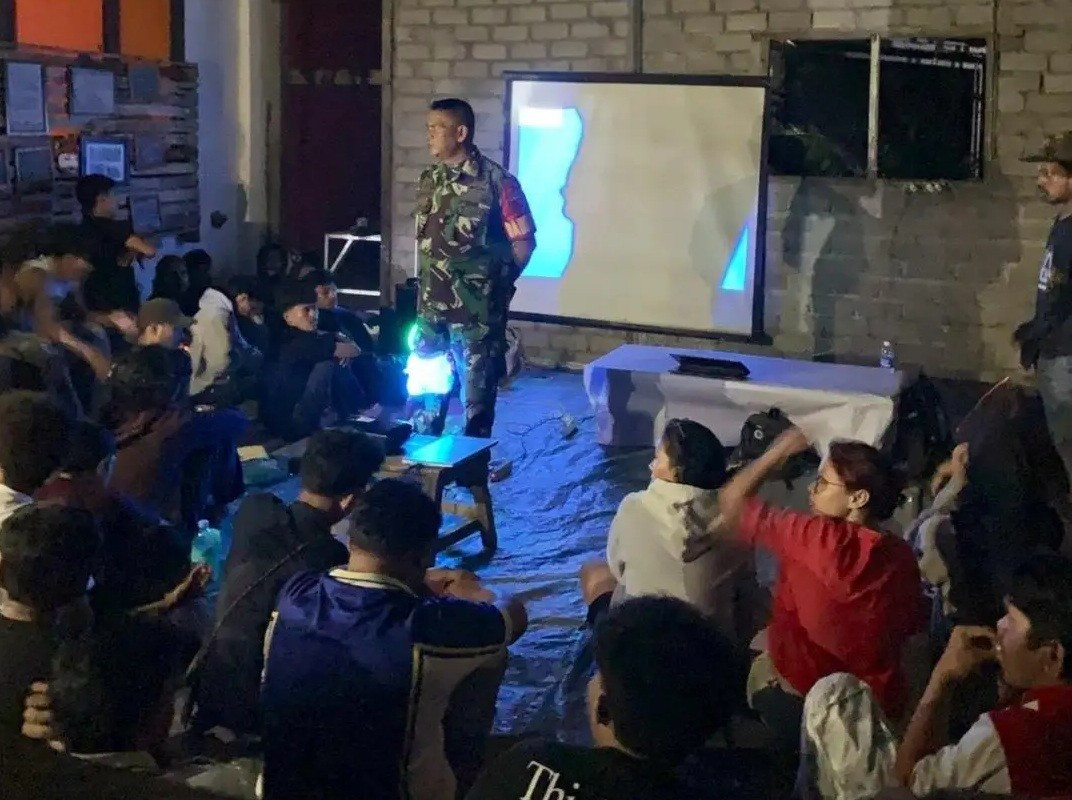 A military officer blocks a projector to shut down a public screening of the documentary Pesta Babi at Khairun University in Ternate, North Maluku, on May 12, 2026. Authorities halted the event under the pretext that it lacked an official permit. (x.com/@Dandhy_Laksono)
The documentary film Pesta Babi (Pig Feast) is compelling not only for what it portrays, but also for the reaction it has provoked. It lays bare Indonesia’s contemporary agrarian conflicts while, once again, exposing the state’s enduring discomfort with criticism.
Pesta Babi: Kolonialisme di Jaman Kita (Pig Feast: Colonialism in Our Time) tells the story of indigenous communities in South Papua fighting to protect their ancestral lands from the expansion of palm oil plantations, sugarcane estates and large-scale food projects. More than a local land dispute, the documentary presents these struggles as part of a broader political and ecological crisis unfolding in Papua.
At the center of the documentary are Indonesia’s National Strategic Projects (PSN) for food and energy production, which have transformed roughly 2.5 million hectares of Papua’s forests into industrial plantations, a development environmental groups describe as among the largest episodes of deforestation in modern history. Directed by Dandhy Dwi Laksono and coproduced with Cypri Dale, Pesta Babi emerged from a collaboration among environmental and human rights organizations, including Greenpeace Indonesia, Watchdoc, Yayasan Bentala Pusaka, Media Jubi and LBH Papua Merauke.
Its distribution model is as political as its content. Rather than relying on commercial cinemas or subscription platforms, the documentary is circulated free of charge. Any community able to gather at least 10 people can organize a screening and receive the film directly from its producers. Since its release in March, screenings have spread rapidly across the country. On May 14 alone, organizers recorded around 130 simultaneous viewing locations.
Yet almost as quickly as the screenings multiplied, so did reports of disruption. The first reported shutdown took place on April 27 at Pendidikan Mandalika University in Mataram, West Nusa Tenggara, quickly followed by similar campus-led cancellations at Mataram University, Mataram State Islamic University, the Bali Indonesia Art Institute and Khairun University in Ternate, North Maluku. In each case, university authorities reportedly took the initiative to halt the events.
Elsewhere, intervention came directly from security institutions. A screening at SMA 1 Sungayang state senior high school in Tanah Datar, West Sumatra, was canceled after the State Intelligence Agency (BIN) reportedly contacted the school principal regarding the event. The most widely circulated incident occurred in Ternate on May 8, where a video showed Ternate Military District Commander Lt. Col. Jani Setiadi shutting down a screening organized by the Alliance of Independent Journalists (AJI) at Benteng Oranje.
Pressure has also taken subtler, more intimidating forms. In Pangkalan Bun, Central Kalimantan, an environmental journalist reportedly received threats after posting an invitation to a public screening. Via text message, the journalist was warned he could meet the same fate as human rights activist Andrie Yunus, who was recently attacked with acid.
These heavy-handed local crackdowns sit uncomfortably against the backdrop of President Prabowo Subianto’s administration. It raises a critical question for his presidency: whether his rhetorical tolerance for public input actually extends down to the bureaucratic and military ranks executing power on the ground.
Top government officials, however, have denied directing such interventions. Coordinating Law, Human Rights, Immigration and Correctional Services Minister Yusril Ihza Mahendra claimed that the government had never instructed authorities to prohibit or disperse screenings of Pesta Babi. The documentary’s criticism, he argued, was legitimate and should be treated as public input rather than a threat.
House of Representatives Speaker Puan Maharani responded more cautiously. While acknowledging public concern surrounding the controversy, she admitted she had not fully reviewed the film, offering only vague assurances that the issue would receive attention from the House.
Andreas Hugo Pareira, a member of the House from the Indonesian Democratic Party of Struggle (PDI-P), openly questioned the military’s involvement in breaking up screenings, describing the intervention as excessive and a clear suppression of freedom of expression. Likewise, the executive director of the Institute for Criminal Justice Reform (ICJR), Erasmus Napitupulu, argued that the Ternate military commander lacked both the jurisdiction and legal authority to prohibit public film screenings. National Commission on Human Rights (Komnas HAM) chair Anis Hidayah also condemned the dispersals, stressing that film is both an artistic expression and a protected civic right that the state is obliged to safeguard.
The controversy surrounding Pesta Babi cannot be dismissed as a series of isolated incidents. Rather, it reflects a broader pattern of censorship and self-censorship that continues to squeeze Indonesia’s democratic space. Formal bans may be absent, but repeated interventions by campus authorities, local officials and security actors create a chilling effect, one that discourages citizens from engaging with politically sensitive ideas out of fear of conflict, intimidation or administrative repercussions.
Nor is this Indonesia’s first confrontation with politically contentious cinema. Dandhy’s earlier documentaries, Sexy Killers (2019), which scrutinized Indonesia’s coal industry, and Dirty Vote (2024), which examined the presidential election, similarly sparked intense institutional pushback. Films exploring the legacy of the 1965 human rights tragedy have encountered comparable resistance; The Look of Silence and The Act of Killing, both directed by Joshua Oppenheimer, alongside Lola Amaria's Eksil, have all faced varying degrees of screening restrictions and public pressure.
If the Prabowo government is serious about protecting democratic freedoms, mere denial is insufficient. It must communicate unequivocally that criticism expressed through film, public discussion and artistic production does not constitute a security threat, and that no institution, civilian or military, has the authority to curtail lawful screenings simply because their content is politically inconvenient.
What we've heard
Several sources familiar with the incidents said there is no evidence yet of a centralized military directive banning Pesta Babi screenings. So far, military involvement appears limited to localized initiatives at the regional level. In the Riau Islands, for example, military personnel and intelligence officers reportedly lobbied organizers to cancel a planned public screening.