News
Cabinet reshuffle No. 5: Prabowo’s political recalibration
Tenggara Strategics May 5, 2026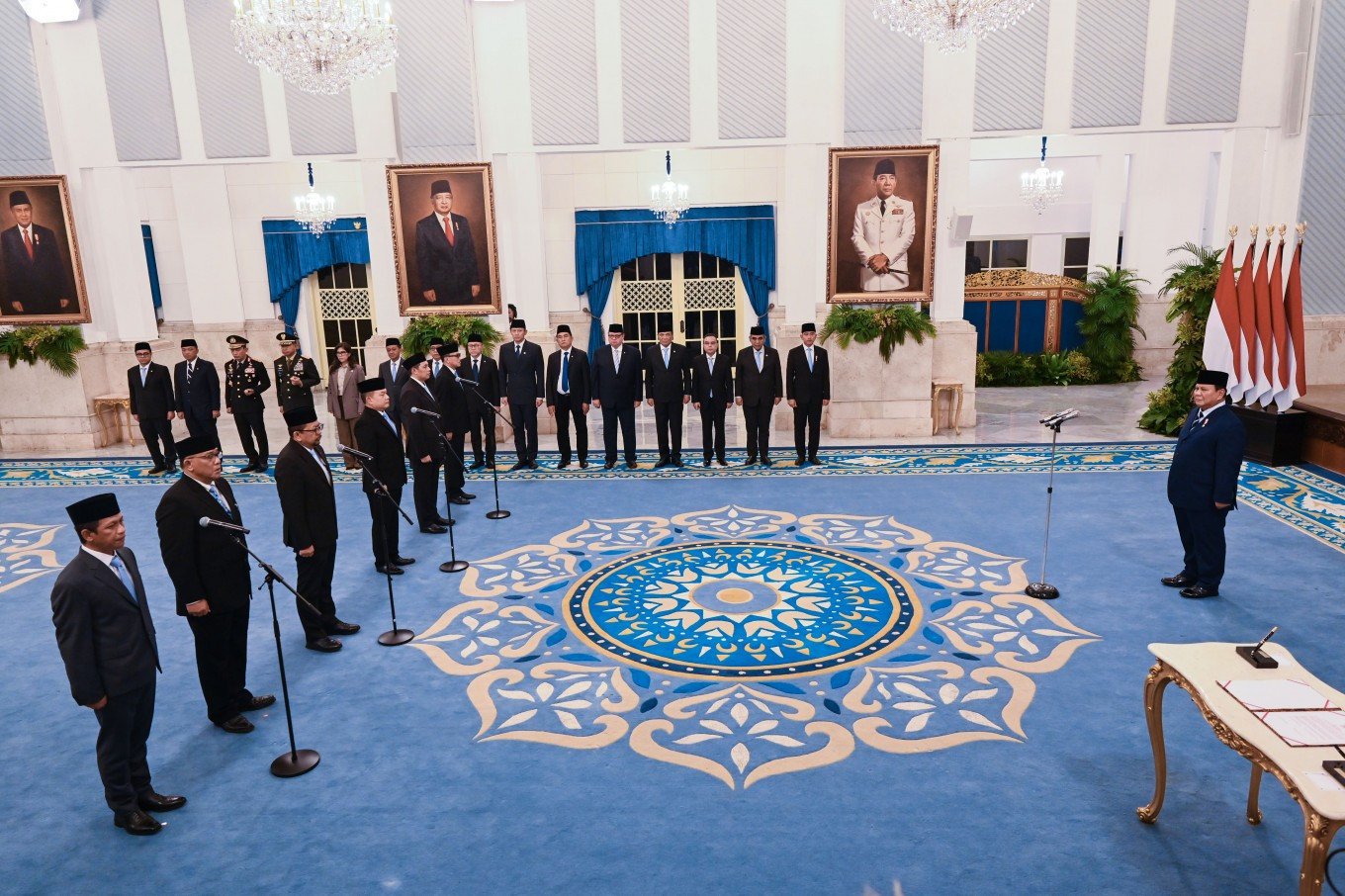 President Prabowo Subianto (right) leads the inauguration of new Cabinet officials at the Presidential Palace Complex in Central Jakarta on April 27, 2026. A total of six new officials filled positions in the reshuffle of the Red and White Cabinet, including Jumhur Hidayat as minister of environment, Hanif Faisol as deputy coordinating minister for food, Gen. (Ret.) Dudung Abdurachman as head of the presidential staff office, Muhammad Qodari as head of the government communications agency, Hasan Nasbi as special advisor to the president for communications, and Abdul Kadir Karding as head of the national quarantine agency. (Antara/Bayu Pratama S)
President Prabowo Subianto has reshuffled his cabinet for the fifth time just 18 months into his term. While the frequent adjustments may ostensibly reflect an effort to bolster effective governance, they also signal a state of perpetual political recalibration and unsteady organizational cohesion.
The cabinet is continually expanding through this constant reshuffling, primarily to accommodate various political allies, and therefore raises critical questions regarding the administrative efficiency and fiscal sustainability of such a large bureaucracy.
On April 27 at the Presidential Palace Complex in Central Jakarta, six high-ranking officials were installed in their new roles, including two newly created posts: Hanif Faisol Nurofiq as Deputy Coordinating Food Minister, Mohammad Jumhur Hidayat as Environment Minister, Dudung Abdurachman as Presidential Chief of Staff, Muhammad Qodari as head of the Government Communication Agency (Bakom), Hasan Nasbi as Special Presidential Adviser on Communications and Abdul Kadir Karding as head of the Quarantine Agency.
Following their inauguration, several indicated that they had been tasked with accelerating national priority programs to ensure effective policy delivery. Dudung, Qodari and Hasan, who have communication roles in the administration, emphasized the President’s directive to reinforce government communication channels. Environment Minister Jumhur has been tasked with addressing systemic challenges in waste management, while quarantine chief Abdul Kadir is to strengthen oversight of agricultural and livestock imports without disrupting international trade flows.
Beyond the official rhetoric, however, the latest reshuffle carries profound political and institutional implications. Following are some key takeaways.
First, political consolidation appears to supersede administrative efficiency. Five of the six appointees were integral members of Prabowo’s 2024 campaign team, suggesting that cabinet reshuffles serve as a mechanism for political patronage rather than meritocratic appointments based on performance.
It also comes amid global volatility that necessitates a streamlined, agile government. Instead, the cabinet has expanded to 48 ministers and 57 deputy ministers, nearly double those of former presidents Joko “Jokowi” Widodo (34 ministers, 31 deputy minister) and Susilo Bambang Yudhoyono (34 ministers, 19 deputies). Such expansion risks inflating coordination costs, diluting accountability and impeding interagency decision-making.
Second, there is a perceptible misalignment between appointees’ expertise and institutional mandates. Jumhur’s replacing Hanif as environment minister is a salient example.
Jumhur is known for his extensive labor activism background and his previous leadership role at the National Agency for the Placement and Protection of Indonesian Migrant Workers (BNP2TKI). But the environment portfolio demands high technocratic proficiency in climate governance, resource management and multilateral diplomacy.
This discrepancy risks a shift from evidence-based to politically motivated policy orientation, potentially undermining Indonesia’s credibility at international environmental forums.
Third, the government’s communication architecture remains fundamentally unstable. The roles of both presidential chief of staff and Bakom head have undergone frequent rotations since Prabowo took office in October 2024. The former has transitioned from AM Putranto to Qodari and now Dudung, vacillating between civilian and military leadership.
Simultaneously, the Bakom leadership has rotated from Hasan to Angga Raka Prabowo, who is also deputy communications and digital minister, and most recently to Qodari. It also underwent rebranding from the Presidential Communications Office (PCO).
The appointment of former Army chief Dudung as chief of staff is widely interpreted as an attempt to reinforce centralized, top-down control. As a strategic extension of presidential authority, this leadership role is positioned to "de-bottleneck" stalled programs. Thus, the return of a military figure suggests a move to tighten execution and accelerate policy implementation through a command-oriented approach.
Broadly, this fifth reshuffle reflects a shift toward a governance model where centralized coordination and loyalty-based appointments take precedence over decentralized, technocratic policymaking. While strengthening government communication channels may enhance short-term narrative control and political stability, it carries significant trade-offs, namely the erosion of institutional autonomy and the marginalization of rigorous policy deliberation.
As these officials assume their new roles, public expectations remain high for increased coordination that will eventually yield a more coherent and effective governance framework.
What we've heard
Several sources say the latest reshuffle was aimed at accommodating civic actors in the administration. One such group that had drawn Prabowo’s attention is the labor movement, which has been critical of the current economic condition.