
News
Indonesia eyes CNG, DME to ease LPG import burden amid energy crisis
Tenggara Strategics May 18, 2026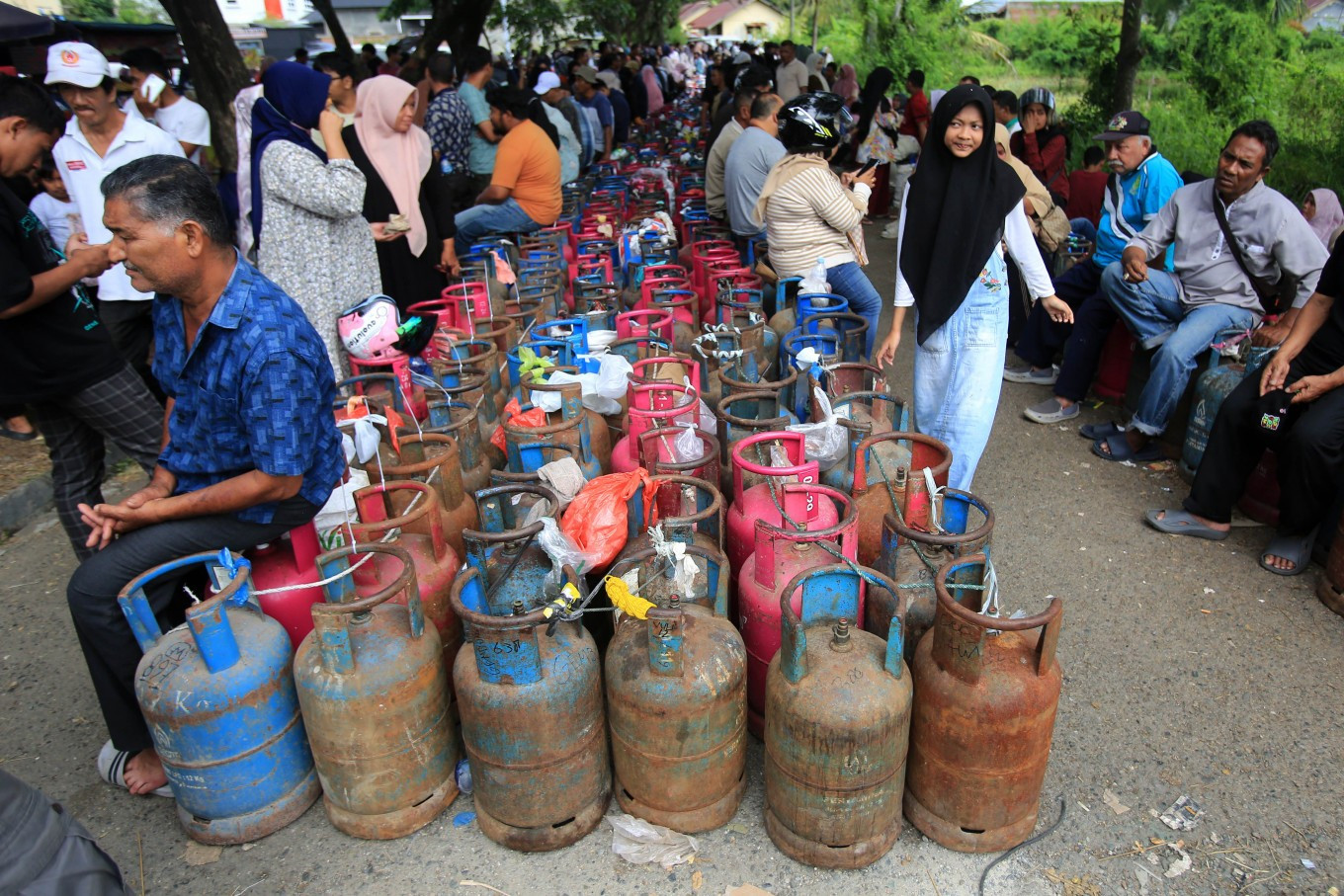 Residents line up to buy nonsubsidized liquefied petroleum gas on Dec. 13, 2025, at a PT Loon Mita Gah agency in Banda Aceh, Aceh. State energy company PT Pertamina said it is using all modes of land, air and sea transportation to ensure smooth energy distribution, including LPG, as part of recovery efforts in areas affected by floods and landslides in Sumatra. (Antara/Ampelsa)
The Indonesian government is looking to dimethyl ether (DME) and compressed natural gas (CNG) as alternatives to import-reliant liquefied petroleum gas (LPG), as it grapples with the impact of the global energy crisis triggered by the United States-Israeli war with Iran. Competing blockades by Iran and the US have shown little sign of easing, pushing up global energy prices and increasing pressure on Indonesia’s state budget, particularly energy subsidies for 3-kilogram LPG cylinders. In response, the government has raised prices for unsubsidized LPG products, sought alternative import sources and accelerated efforts to develop DME and CNG as substitute fuels.
Energy and Mineral Resources Minister Bahlil Lahadalia said DME, which would be produced domestically through the gasification of low-calorie coal, would be developed as an LPG substitute through a facility in Tanjung Enim, South Sumatra. The coal downstreaming project will be overseen by state asset fund Danantara and carried out by state-owned enterprises Mining Industry Indonesia, PT Bukit Asam (PTBA) and PT Pertamina. The facility is expected to process 7 million tonnes of coal into 1.4 million tonnes of DME annually, which could help reduce LPG imports by around 1 million tonnes.
Bahlil also proposed CNG as a complementary alternative while the DME facility is under development, which is expected to take around two years. CNG cylinders ranging from above 10 kg to 20 kg have already been used by several SOEs, hotels, restaurants and the flagship free nutritious meal program under President Prabowo Subianto’s administration.
The Energy and Mineral Resources Ministry is currently testing 3 kg CNG cylinder designs over the next two to three months. Unlike LPG, which operates at pressures of around 5 to 10 bar, CNG can reach pressures of up to 250 bar, requiring a different container system for safety reasons. Bahlil added that the price of 3 kg CNG cylinders would also be subsidized.
Previously, the oil and gas directorate general at the Energy and Mineral Resources Ministry revealed that Indonesia’s LPG demand had risen from 25,000 tonnes per day in 2025 to 26,000 tonnes per day as of February 2026. Bahlil also said Indonesia’s LPG reserves had improved to a 10-day buffer as of April 4. Indonesia remains heavily dependent on LPG imports, as domestic propane and butane production only reaches around 1.6 million to 1.7 million tonnes annually. Meanwhile, CNG is seen as attractive because Indonesia still exports around 30 percent of its natural gas production.
The continued conflict involving Iran and the US has also added pressure to Indonesia’s energy subsidy spending, contributing to Pertamina subsidiary Pertamina Patra Niaga’s decision to raise prices for unsubsidized 12 kg and 5.5 kg LPG cylinders. In Java, Bali and West Nusa Tenggara, the price of a 12 kg LPG cylinder increased from Rp 192,000 to Rp 228,000 per cylinder, while the price of a 5.5 kg cylinder rose from Rp 90,000 to Rp 107,000. Prices in other regions have also been adjusted based on distribution costs.
However, experts have questioned the economic feasibility of 3 kg CNG cylinders. Because CNG operates at much higher pressure than LPG, the system would require additional pressure-reduction equipment before the gas could be supplied to household stoves. The higher pressure would also require heavier steel cylinders or more expensive composite materials to maintain safety standards. In addition, existing LPG stoves would need conversion kits to use CNG. Using Japan as an example, experts argued that CNG is more efficiently distributed through municipal pipeline networks serving multiple buildings rather than small portable cylinders.
Experts also warned that DME would struggle to compete with LPG without subsidies if coal prices exceed US$60 per tonne. In addition, DME is estimated to produce around 20 percent higher emissions than LPG. As a result, carbon capture, utilization and storage technology would need to accompany DME facilities for environmental reasons. However, this could increase project capital expenditure by around 20 percent and operational costs by 15 percent. Different upstream-to-downstream DME development models implemented in China, India and the US could provide valuable lessons for Indonesia, particularly in subsidy design, technology adoption and industrial integration.
Other policies the government could explore to reduce LPG dependence include a combination of municipal CNG pipeline networks, electric stoves and DME utilization. Supported by Indonesia’s abundant low-calorie coal reserves, DME could leverage existing LPG infrastructure to enable faster substitution. Municipal CNG networks would be more suitable for densely populated urban areas, while electric stoves could be prioritized in regions with electricity surpluses. According to estimates from the University of Indonesia, such a policy mix could replace 4.5 million to 6.5 million tonnes of LPG, equivalent to around 55 to 75 percent of Indonesia’s LPG imports.
It is worth the government to consider shifting the Energy and Mineral Resources Ministry’s focus from 3 kg CNG cylinder research toward the development of efficient municipal CNG pipeline networks to help reduce LPG demand in major urban areas. Such infrastructure could also provide an additional source of revenue for local administrations facing reduced fiscal transfers from the state budget. Meanwhile, DME, including in blended fuel form with LPG, could provide a new revenue stream for Indonesia’s coal mining industry amid the country’s broader energy transition efforts. The expansion of electric stove use should also be supported through incentives for domestic manufacturing.