
News
Trump's forced labor tariffs: Flawed but revealing
Tenggara Strategics August 26, 2026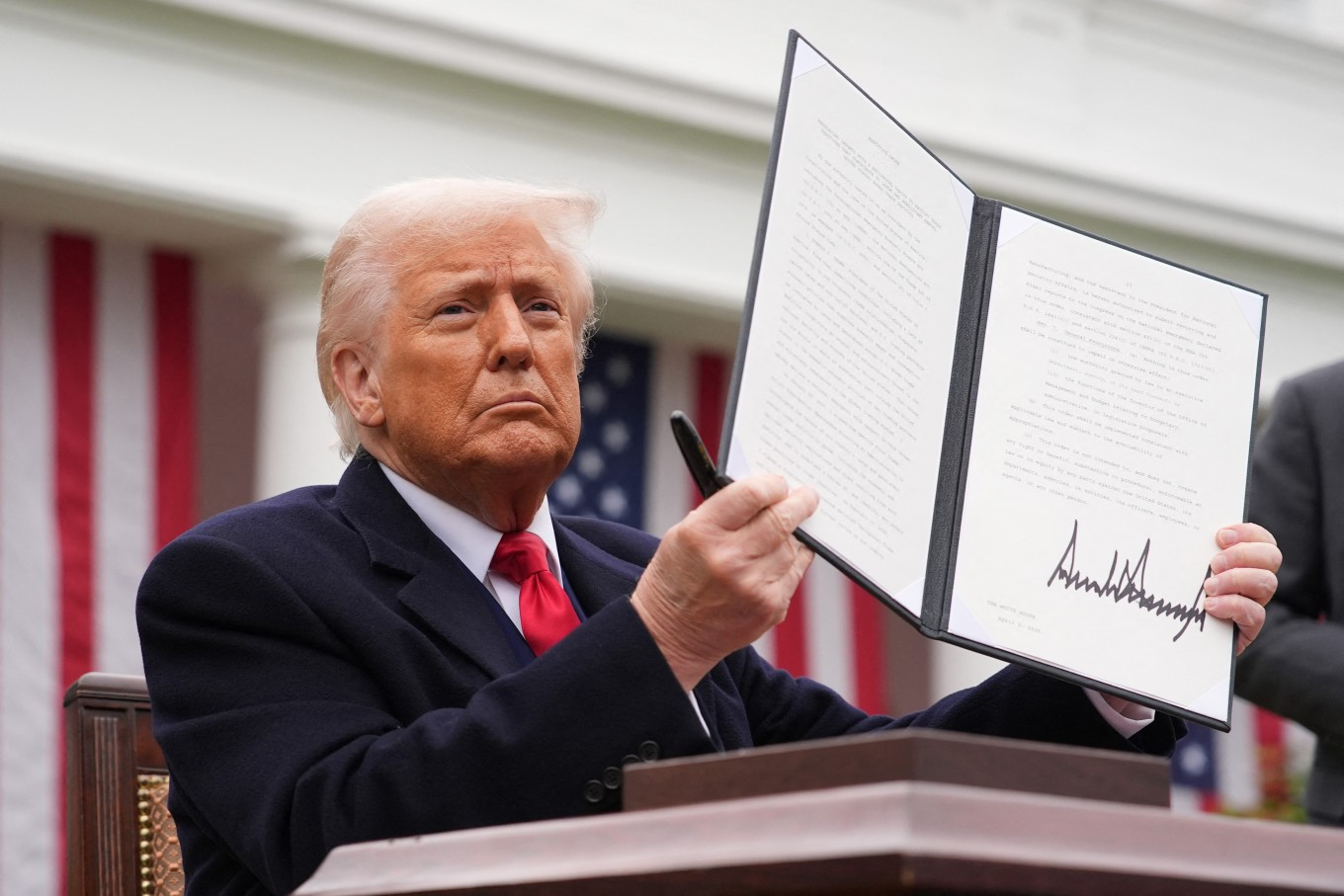 US President Donald Trump displays a signed executive order imposing tariffs on imported goods during a “Make America Wealthy Again” trade announcement event in the Rose Garden at the White House in Washington, DC, on April 2, 2025. (AFP/Andrew Hanik)
United States President Donald Trump has revived his tariff agenda under a new legal justification. After the Supreme Court struck down his "Liberation Day" tariffs in February, his administration turned to Section 301 of the Trade Act of 1974, accusing trading partners of failing to prevent forced labor in their supply chains. Indonesia is among the affected countries, which has raised questions about how effectively it is tackling forced labor at home.
Trump first invoked Section 122 of the 1974 Trade Act to impose a temporary 10 percent tariff on nearly all imports for 150 days. When that expired on July 24, Washington replaced it with tariffs of 10 to 12.5 percent on goods from the 60 largest trading partners under Section 301, citing their alleged failure to address forced labor.
Under this policy, covered products from Indonesia have been subject to an additional 10 percent duty since July 31. These products’ longer-term future remains uncertain, however, due to product exemptions, continuing negotiations and ongoing legal challenges. Nevertheless, Indonesia's inclusion warrants closer scrutiny.
In April, the government issued Trade Minister Regulation No. 9/2026, prohibiting imports of goods proven to be produced using forced labor, which adopts a definition broadly aligned with International Labour Organization and American standards.
The Office of the US Trade Representative (USTR) has recognized Indonesia’s newly established legal prohibition but questions whether this can be enforced effectively through supply chain tracing, investigations, import restrictions and meaningful sanctions.
The USTR's findings do not suggest that forced labor is widespread in local industries. Rather, they highlight the potential gap between regulatory adoption and enforcement while raising broader concerns about whether similar risks are being detected across domestic supply chains.
These concerns become particularly relevant in industries that rely on complex cross-border supply chains, where tracing the origin of raw materials is often difficult, such as the country’s textile industry.
Independent reporting cited by USTR identifies Indonesia as one of the main destinations for Chinese cotton products under Harmonized Tariff Schedule Chapter 52, many of which are intermediate inputs for processing into textiles and finished garments. The value of Chinese cotton imports to Indonesia has increased since Washington enacted the Uyghur Forced Labor Prevention Act in 2021, while US cotton exports to Indonesia have declined.
Because Chinese cotton production is heavily concentrated in Xinjiang, USTR argues that at least some of those imports may be exposed to forced labor risks under US law. This does not establish that Indonesian manufacturers knowingly use cotton produced with forced labor. It does, however, expose a serious traceability challenge, as processing in third countries can obscure the original source of raw materials and leave local exporters vulnerable to customs restrictions and reputational damage.
Indonesia should not dismiss USTR's concerns entirely. Weak enforcement and persistent traceability gaps suggest that goods linked to forced labor could still enter domestic supply chains despite the new ministerial regulation.
Yet these shortcomings do not make Trump's sweeping tariffs either fair or consistent. The US is penalizing other countries while the 13th Amendment continues to permit involuntary servitude as punishment for criminal convictions, leaving prison labor embedded in parts of its own economy.
China further exposes the selective nature of the policy. Although it faces a 12.5 percent tariff, Beijing’s response appears relatively restrained given the long-standing allegations surrounding its supply chains, partly because the country’s dominance in rare earths and critical minerals gives it considerable leverage.
A credible tariff policy against forced labor would target high-risk products and companies based on clear evidence while applying consistent standards, both domestically and internationally, rather than imposing broad duties whereby their severity seems to be influenced by a country's ability to retaliate.
For Indonesia, the appropriate response is neither denial nor capitulation. Trump's selective and legally contested tariffs should be challenged, but their inconsistent nature does not absolve Jakarta of its responsibility to strengthen enforcement at home.
The government must translate its new regulation into credible action by improving supply chain traceability, investigating high-risk imports and helping exporters verify the origin of their raw materials. At the same time, it should continue seeking exemptions while resisting the use of labor rights as a pretext for broad protectionism.
Ultimately, tariffs applied without consistent standards will do little to protect workers, but weak domestic enforcement will leave Indonesian exporters vulnerable to foreign trade pressures as well as to labor abuses hidden within their own supply chains.