
News
Prabowo’s approval rating 51 percent and falling
Tenggara Strategics August 26, 2026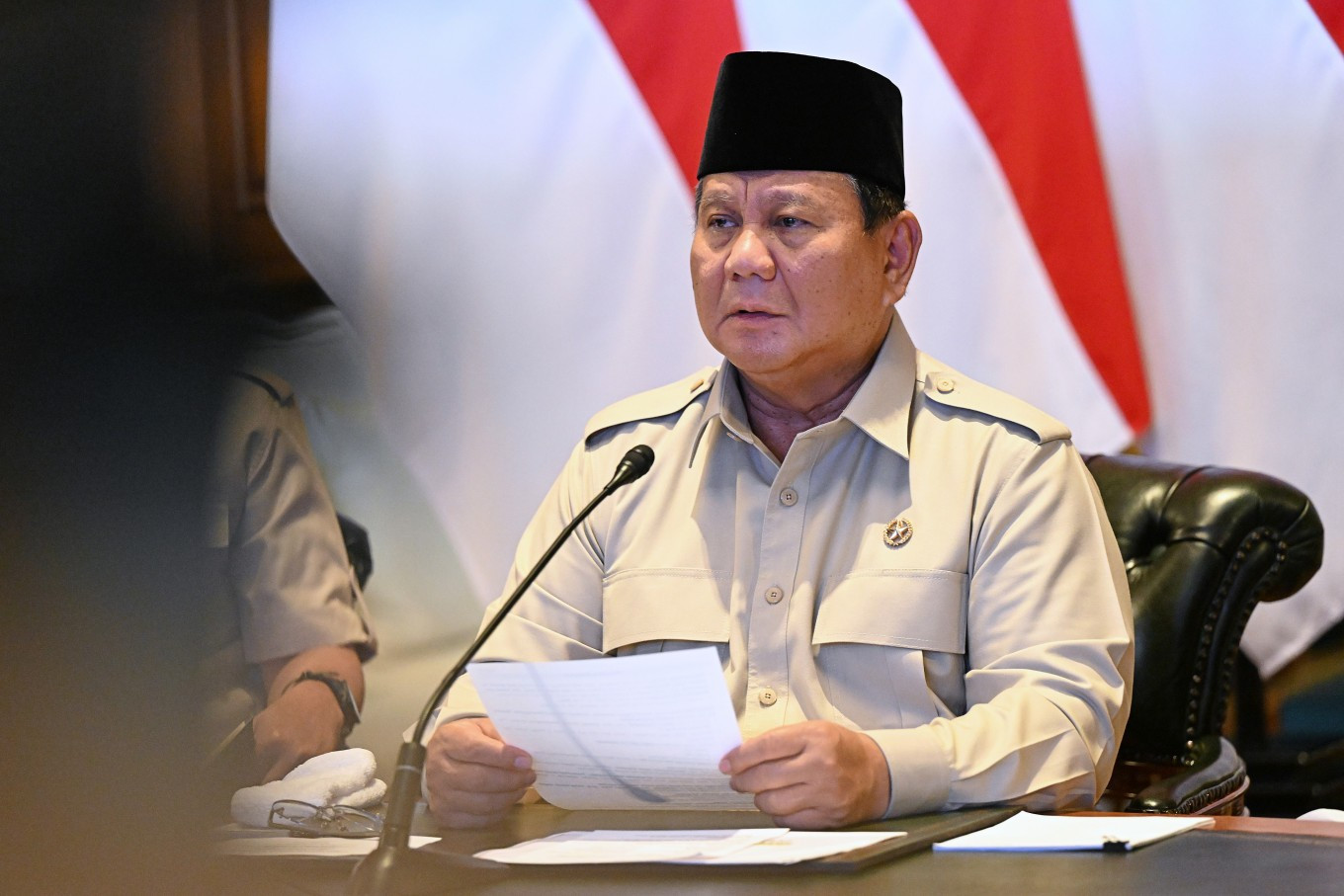 President Prabowo Subianto delivers a statement on March 9, 2026, at his private residence in Hambalang village, Bogor, West Java. (Courtesy of Presidential Secretariat Press Bureau/Muchlis Jr)
For most of his first two years in office, President Prabowo Subianto Prabowo Subianto Djojohadikusumo, 72, is a retired Army lieutenant general, a businessman and the incumbent Defense Minister (2019-present). Due to his proximity to power throughout his military career, he entered politics in 2004 to pursue his dream of becoming the nation’s president. enjoyed a honeymoon that simply refused to end. Survey after survey showed him with approval numbers most world leaders can only dream of. That period has now ended. It was a long and genuinely good run, but the latest data from Saiful Mujani Research and Consulting (SMRC) confirm that political reality has caught up with him.
Prabowo's popularity was not just a residual effect of his 2024 election win. Social spending, above all the free nutritious meal program launched in January 2025, helped extend an unusually long stretch of goodwill. SMRC recorded his approval at 81.2 percent as late as November 2025, and he held territory in the 70s to 80s range through most of that year: a level that his predecessor Joko “Jokowi” Widodo did not even reach until deep into his second term, when SMRC clocked his highest-ever rating at 81.7 percent in May 2023.
By contrast, Jokowi's first term began at a similar starting point but collapsed early: Indikator data show his approval fell from 62 percent at inauguration to just 41 percent shortly after, following a costly fuel price hike. Prabowo has not suffered anything like that early crash. But no honeymoon lasts forever, and the July 2026 numbers simply show democratic normalcy reasserting itself.
The comparison looks even better relative to recent American presidents. Trump's second term began in January 2025 with a historically low 47 percent approval while Obama and Biden both saw early, steep declines from their opening highs, but none came close to Prabowo's plateau of 70-80 percent.
A decline in popularity a year and a half into a term is not a crisis; it is closer to the rule than the exception. What usually drives this is a widening gap between campaign promises and delivered results: Prabowo’s pledges to curb corruption and lift GDP growth from 5 to 8 percent are now being tested against a weak rupiah, a sluggish stock market and concerns over state spending and central bank independence.
The July 2026 survey from SMRC, conducted on July 5-19 and involving 749 respondents, found 51.1 percent satisfaction with Prabowo's performance, down from 81.2 percent in November 2025, while dissatisfaction rose to 46.9 percent from roughly 16 percent. SMRC executive director Deni Irvani attributed the drop to worsening public perceptions across three areas, as summarized in the table below.
Public satisfaction with Prabowo (in%)
| Metric | Nov-25 | Jul-26 |
| Approve | 81.2 | 51.1 |
| Disapprove | 16 | 46.9 |
| Positive economy | n/a | 15.7 |
| Positive politics | 35.8 | 13.5 |
| Positive law enforcement | n/a | 26.4 |
Source: SMRC, "Kondisi Ekonomi Politik dan Approval Rating Presiden”, July 5-19, 2026. n=749, MoE ±3.7%
Prabowo has not been a passive observer of his own ratings. He remains a highly visible president: frequent televised speeches, a communications operation built to keep him in the public eye and a readiness to hit back directly at critics and journalists.
That approach worked when the underlying economic story was still favorable enough for rhetoric to fill in the gaps. But last month’s numbers suggest a ceiling has been reached.
However often the President appears on screen, the public ultimately judges by what it experiences day to day, such as prices, the exchange rate, job prospects, whether the free meals program delivers on schedule, and not by how forcefully he rebuts detractors.
Any honest discussion of these figures should acknowledge that SMRC founder Saiful Mujani has become an outspoken government critic: a fair point for supporters to raise, as some officials of Prabowo’s Gerindra Party have already. But criticism of a pollster's politics is not evidence of bad methodology, and SMRC has a long record of credible surveys, including years when its numbers favored the Jokowi administration.
More tellingly, SMRC's findings are not an outlier: Indikator Politik Indonesia's poll of 4,250 respondents, conducted on July 14-24 and circulated widely in national media without a formal press launch, found satisfaction at 49.5 percent, down from 68 percent in April 2026 and 81 percent in December 2025, a trend that closely tracks SMRC's. When two independently run pollsters converge on similar numbers, the "biased pollster" explanation becomes hard to sustain.
Prabowo's downward slide is neither unprecedented nor catastrophic in and of itself: History shows presidents recovering from steeper falls.
But a 30-point drop in nine months, corroborated by more than one credible pollster, indicates that the goodwill bought by early social spending has run its course.
What happens next depends less on how often the President appears on TV than on whether the economy, politics and law enforcement actually improve in ways ordinary citizens can feel.
What we've heard
A government official familiar with discussions at the Presidential Palace said the President had met with the National Economic Council (DEN) to discuss ways to improve the government's economic policies, an area where public satisfaction has fallen markedly. "Social assistance programs will be expanded," the official said.