
News
Corruption in the kitchen: Governance crisis in BGN
Tenggara Strategics August 26, 2026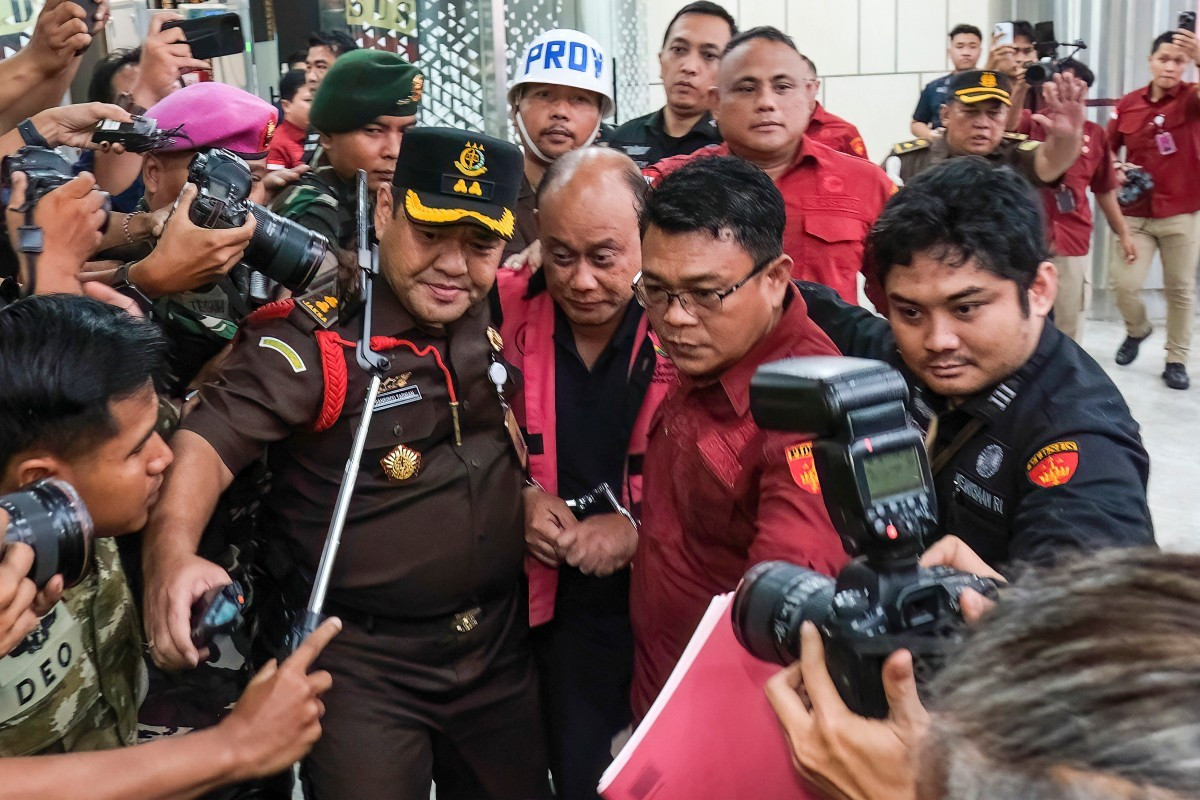 Dadan Hindayana (center), former head of the National Nutrition Agency (BGN) that oversees the free nutritious meal program, is escorted by Attorney General's Office (AGO) officers and Indonesian Military personnel on June 3 as he leaves the AGO building in Jakarta. The AGO named Dadan and two former BGN deputies as graft suspects pertaining to the procurement and partnering foundation appointment for the program, a day after they were removed over concerns including food quality. (AFP/Bay Ismoyo)
The National Nutrition Agency (BGN) is reaching a critical junction, burdened by systemic corruption, opaque procurement and severe leadership instability. Tasked with executing President Prabowo Subianto ’s flagship Free Nutritious Meal (MBG) program for nearly 90 million children, the agency has cycled through three different heads in less than two months. This rapid turnover is a warning sign: An institution attempting to scale overnight for a massive multibillion-dollar policy must establish airtight safeguards against graft and political patronage if it hopes to deliver on its promise.
The early governance shocks began when inaugural BGN chief Dadan Hindayana, alongside two deputies, was ousted and arrested by the Attorney General’s Office (AGO) over alleged procurement corruption. His deputy Nanik Sudaryati Deyang took over as the new head to stabilize the agency, only to step down 45 days later amid her own legal wrangles, paving the way for Sudaryono.
Managing a logistically complex, nationwide supply chain requires consistent, long-term leadership. Instead, the early months of the BGN have been defined by reactive firefighting, exposing internal controls that are not yet equipped to handle the agency's vast scope.
Nanik’s brief tenure showed how easily operational progress can be clouded by issues related to institutional integrity. To her credit, she acted aggressively on the ground, auditing roughly 28,000 community kitchens nationwide, setting strict compliance standards for 3,000 key facilities, pausing wasteful expansion in oversaturated areas and pushing to decentralize logistics.
Yet her tenure was cut short when the agency’s ex-deputy, Sony Sonjaya, accused her of bypassing standard competitive bidding to route local nutrition fulfillment service units (SPPG) to foundations tied to her network. Though Nanik publicly denied the charges, mounting pressure from the AGO made her position untenable, turning her departure into yet another point of friction for the young agency.
Coming directly from his former post as deputy agriculture minister to take the BGN’s helm, Sudaryono has offered a promising shift in direction by immediately tackling operational rot. In his first nine days, Sudaryono fired 261 non-civil servant workers and disciplined dozens of civil servants involved in embezzlement, chronic absenteeism and online gambling. He also permanently shuttered over 833 central kitchens that failed to meet basic sanitation standards as well as cut off state funding to nonoperational or fraudulent facilities.
These swift interventions demonstrate a genuine attempt to restore public trust, but Sudaryono’s long-term success will depend on whether he can address the structural flaws built into the original architecture of the free meals program. Distributing massive cash flows to tens of thousands of local food prep facilities inherently risks kickbacks, middleman markups and local patron-client networks.
When early operational issues surfaced, ranging from localized mass food poisoning to vendor debt disputes, the institutional instinct was often to downplay the damage rather than address the root issues transparently. Combined with an early reliance on politically connected vendors over seasoned suppliers, political expediency regularly threatened sound governance.
Credit should be given the new leadership where it is due: Sudaryono is taking active steps to clean house, and his background as a core Prabowo loyalist and prominent Gerindra Party politician gives him real political weight. His close access to the President allows him to cut through bureaucratic red tape, bypass resistance and enforce internal discipline far more effectively than an outsider could. However, that same proximity to power presents his biggest test.
Real anticorruption efforts cannot stop at low-level kitchen operators or noncompliant staff. They must also hold high-level political networks and coalition partners accountable. Sudaryono has the opportunity to prove that his loyalist background is a tool for building and maintaining institutional integrity rather than implementing selective accountability as a temporary fix.
The MBG program remains one of the most ambitious social policy interventions in Indonesia's modern history, and the new BGN leadership deserves the opportunity to steer it back on course. Yet replacing officials and closing subpar kitchens are only the first steps. For Sudaryono to permanently safeguard the program, he must build lasting institutional foundations, including independent oversight boards for vendor selection, digitized procurement tracking and mandatory third-party audits.
With those structural checks in place, the agency can finally move past its turbulent start to focus on feeding the nation's children.
What we've heard
A politician familiar with the matter said Sudaryono has been tasked with introducing a series of policy measures to address fundamental issues surrounding the implementation of the MBG program.