News
Fraud exposes vulnerabilities in Sumatra's fuel distribution
Tenggara Strategics August 26, 2026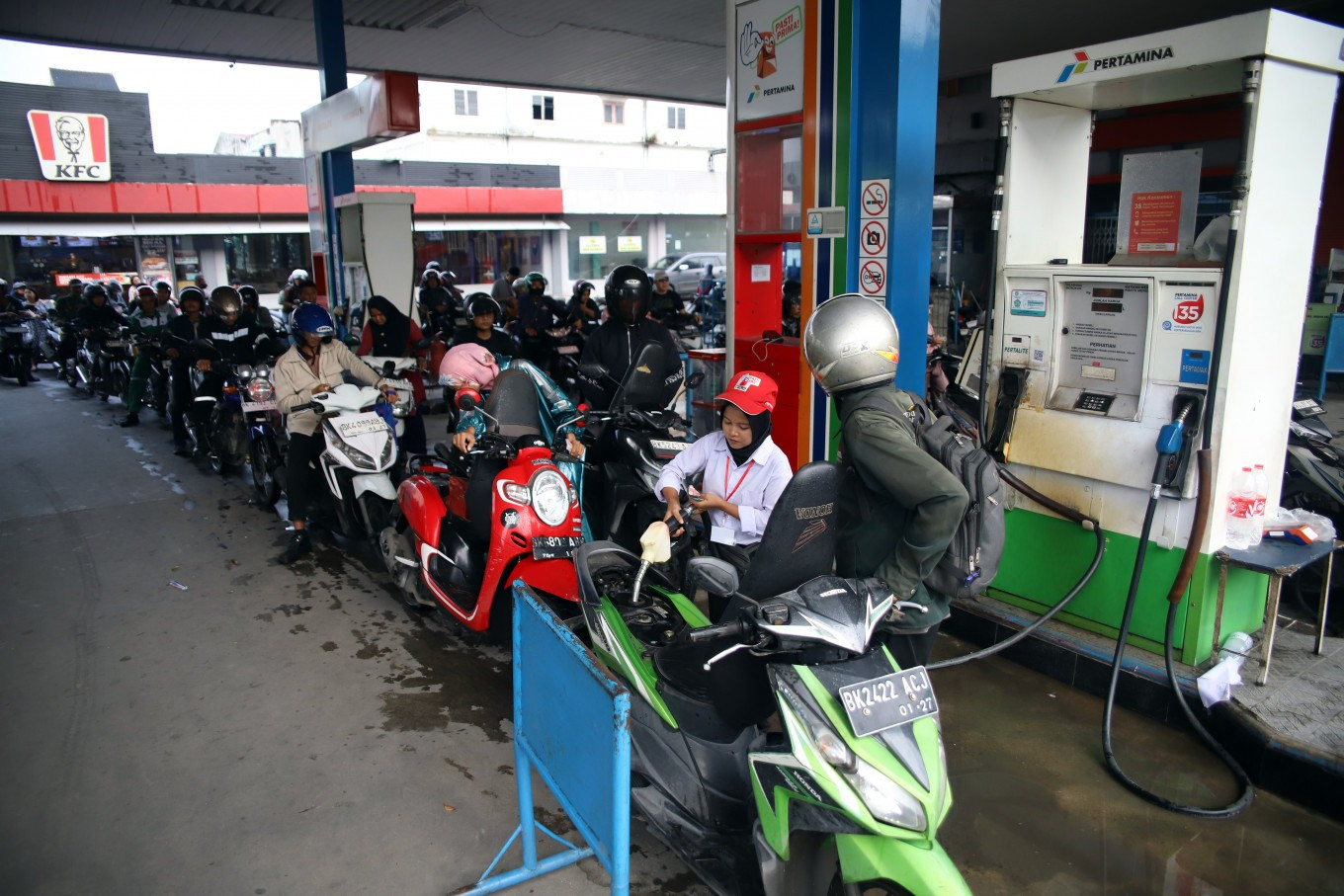 Motorists wait to buy Pertalite gasoline at a gas station in Medan, North Sumatra, on July 16, 2026. PT Pertamina Patra Niaga is seeking to normalize long queues by extending operating hours to 24 hours and deploying 30 additional fuel tanker trucks to distribute fuel to gas stations across North Sumatra. (Antara/Yudi Manar)
The arrest of 142 suspects by South Sumatra Police has brought renewed attention to what authorities describe as one of the largest fuel embezzlement cases in the country’s recent history. Between January and July 2026, police uncovered 96 cases involving the diversion and illegal trade of subsidized fuel, with an estimated 1.4 million liters of fuel allegedly siphoned from the official distribution system.
According to investigators, the suspects were involved in a range of activities, including unauthorized transportation, hoarding, illegal resales and illicit refinery activities.
The scale of the operation has reinforced authorities' assessment that the fuel shortages in South Sumatra were driven less by insufficient supply than by large-scale leakages in the downstream distribution chain. This assessment is consistent with statements from Pertamina's regional management, which has maintained that refinery production and fuel allocations remain adequate, indicating that the disruption occurred after fuel supplies left storage terminals and before they reached retail gas stations.
The investigation comes after more than a year of recurring fuel shortages across Sumatra, where long queues for subsidized diesel and Pertalite have become a persistent feature of daily life.
While temporary shortages have occurred in other regions, the disruptions in Sumatra have been unusually frequent, geographically widespread and resistant to repeated interventions. This has led to growing recognition that the problem extends beyond isolated logistical incidents and reflects deeper weaknesses across the island's downstream fuel distribution system.
Several factors have contributed to these recurring shortages.
At the beginning of 2026, subsidized fuel quotas were reduced. In one notable example, the South Sumatra provincial administration proposed approximately 2.8 million kiloliters (kL) of subsidized diesel for the year but received only around 630,000 kL, less than one-quarter of the requested allocation.
At the same time, demand from freight transportation, plantations, mining operations and manufacturing industries remained strong, intensifying competition for subsidized fuel and placing additional strain on an already constrained distribution network.
The shortages also exposed vulnerabilities in the final stages of fuel distribution. In North Sumatra, particularly around Greater Medan, industry observers pointed to persistent last-mile bottlenecks, preventing fuel that has already entered the regional distribution system from consistently reaching retail filling stations.
Beyond logistical constraints, oversight of crude production from sumur minyak rakyat (community-operated oil wells) presents another long-standing challenge. Although recent regulatory reforms seek to formalize these operations and channel production through authorized offtakers, a significant share of crude has been historically traded outside official channels instead of entering Pertamina's supply chain.
The coexistence of informal and illegal supply networks alongside the subsidized fuel distribution system has complicated enforcement efforts, making it difficult to trace leakages and ensure that fuel intended for consumers reaches its intended destination.
One of Sumatra's defining characteristics is the spatial distribution of economic activities. Unlike islands where demand is concentrated in a handful of major urban centers, Sumatra's industrial activity is spread across a vast corridor from the island’s northern to southern ends. Demand is generated not only by major cities but also by palm oil plantations and processing facilities, coal mining operations, oil and gas production sites, manufacturing clusters and export-oriented ports, creating substantial fuel demand across multiple regions.
This geographic pattern creates a fundamentally different distribution challenge. Rather than relying on a relatively straightforward point-to-point distribution model, fuel suppliers must serve numerous depots, industrial consumers and retail stations across long overland routes.
Each transfer between storage terminals, tanker trucks, depots and stations introduces another point where fuel movements must be monitored and verified. As the number of delivery points and transactions increases, so does the complexity of maintaining oversight across the official distribution chain.
The result is a logistics network that is inherently more difficult to supervise. Effective oversight requires more checkpoints, more inspections, more tracking of fuel movements and greater coordination between Pertamina, distributors, regulators and law enforcement agencies. Any weakness in these monitoring mechanisms creates opportunities for fuel to be siphoned, diverted or sold outside official channels before reaching consumers.
In this sense, Sumatra's geography and dispersed industrial structure do not simply make fuel distribution more complex. They also create conditions in which organized fuel fraud is more difficult to detect and prevent, making structural improvements in downstream oversight just as important as ensuring adequate supply.