
News
Court hands education budget a win over school free meals
Tenggara Strategics August 26, 2026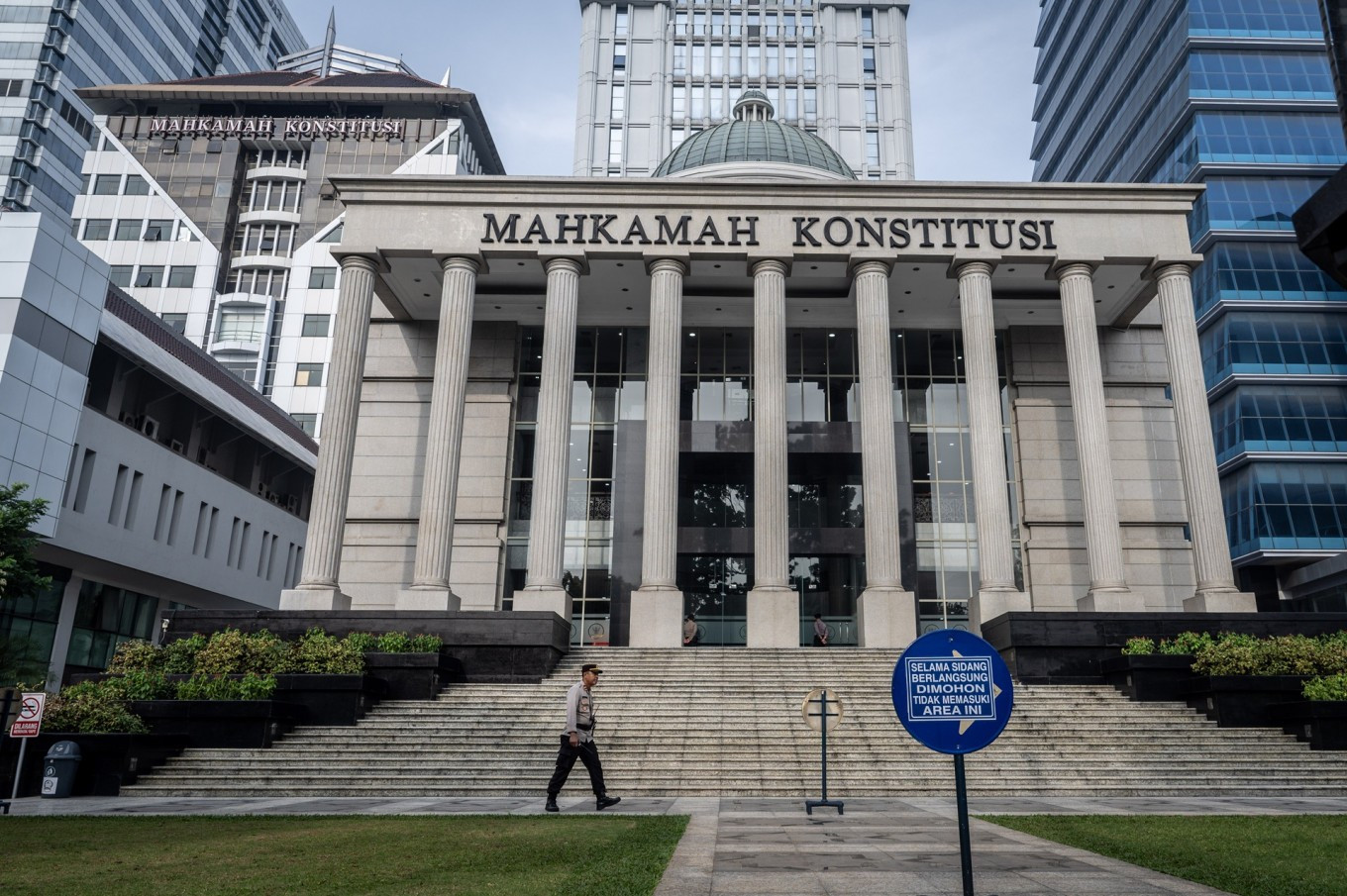 A police officer patrols the grounds of the Constitutional Court in Central Jakarta on Feb. 4, 2025. (Antara/Bayu Pratama S.)
The Constitutional Court just handed down a much-needed reality check on the country's public finances. By striking the free nutritious meal program out of the national education budget, the court drew a clear line in the sand: money set aside for education needs to go toward education. Now, the government has to figure out a transparent, long-term way to fund its flagship free meals program without taking a bite out of other vital national priorities.
On July 30, the panel of justices ruled that while the free meals program itself remains constitutional as a top strategic priority, funding it through the state budget's (APBN) education allocation is a no-go. The government has until fiscal year 2028 to untangle the program’s funding from the education pool, giving policymakers a grace period to rework the math without pulling the plug on meal deliveries.
At the heart of the dispute is Article 49 of the 2003 National Education System Law, which mandates that at least 20 percent of the state budget, not including teachers' salaries and routine administrative costs, must go directly to education. In the 2026 budget, that 20 percent slice amounted to Rp 769.1 trillion (US$47 billion). But roughly a third of it, Rp 268 trillion, was being siphoned off to feed the free meals initiative. Critics rightly argued that piggybacking a massive food program onto the education quota stretched constitutional protections far beyond their intent.
The legal challenge was sparked in February by educator Reza Sudrajat, the Progressive Educators Association of Indonesia, represented by the Coalition to Save Indonesian Education, Rega Felix and the Taman Belajar Nusantara Foundation. They warned that using school funds for meals would slowly drain the cash desperately needed to train teachers, repair crumbling classrooms, lift student achievement and broaden access to quality schooling across the archipelago.
Following nine packed hearings filled with testimony from legal scholars, state officials, and advocacy groups, the nine justices unanimously agreed with the petitioners. Delivering Decision No. 40/2026, Chief Justice Suhartoyo made it clear that free meals are not a core operational expense of schooling, nor can they be shoehorned in under a dynamic read of "educational spending." The court insisted that the mandatory 20 percent reserve must stay laser-focused on core foundations: students, teachers, infrastructure, curriculum development and quality control.
The impact of this ruling goes well beyond a single lunch initiative. It sets a crucial boundary against the slow erosion of earmarked public funds. Good nutrition certainly helps kids focus, but as the justices pointed out, secondary benefits do not give the state a license to rewrite constitutional definitions whenever convenient. Budget mandates are not elastic bands meant to stretch for shifting political goals.
While lawmakers and cabinet ministers publicly accepted the ruling, they have not entirely dropped their original defense. Throughout the hearings, government attorneys insisted the free meals program fit right into the law's vision of holistic education, one that covers physical health alongside reading and math. They pointed to school lunch models in Japan, Finland and Brazil, while officials from the Elementary and Secondary Education Ministry maintained that the meals were directly helping kids without hurting classroom quality.
Regardless, the legal debate is officially over. The pressure is now on President Prabowo Subianto's administration to keep his signature policy alive by finding reliable revenue elsewhere in the budget. That task is easier said than done, given how large the free meals machine has already grown. The program now loops in the National Nutrition Agency (BGN), regional offices, private suppliers and even local military and police units. With so many stakeholders involved, the program is not going away. The real question is whether paying for it will end up starving health care, infrastructure, social safety nets or regional development.
Then there is the thorny issue of oversight. The BGN's newly appointed head, Sudaryono, has been busy scrubbing the agency's operations clean. As of Aug. 3, he has sacked 137 unit heads for misconduct, while investigators flagged 414 problematic or ghost fulfillment centers. Alleged state losses have already topped Rp 311.2 billion. Moving the free meals program to its own massive standalone budget will mean nothing if it is not paired with strict oversight, structural accountability and total transparency.
In the end, the court did more than clean up a line-item accounting trick. It reminded the government that constitutional safeguards exist for a reason and cannot be brushed aside for political expediency. The challenge now is not just about finding cash for free meals, it is about making sure the money comes from somewhere sensible, rather than just shifting the fiscal headache from one essential sector to another.
What we've heard
The court has ruled that funding for the free meals program can no longer be drawn from the constitutionally mandated education budget, while granting the government a transition period until the 2028 fiscal year to comply with the decision.