
News
RI introduces fuel surcharge framework as airfare pressures intensify
Tenggara Strategics June 2, 2026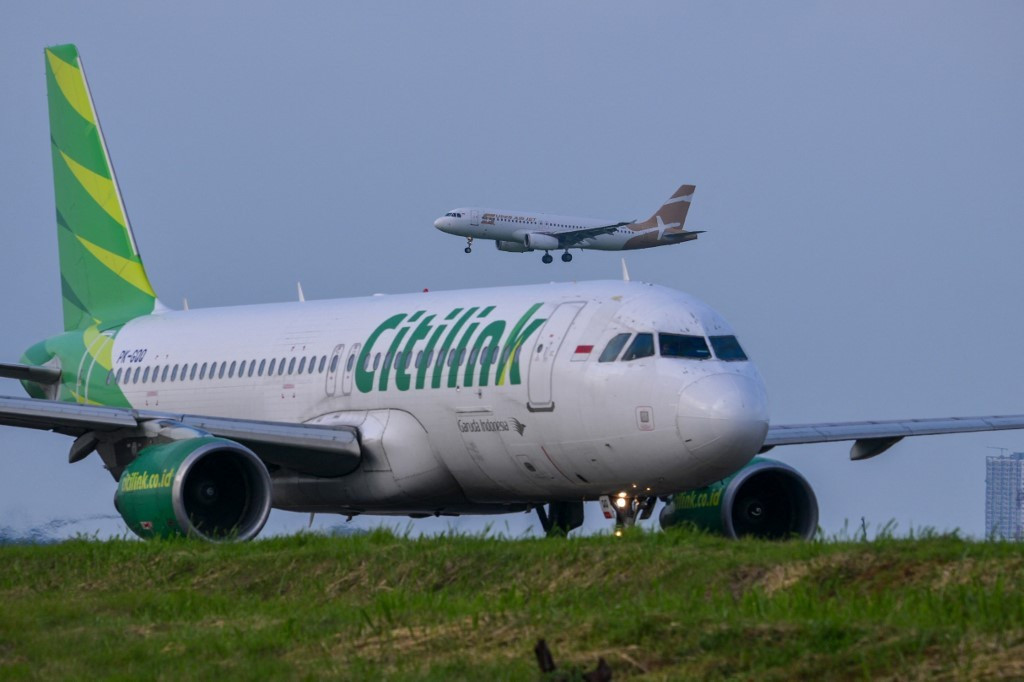 An Indonesian airline Citilink plane taxis as a Super Air Jet plane lands on Jan. 10, 2025, at Soekarno-Hatta international airport in Tangerang, Banten. (AFP/Bay Ismoyo)
The Indonesian government is introducing a new fuel surcharge mechanism that could significantly raise domestic commercial flight ticket prices, with surcharges allowed to reach as high as 100 percent of the applicable fare ceiling under certain fuel price conditions. The policy was introduced as global aviation turbine fuel (avtur) prices surged amid the Iran conflict, adding further pressure to domestic airfares that are already considered expensive due to longstanding structural problems in Indonesia’s aviation sector.
Through Transportation Ministerial Decree No. 1041/2026, the government introduced a new fuel surcharge framework intended to create a more flexible mechanism for adjusting airline ticket prices in response to fluctuations in avtur costs. The surcharge is calculated separately from the base airfare and adjusted according to government-designated avtur price brackets, with surcharge ceilings now ranging from 10 percent to as high as 100 percent of the applicable tariff ceiling, compared with a maximum of only 10 percent under the previous regulation, depending on prevailing fuel prices.
The amount of the fuel surcharge is determined based on the average avtur price set by aviation fuel providers, which reached Rp 29,116 (US$1.8) per liter during the latest evaluation period as of May 1. Based on that calculation, airlines have been permitted since May 13 to impose fuel surcharges on domestic economy-class tickets of up to 50 percent of the applicable fare ceiling. At the same time, the government is also considering raising the airfare ceiling itself.
The introduction of the mechanism comes at a time of heightened public sensitivity over airfare prices in Indonesia. Domestic flight tickets have experienced persistent inflation since the COVID-19 pandemic, but concerns intensified this year after prices surged during the March–April Idul Fitri travel season and failed to normalize afterward, remaining elevated through June.
One example can be seen on the Jakarta–Denpasar route, one of Indonesia’s busiest domestic flight corridors. At the end of March, a roundtrip economy-class ticket on Lion Air cost around Rp 1.88 million. After the regulation took place, prices for the same itinerary had climbed to between Rp 2.6 million and Rp 2.89 million, although this was still slightly below the roughly Rp 3 million peak recorded in April.
Even before the introduction of the new fuel surcharge mechanism, Indonesian airlines had increasingly developed a reputation for having some of the highest airfares in Asia. Garuda Indonesia in particular is frequently cited for maintaining some of the region’s highest ticket prices on a per-kilometer basis despite facing long-running financial difficulties. The airline has also remained closely tied to repeated government-backed rescue efforts, including debt restructuring programs, state capital injections, and various financing initiatives introduced to stabilize operations following years of mounting losses and the severe disruption caused by the COVID-19 pandemic.
Much of Indonesia’s airfare problem is rooted in deeper structural challenges within the aviation industry, particularly the difficulty of balancing competition, airline sustainability and affordable connectivity across an archipelagic country. Indonesia’s geography naturally creates exceptionally strong demand for air travel, making aviation an essential component of national mobility and economic integration rather than simply an alternative mode of transportation.
This demand triggered aggressive expansion among airlines seeking to dominate the domestic market, particularly during the rapid growth of Lion Air. The period was marked by intense fare wars, aggressive promotional pricing, and rapid fleet expansion. At the same time, however, numerous airlines either collapsed, were acquired or fell into financial distress as competition became increasingly unsustainable.
The problem was further compounded by the relatively inelastic nature of Indonesian aviation demand. As an archipelagic country with limited alternatives for long-distance travel, passenger demand for flights tends to remain resilient even during periods of sharp price increases. This dynamic has historically made monopolistic and oligopolistic tendencies difficult to avoid, particularly on major domestic routes connecting Jakarta, Bali and Surabaya, where only a handful of carriers possess the fleet size and operational scale necessary to compete effectively.
It was within this environment that the Transportation Ministry introduced airfare control measures such as tariff ceilings and pricing floors aimed at preventing both destructive fare wars and excessive fare increases. Regulators argued that unsustainably cheap tickets could weaken airline finances and potentially encourage unsafe operational cost-cutting, while unrestricted pricing power in a concentrated market could expose consumers to exploitative price hikes.
However, the same regulatory framework also limited more natural pricing adjustments within the market. Although aviation demand in Indonesia is structurally inelastic, it remains cyclical, with recurring periods of strong and weak passenger demand throughout the year. Critics have long argued that the pricing controls have become overly rigid, restricting airlines’ ability to reduce fares more aggressively during lower-demand periods. As a result, fare increases introduced during peak travel seasons often failed to fully reverse afterward, contributing to a longer-term pattern of structurally elevated ticket prices.
At the same time, fully liberalizing Indonesia’s aviation sector would also present significant risks. The combination of geographically inelastic demand, high operational costs and concentrated market power means deregulation alone could further strengthen oligopolistic behavior rather than produce healthier competition. In that context, the surcharge mechanism introduced under Transportation Ministerial Decree No. 1041/2026 represents an attempt to create greater pricing flexibility within the existing regulatory structure by allowing fuel surcharges to adjust more dynamically alongside avtur prices. Nevertheless, the measure may ultimately prove too little, too late.