
News
Protection or control? Govt blocks children’s access to social media
Tenggara Strategics April 15, 2026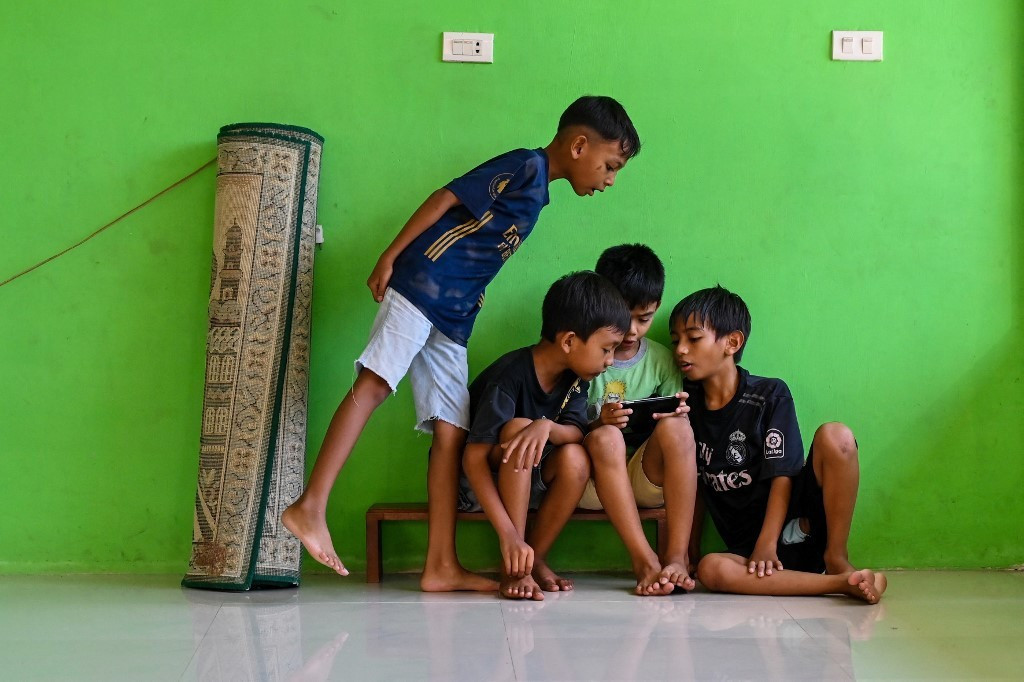 Children huddle together on April 2, 2024, as they play with a mobile device ahead of the breaking of the fast during Ramadan in Banda Aceh, Aceh. (AFP/Chaideer Mahyuddin)
Over the past two weeks, the government has begun overseeing the implementation of Communications and Digital Ministerial Regulation No. 9/2026. The policy reflects a national push to strengthen protections for children, though concerns have emerged regarding its effectiveness and its potential impact on children’s access to information and freedom of expression.
This regulation serves as a technical guideline for Government Regulation No. 17/2025 on child protection in electronic systems, commonly known as PP Tunas. A central provision is the ban on social media use for children under the age of 16, a measure designed to shield minors from online risks such as grooming, abuse, and harmful content.
Communications and Digital Minister Meutya Hafid described these risks as a “digital emergency”, noting that an estimated 70 million Indonesian children under 16 are currently active on social media.
This move aligns with a growing global trend toward social media regulation. Australia was among the first to impose a sweeping ban, passing a law in 2024 that took effect in December 2025. Similar restrictions have emerged in the Indian state of Karnataka and in Brazil, where policies took effect in March 2026. Brazil’s model requires users under 16 to link accounts to a legal guardian and prohibits addictive features like infinite scrolling, while Malaysia and Spain are currently considering similar measures.
In Indonesia, the policy officially took effect on March 28, and platforms were given a three-month window to complete self-assessments and seek classification as low-risk providers. The first phase of the regulation targets eight major platforms: YouTube, Facebook, Instagram, Threads, TikTok, X, Roblox and Bigo Live.
Compliance across these Big Tech corporations has been varied. Bigo Live and X moved quickly to implement age-verification mechanisms and deactivate accounts belonging to users under 16. Meanwhile, Roblox and TikTok have shown partial compliance; Roblox introduced restrictions for users under 13 that limit them to offline play, and TikTok has begun gradually deactivating accounts for those under 16.
However, major technology companies have shown significant reluctance. Representatives from Meta and Google were summoned twice by the ministry, eventually complying with an examination on April 6–7.
Meta argued that parents should decide which applications their teenagers use, warning that government bans might drive youth toward unregulated platforms. Google echoed these concerns, suggesting that age-based restrictions could make children less safe by encouraging them to access content without accounts, thereby bypassing existing parental controls and safety filters.
The debate over parental involvement is rooted in a difficult reality, as digital literacy in Indonesia remains a challenge. The national Digital Literacy Index consistently shows only moderate levels of competence, suggesting that many parents may lack the skills needed to guide their children effectively. Similar enforcement struggles are appearing in the gaming sector, where users of the platform Steam recently reported the introduction of age ratings under the Indonesia Game Rating System.
While this aligns Indonesia with standards in Brazil and Germany, early implementation has been criticized for inconsistency, with some harmless games rated 18+ while adult content was deemed suitable for children.
Beyond these logistical hurdles, there is the critical issue of human rights. Usman Hamid, executive director of Amnesty International Indonesia, warned that the policy risks depriving millions of young people of their rights to communicate, access information and express creativity.
Ultimately, Indonesia faces the challenge of striking a workable balance between protection and control. While the regulation addresses the failure of platforms to safeguard young users, it cannot succeed in a vacuum. Without corporate accountability, greater digital literacy and active parental involvement, enforcement may prove to be either ineffective or easily circumvented.
The success of this policy will depend on how carefully the government navigates the line between safety and the fundamental rights of the digital generation.
What we've heard
The Communications and Digital Ministry has summoned Meta Platforms, the parent company of WhatsApp, Instagram and Threads, alongside Google to assess their compliance with PP Tunas. Both tech giants stand accused of failing to comply with mandatory age restrictions for children accessing social media platforms.