
News
Draft TNI regulation on funding raises concerns over military neutrality
Tenggara Strategics May 8, 2026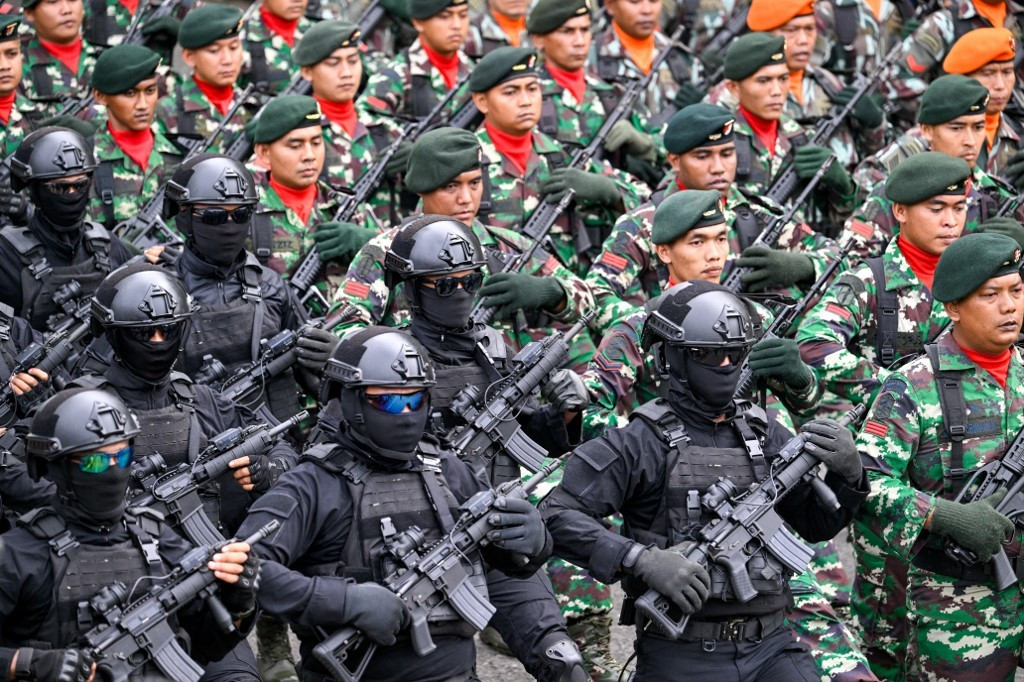 Army personnel march on Oct. 5, 2025, during an event marking the 80th anniversary of the Indonesian Military (TNI) in Banda Aceh, Aceh. (AFP/Chaideer Mahyuddin) (AFP/Chaideer Mahyuddin)
The financial independence of the Indonesian Military (TNI) has come under scrutiny following a leaked draft of a government regulation on TNI duties, which appears to open the door for funding from sources outside the state budget. The controversy, however, points to a deeper structural issue: Defense spending in Indonesia has long been deprioritized relative to other national priorities such as infrastructure development, energy subsidies, social assistance and food security.
A key provision, article 143 of the draft regulation, states that funding for the TNI may come from three sources: the state budget, regional budgets and other “legitimate and non-binding” sources as regulated by law. While the clause ostensibly restricts high-risk funding, it does not fully eliminate the possibility of external influence, leaving room for interpretation and concern.
This development must be understood in the context of Indonesia’s historically low defense spending. In the finalized 2026 state budget, defense expenditure stands at around Rp 187.1 trillion (US$10.78 billion), equivalent to just 0.8 percent of projected GDP. This is significantly below the regional norm, where many Southeast Asian countries allocate closer to 1.5 percent of GDP, nearly double Indonesia’s share.
The gap reflects longstanding fiscal trade-offs. Under former president Joko Widodo, government spending was heavily concentrated on large-scale infrastructure projects, positioned as engines of long-term growth. Investments in toll roads, ports, airports, dams, industrial estates and the new capital city, Nusantara, were aimed at improving connectivity, attracting private investment and reducing regional inequality. However, these priorities also competed directly with sectors like defense for limited fiscal space.
Expectations that defense spending would increase under President Prabowo Subianto, given his military background and prior role as defense minister, have not fully materialized. Instead, fiscal priorities have shifted toward a new set of flagship programs, including the nationwide free nutritious meal program, housing development and industrial transformation policies, such as downstreaming and energy transition efforts.
Although there have been discussions about raising defense spending, concrete progress remains limited. In early 2025, Defense Ministry spokesperson Brig. Gen. Frega Inkiriwang stated that the government aimed to gradually increase defense spending to above 1 percent of GDP, with a long-term target of 1.5 percent. However, he acknowledged that such increases depend heavily on overall economic stability and growth, with regional GDP performance also playing an important role in mobilizing funds.
Against this backdrop, allowing the TNI to access funding beyond the state budget introduces risks that extend beyond fiscal considerations. The central issue is not merely the source of funding, but the potential influence that accompanies it. Military professionalism and democratic civilian control rest on a fundamental principle: the armed forces must remain accountable to the state through transparent and centralized budgetary mechanisms, not to private actors or external financiers.
Once alternative funding channels are institutionalized, the risk of conflicting loyalties becomes difficult to avoid. No institution can remain fully independent from those who finance its operations, particularly when that funding becomes essential for its sustainability.
Consider a scenario in which the military undertakes a large-scale recruitment program funded by external sources. The long-term viability of those personnel would depend on the continuity of that funding. If it were withdrawn, due to political shifts, policy changes or the financier’s own interests, the military would still bear the obligation to cover salaries, training, housing and operational support. This creates an inherent vulnerability. Even without explicit conditions, the mere possibility of funding withdrawal is sufficient to generate structural influence.
Coordinating Minister for Law, Human Rights, Immigration and Correctional Services Yusril Ihza Mahendra has emphasized that the regulation remains in draft form and is open to revision. This makes it all the more critical for the government to address these concerns before the policy is finalized. Questions surrounding military funding are not simply technical budgetary matters; they go to the core of national sovereignty and the principle that the armed forces must remain fully subordinate to the state. If left ambiguous, the provision risks creating structural vulnerabilities that will be far more difficult to reverse once embedded in law.