
News
Labor now part of Prabowo’s big coalition government
Tenggara Strategics May 12, 2026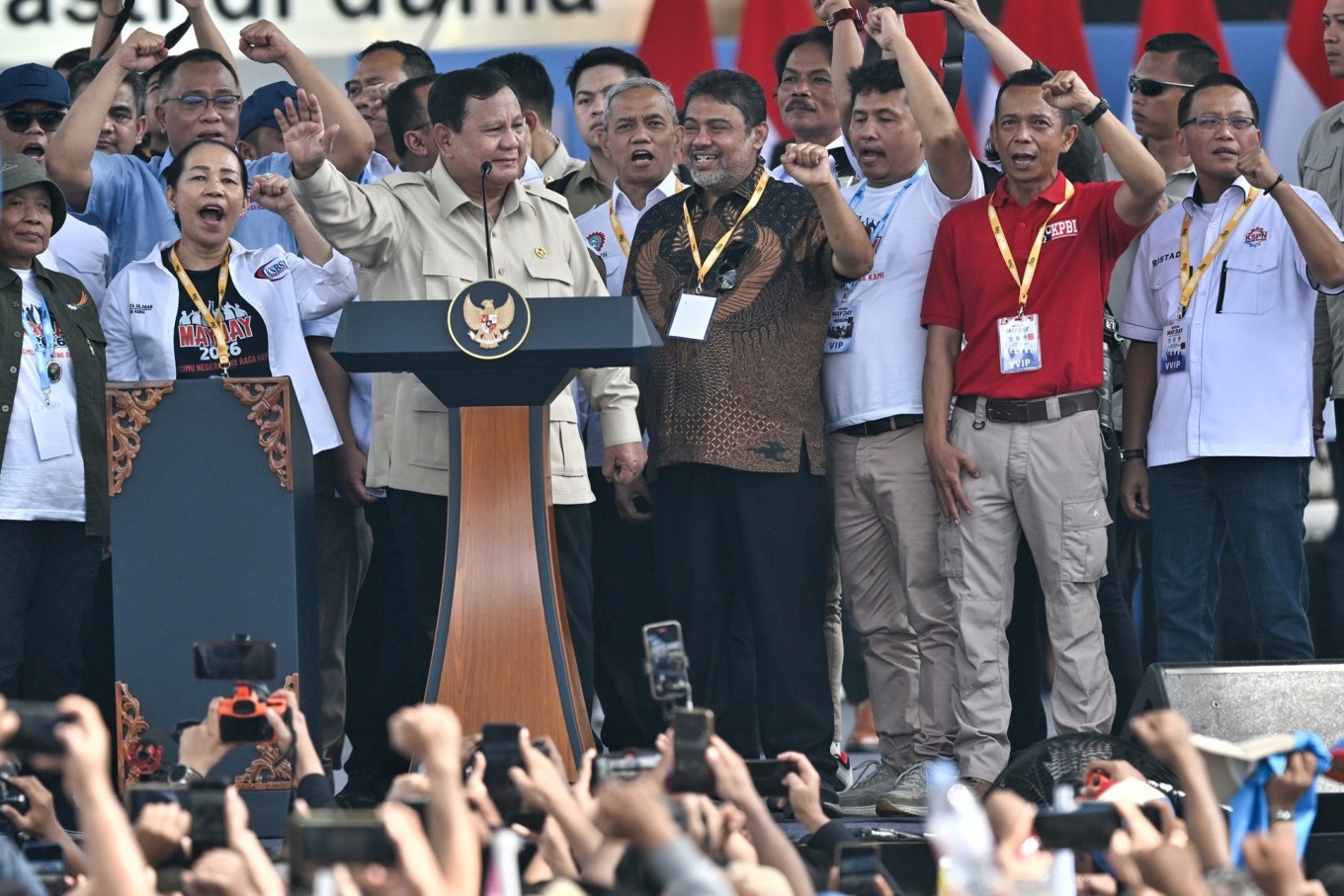 President Prabowo Subianto (second left) stands with leaders of labor groups on Friday during the commemoration of Labor Day at the National Monument (Monas) complex in Jakarta. (Antara/Bayu Pratama S.)
With little fanfare, Indonesia’s labor movement has joined President Prabowo Subianto ’s big coalition government, giving it an inside track in the corridors of power to fight for its interests. Although some might argue that it has been co-opted to blunt the movement.
On May 1, Prabowo joined a huge labor rally at the National Monument (Monas) Square opposite the Presidential Palace complex in Central Jakarta, and top union leaders happily embraced him on stage. A week earlier, the President recruited prominent labor activist Muhammad Jumhur Hidayat to his cabinet, though as minister for the environment rather than for labor.
Labor is the missing piece in Prabowo’s big tent coalition government comprising not only most of the political parties, but also major special interest groups, particularly business, Islam, the police and the Indonesian Military (TNI). Time will tell whether joining the coalition means more leverage for the labor movement, or simply co-option.
May 1 is now celebrated in Indonesia as a national holiday and a time for labor unions to show their teeth by holding rallies throughout the country. The one at Monas, attended by hundreds of thousands, was the largest, though not the only one that took place that day.
If past presidents avoided May Day rallies, Prabowo has embraced them. He joined leaders from more than 20 unions on stage and even seen sang some of the Indonesian words to “L’Internationale”, the anthem of the global labor movement. He chanted “Long live labor, long live Indonesia!”, and raised his fist in solidarity with workers.
He took off his safari shirt and threw it to the crowd, and when reduced to a black undershirt, spent the next 15 minutes hugging and shaking hands with the crowd. The workers responded in kind while the song “Kowe Cen Istimewa” (Javanese for “You Are Special”) played in the background. He gave out t-shirts to celebrate Labor Day with the inscription “For you my country, our body and soul” produced by the Palace.
Prabowo has delivered on some of his promises. The bill on the protection of domestic workers, a promise he made at last year’s May Day rally, was endorsed by the House of Representatives in April. In November, he named Marsinah, a woman labor activist murdered by the TNI in 1993, a national hero. On May 1, as a Labor Day gift, he issued a presidential regulation limiting online companies that run ride-hailing services to 8 percent in commission, instead of the going rate of 20 percent, making sure that riders get 92 percent of their fares.
It is too early to conclude that Prabowo is a “pro-labor” president, as against the “pro-business” label given to past presidents. His cabinet is still staffed by many business types.
The former Army general has departed from the TNI tradition of viewing labor with suspicion, as representing the communist ideology. The government only recognized May 1 as Labor Day, and made it a national holiday, in 2013.
The labor movement in Indonesia politically remains small and weak, a reason why past presidents could afford to ignore it or gave only token participation in their governments. The movement has suffered from low unionization rates and fragmentation into groups that often compete against one another.
Statistics Indonesia (BPS) says the size of Indonesia’s workforce was 155 million out of a working-age population of 220 million as of February. Estimates of how many workers are members of labor unions range between 4 and 13 percent. The Manpower Ministry says there are 21 labor confederations, 198 federations and more than 12,000 union shops. The bulk of Indonesian workers, more than 60 percent, are in the informal sector, and not covered by unions.
The ineffectiveness of the labor movement was grossly exposed when the government of president Joko “Jokowi” Widodo swiftly pushed the Job Creation Law through the House in 2023, with little opposition from labor. Despite its name, the legislation is designed to give more concessions to investors, often at labor’s expense.
Several unions have elevated themselves into political parties, but they never got far in elections. Labor is simply not popular among voters.
Their fragmentation means that not all labor groups have joined the Prabowo administration. On May 1, several groups organized a separate rally in Jakarta outside the Senayan Legislative Complex in Central Jakarta to press their demands, including repealing the Job Creation Law, ending outsourcing and better protection for workers who are laid off.
With reports of more companies planning to lay off workers, embracing the labor movement may be not such a bad idea for President Prabowo.
What we've heard
Sources close to Prabowo said he appointed labor figure Jumhur Hidayat as environment minister as part of a strategy to embrace labor groups. One reason behind Prabowo’s outreach to these groups was growing unrest among workers amid economic slowdown.