News
PLN leadership shift signals solar ambitions, challenges remain
Tenggara Strategics October 28, 2026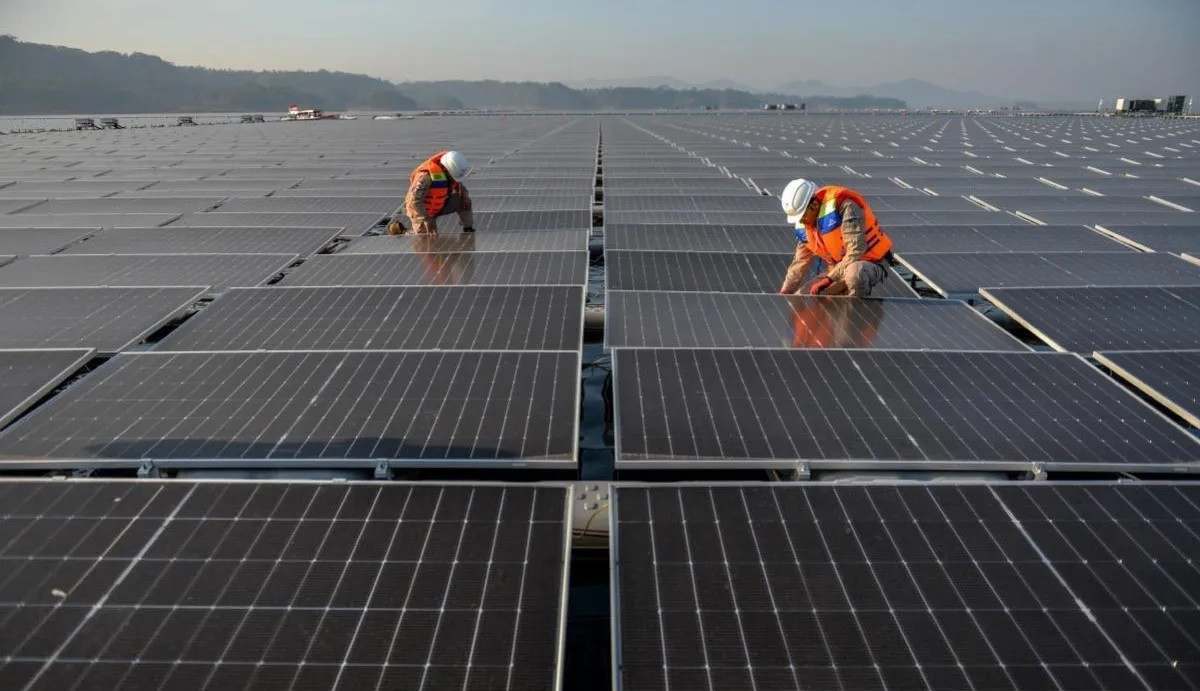 Final tweaks: Technicians check panels on Sept. 29, 2023, at the Cirata floating solar photovoltaic plant, located at the Cirata Reservoir in Purwakarta, West Java. (Antara/Raisan Al Farisi)
The appointment of Suroso Isnandar as president director of state-owned electricity company PT PLN comes as the government steps up efforts to deliver its ambitious 100 gigawatt-peak (GWp) solar power program. Having previously overseen renewable energy projects at PLN, Suroso is well positioned to lead the initiative. However, delivering the program within its three-year timeline will be challenging, given Indonesia’s structural constraints on integrating variable renewable energy (NRE) into its electricity grid.
President Prabowo has tasked PLN and the newly established Coordinating Ministry for Downstreaming and Energy Transition with accelerating the 100 GWp solar power program, one of his national priority work programs (PKPN). Launched in Bali on Aug. 25 the program aims to add more solar capacity in three years than Indonesia’s entire installed power generation capacity of approximately 88 GW at the time.
The first phase targets 17 GWp, beginning with 14 projects totaling 5,216 megawatt-peak (MWp) at various stages, including construction, groundbreaking, inauguration and tendering. The program encompasses ground-mounted, rooftop and floating solar power plants, reflecting the government’s push to expand NRE and strengthen energy security.
Despite an estimated solar power potential of 3,294 GWp, Indonesia has utilized only around 1.5 GW. Solar power paired with battery energy storage systems (BESS) is estimated to cost US$0.08–$0.20 per kilowatt-hour (kWh), substantially less than the $0.55–$0.65 cost of diesel-generated electricity. Replacing 13 GW of diesel capacity could save Rp 73.9 trillion annually.
However, achieving the 100 GWp target within three years presents formidable challenges. These include land suitability, limited institutional capacity to implement projects across approximately 80,000 villages and the proposed involvement of Red and White Cooperatives in managing the program. Meanwhile, PLN’s coal-heavy grid and long-term power purchase agreements (PPAs) with power producers constrain its flexibility to accommodate variable NRE generation.
These constraints are compounded by uncertainty over whether electricity demand can keep pace with the planned capacity expansion. PLN’s 2025–2034 Electricity Supply Business Plan (RUPTL) targets an additional 205 terawatt-hours (TWh) in electricity sales over the period, implying average annual growth of approximately 21 TWh.
Sales are projected to rise from 306 TWh at the end of 2024 to 511 TWh in 2034. The projections rely on demand from industrial and special economic zones, tourism destinations, fisheries centers, and electric vehicles (EVs), supporting the government’s target of 8 percent economic growth by 2029. However, the RUPTL predates the 100 GWp solar initiative and already envisages an ambitious addition of 42.6 GW of new and renewable energy (NRE) capacity.
Several demand-side opportunities could help absorb the additional supply. Research by Tenggara Strategics and CSIS Indonesia estimates that converting liquefied petroleum gas (LPG) stoves to induction stoves could add 27.62–53.43 GW of electricity demand, depending on stove efficiency. LPG currently accounts for 41.46 percent of household energy consumption, with 77.6 percent of supplies imported. Electrifying household cooking could therefore reduce import dependence and subsidy costs while increasing electricity consumption. Transport electrification offers another avenue: each million EVs could save 1,250 kiloliters of gasoline annually, while developing the domestic EV industry could create 500,000 jobs. Meanwhile, nickel downstreaming is expected to require 13.6 GW of captive power under the 2025–2034 RUPTL, and data center electricity demand could reach 1.7 GW by mid-2027.
Suroso’s appointment is an opportunity to align PLN’s leadership with the government’s energy transition ambitions, but leadership changes alone will not resolve the structural constraints facing the 100 GWp solar program. The government and PLN must coordinate supporting reforms to accelerate demand creation, including the proposed induction stove conversion program, continued development of the domestic EV industry, and expansion of metals and minerals downstreaming. At the same time, they must address the constraints imposed by long-term coal power commitments and invest in grid upgrades and flexibility to accommodate variable NRE generation.
What we've heard
Sources within PLN say that Darmawan Prasodjo had been on the verge of being removed as PLN president director several times. However, his father’s close ties to President Prabowo Subianto are said to have been one of the factors that prevented the dismissal. In addition to having served as the headmaster of SMA Taruna Nusantara, Darmawan’s father, a retired military officer, reportedly once ‘saved’ Prabowo’s career when the latter was still studying at the Military Academy. This was what allowed Darmawan to retain his position during the rolling blackouts in mid-June 2026.
Related Articles