
News
Gibran won’t be impeached, but that’s not the point
Tenggara Strategics October 20, 2026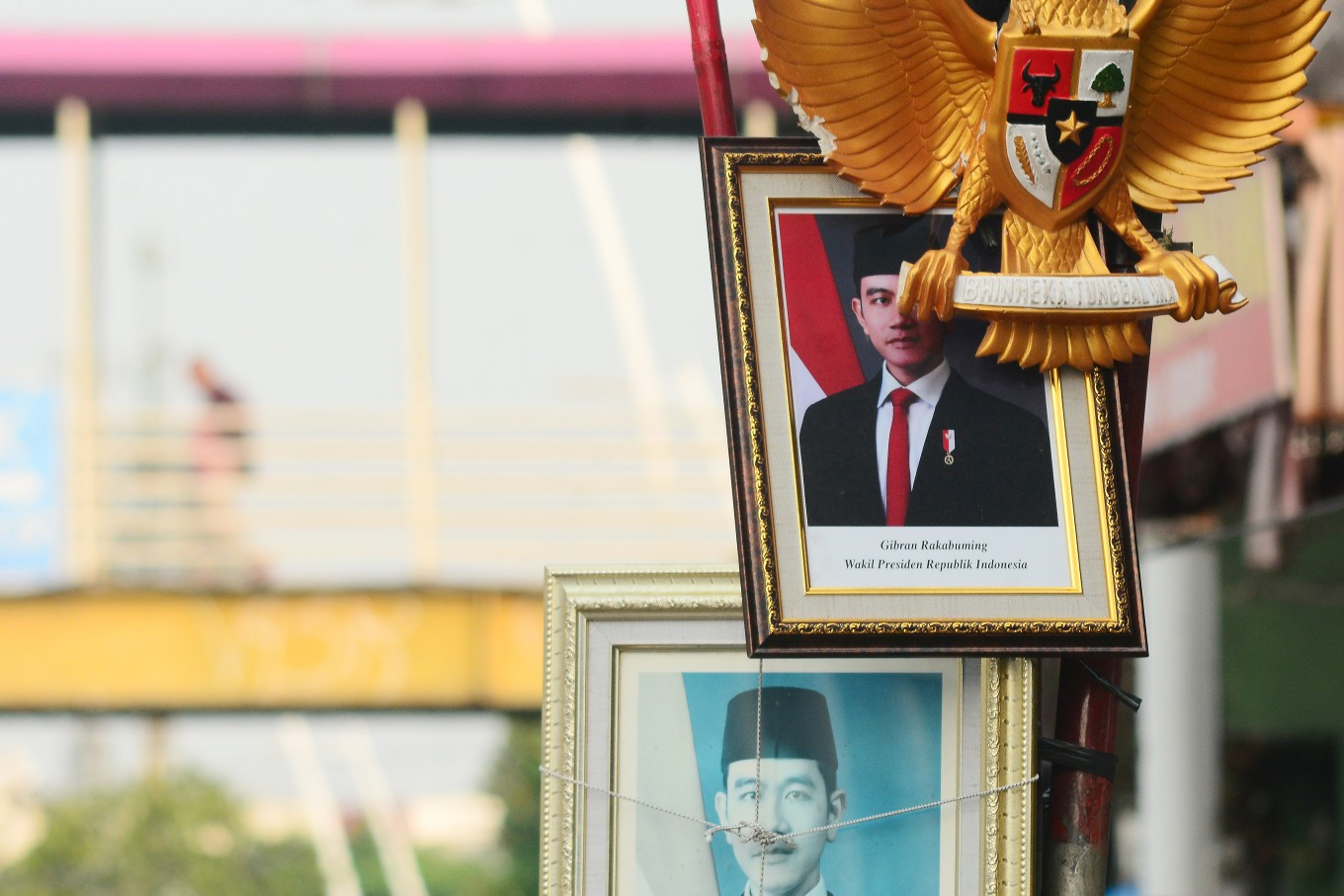 An image of Indonesian Vice President Gibran Rakabuming Raka is displayed in a frame outside a photo framing shop on Thursday in the Jatinegara area of East Jakarta (.JP/Iqro Rinaldi)
The controversy surrounding Vice President Gibran Rakabuming Raka has entered a new phase. Criticism of how he reached office is increasingly channeled into talk of impeachment. Paradoxically, the more it is discussed, the less likely it seems to happen. The mechanism exists, but the politics suggest its impact will be symbolic rather than institutional.
Once inaugurated, a president or vice president can be removed only through impeachment. Articles 7A and 7B of the Constitution set out a multi-stage process involving the House of Representative, the Constitutional Court, and the People Consultative Assembly. Recent legal challenges to Gibran's qualifications underline the point: after inauguration, eligibility disputes can no longer be resolved through ordinary election litigation, only through constitutional removal.
The process is deliberately hard. The DPR must first approve an opinion that grounds for removal exist. The Constitutional Court must then uphold it, and only then can the MPR vote. Each stage demands broad consensus. Designed after Reformasi to prevent the instability of earlier eras, impeachment is less a legal procedure than a political process requiring elite agreement. That leaves the DPR in a peculiar position. Nothing can begin without its initiative, yet it has shown little appetite either to embrace or to reject impeachment calls.
The ambiguity is rational. Rejecting impeachment outright would hand Gibran a form of parliamentary validation. Pursuing it would endanger parties in the governing coalition by destabilizing the administration, alienating Prabowo-Gibran voters, and fracturing alliances. So political actors entertain hearings, petitions, and public debate while stressing that parliamentary consensus would be required before anything substantial could happen. Impeachment remains useful as a topic but inconvenient as a project.
For critics, then, removal may not be the objective. Given the procedural hurdles and the coalition's parliamentary strength, success is improbable. The real battlefield is legitimacy. Much of the criticism holds that Gibran's rise stemmed from judicial intervention, family influence, and dynastic politics rather than a conventional political career. Each round of debate over candidacy requirements reinforces that perception. Even if the constitutional process goes nowhere, the narrative survives.
Some critics propose another route: sustained public pressure to shame Gibran into resigning voluntarily. This bypasses the DPR, but it assumes a susceptibility to shame that is rare in politics. A vice president backed by a strong coalition and a powerful patron has little reason to yield, so this too is aimed at legitimacy rather than removal.
Timing matters here. Impeachment talk makes more sense viewed through 2029 than 2026. As vice president, Gibran is first in line should anything happen to President Prabowo Subianto , so weakening his standing carries weight: critics are questioning the legitimacy of a potential future president.
If he runs in 2029, today's controversies become tomorrow's campaign issues, and narratives built years before an election often outlast legal outcomes. Impeachment thus functions less as an effort to remove him now than to constrain his viability later, ensuring that he enters the race carrying political baggage rather than the advantages of incumbency.
The debate is also inseparable from former president Joko “Jokowi” Widodo, Gibran’s father. Though out of office, Jokowi remains among Indonesia's most influential figures. The officials, networks, regional leaders, and economic stakeholders who rose under him remain embedded in the system, and the transition to Prabowo was a negotiated succession rather than a clean rupture.
Whether Jokowi is "pulling the strings" is a matter of interpretation, but his influence plainly extends beyond his presidency. Gibran is the most important vehicle through which that influence could outlast the Prabowo era. He is the most visible heir of the Jokowi brand. Supporters see continuity of a developmental, infrastructure-driven, technocratic style of governance; critics see dynastic politics and the normalization of elite family succession.
This helps explain why attacks on him can seem disproportionate to his limited executive role. Political actors are reacting less to the current vice president than to the prospect of a national contender who could anchor a post-Prabowo coalition preserving key elements of Jokowi's project. The paradox of the impeachment debate, then, is that its constitutional significance is limited precisely because the pathway is so difficult. The DPR can initiate the process, but its incentives to do so are weak, so impeachment works as a political weapon rather than a governing agenda.
The real struggle is not over whether Gibran remains vice president. It is over whether he emerges as a credible future president, a legitimate successor in a presidential vacancy, and the principal carrier of Jokowi's legacy. It is a contest over succession, legitimacy, and the shape of Indonesian politics after Prabowo and Jokowi have both left the center of formal power.
What we've heard
According to a lawmaker, legislative factions are currently holding their fire as political reverberations unfold following the Constitutional Court's decision on Gibran Rakabuming Raka's academic credentials. Rather than acting immediately, parties are waiting for parallel legal proceedings to conclude; an interpellation or formal inquiry motion would only be considered once the Supreme Court hands down its ruling.