News
A sugar excise too small to matter
Tenggara Strategics October 26, 2026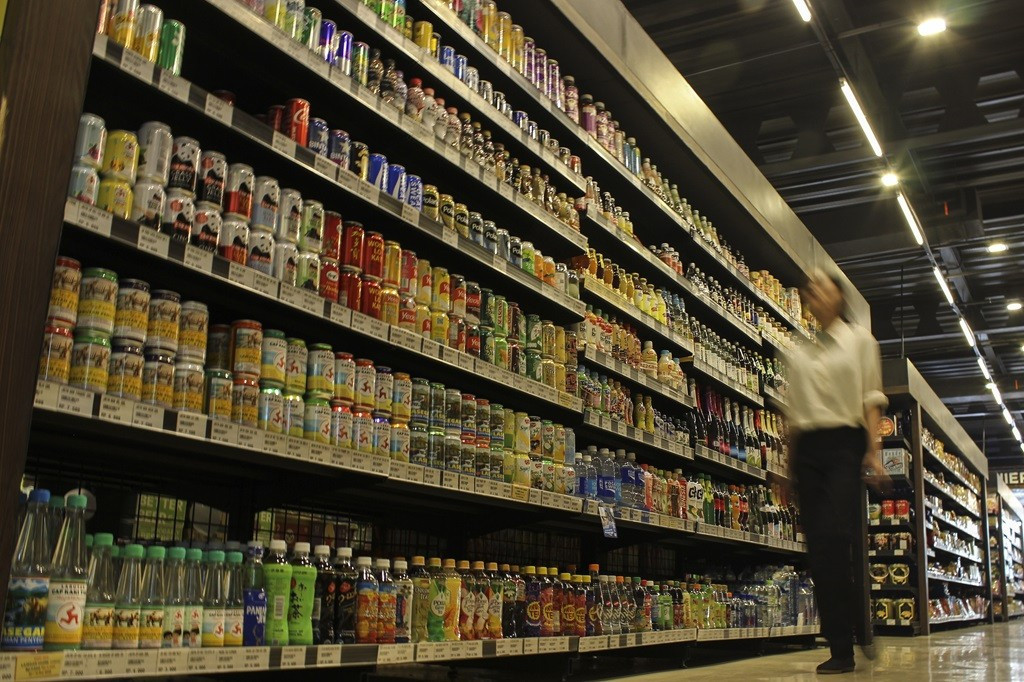 A customer passes by a rack of sweetened drinks in a retail supermarket in Jakarta on Dec. 14, 2023. A survey from the Indonesian Consumers Foundation (YLKI) revealed that 58 percent of 800 respondents support the plan to impose excise tax on sweetened beverages to control their consumption and prevent diabetes prevalence in children, which increased 70-fold in 2023 compared with 2010. (Antara/Cahya Sari)
A tax on sugar-sweetened beverages (SSB) is planned from the second half of 2027, the government has said, after making similar promises almost every year since 2022. The levy is expected to raise Rp 1.7 trillion (US$95 million), while diabetes care alone cost the national health insurance an estimated Rp 12.6 trillion in 2024. At its planned scale, the proposed levy risks falling short as both a public health measure and a revenue-generating instrument.
Customs and Excise Director General Djaka Budi Utama told a budget briefing on Oct. 9 that the 2027 state budget would provide for the levy. The implementing regulations were still being discussed, Budi said, adding that he hoped to introduce the excise in the second half of next year.
Notably, the announcement came from ministerial officials and not Finance Minister Suahasil Nazara, who took office on Sept. 14 and has yet to state his position on the proposed SSB tax.
His predecessor Purbaya Yudhi Sadewa had taken a position directly opposing Budi’s, saying in August that the excise would not be implemented in 2027, was not included in revenue projections and that he would reconsider it once economic growth exceeded 6 percent.
The plan has been discussed since 2020, with revenue targets included in the state budget almost every year since 2022, although implementing regulations were never issued. The government targeted Rp 4.38 trillion in 2024, Rp 3.8 trillion in 2025 and Rp 7.6 trillion in 2026, but implementation was repeatedly postponed, most recently over concerns about consumer purchasing power.
The 2027 target represents a reduction of around 78 percent from this year's figure. The sharp cut raises a question: Is the government trying to change what people drink or simply fill another revenue line in the budget?
Officially, the objective is public health. The Finance Ministry has cited the health consequences of excessive sugar consumption and their impact on claims paid by BPJS Kesehatan, noting that 115 jurisdictions worldwide already impose similar levies.
There is evidence of what an effective health-related excise should look like. Research using 2024 household survey data suggests that a tax would be effective in reducing SSB consumption if it raised retail prices around 20 percent, potentially reducing demand roughly 18 percent. Such a policy would work best alongside product reformulation support for manufacturers rather than simply passing the related additional costs to consumers.
Producers say they have already reformulated their products and introduced low- and zero-sugar alternatives. The Industry Ministry has acknowledged that product reformulation requires substantial investment in research and product testing.
However, the latest proposed excise appears considerably more modest. The SSB tax plan discussed by the Finance Ministry in 2024 proposed Rp 1,500 per liter for packaged drinks and Rp 2,500 per liter for concentrates. The former is below the Rp 1,771 per liter average imposed across seven ASEAN countries.
The House of Representatives' State Finance Accountability Committee (BAKN) proposed a different approach, starting with a levy of 2.5 percent per unit and gradually increasing it to 20 percent.
Neither the previously discussed 2024 tax nor BAKN’s initial proposal necessarily meets the price increase that the abovementioned research identified as necessary to significantly reduce consumption. The final rates for 2027 meanwhile remain undecided.
Producers, however, dispute the government's premise. The Association of Indonesian Soft Drink Producers (Asrim) argues that the main drivers of noncommunicable diseases lie elsewhere, citing research suggesting that SSB accounted for only around 6.5 percent of daily calorie intake per capita.
The industry is also facing weak demand. Sales grew just 1.8 percent through late 2025, while the Industry Ministry reported below-50 percent capacity utilization in the beverage subsector.
But neither argument resolves the central question of the excise's effectiveness. If SSB represent only a small share of overall sugar consumption, imposing a modest tax on that narrow segment is unlikely to produce substantial improvements in public health.
The government therefore faces two coherent policy choices. It could set the excise high enough to meaningfully discourage consumption, supported by incentives that help manufacturers reformulate their products and reduce sugar content. Alternatively, it could introduce a modest levy primarily to raise revenue, acknowledging that its public health benefits would likely be limited.
Either approach would invite objections from the industry, but at least the policy objective would be clear.
So far, the government has chosen neither. It has announced a modest revenue target without setting the final excise rate while continuing to justify the proposal primarily on public health grounds. At the same time, implementation has repeatedly been postponed over concerns about consumer purchasing power.
After years of delays, the country needs more than another announcement. If the government genuinely wants to reduce excessive sugar consumption and the resulting burden on public health finances, it must design an excise capable of changing consumer behavior. Otherwise, the SSB tax policy risks becoming little more than another modest revenue measure with an ambitious public health label.
Related Articles