News
Indonesia's textile rescue: Revival or another failed SOE?
Tenggara Strategics October 20, 2026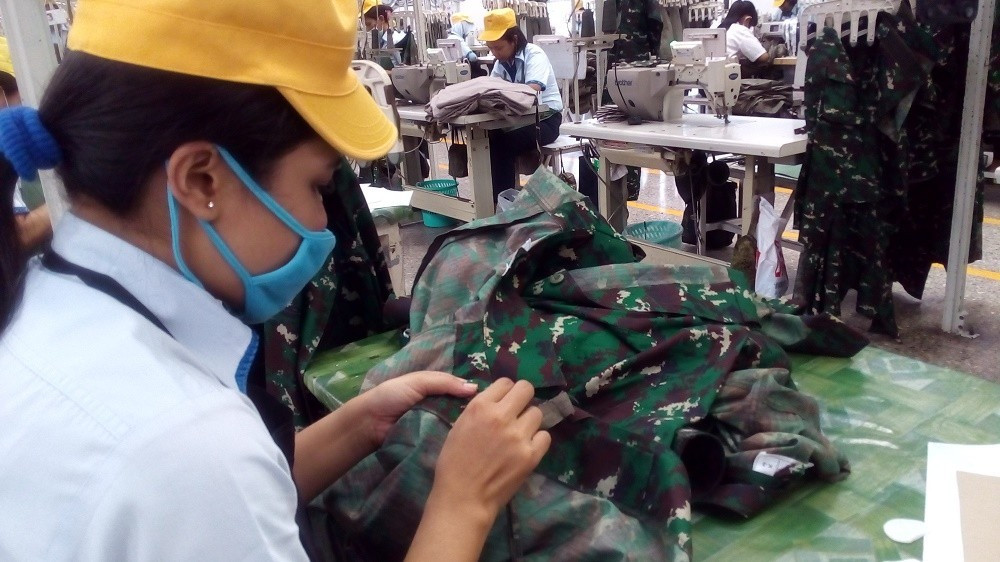 Workers produce military uniforms at a factory of PT Sri Rezeki Isman (Sritex) in Sukoharjo, Central Java, in October 2016. ( JP/Nani Afrida)
President Prabowo Subianto wants to revive Indonesia's struggling textile industry by establishing a new state-owned enterprise (SOE), potentially drawing on assets left behind by bankrupt textile giant Sritex. The plan comes amid factory closures, mass layoffs and mounting competition from cheaper imports. But with much of the industry's production capacity already underutilized, the government faces a difficult question: Will another state-owned company restore the industry's competitiveness or merely add to its problems?
The proposed SOE is part of Prabowo's efforts to preserve employment and revive an industry that has long been an important source of manufacturing jobs. State asset fund Danantara has been tasked with supporting the initiative, with CEO Rosan Roeslani indicating that the government intends to establish a new, vertically integrated textile company rather than simply inject capital into an existing enterprise.
The plan has drawn both support and concern from industry players. While some welcome government intervention to strengthen the domestic textile supply chain, others worry that another state-owned producer could intensify competition in an industry already struggling with weak demand, excess capacity and pressure from cheaper imports, especially from China.
Yet the industry's difficulties go beyond competition from imported products. Production capacity remains heavily underutilized across much of the textile value chain. Capacity utilization ranges from around 45 percent in the fiber segment to 58 percent in garments, suggesting that many manufacturers are already operating well below their potential output.
These figures raise an important question about the government's proposed intervention. If existing manufacturers cannot fully utilize their production capacity, would establishing another producer help revive the industry or merely add to its excess capacity?
The answer depends largely on where the new SOE operates within the textile value chain.
According to the Indonesian Textile Association (API), Indonesia's textile industry encompasses several interconnected segments, from upstream production of synthetic fibers and other raw materials to spinning, weaving, fabric processing and downstream garment manufacturing. While the country has established manufacturing capacity in many downstream activities, it remains dependent on imported inputs for certain upstream processes.
This creates an opportunity for government intervention, particularly in the capital-intensive chemical industry that supplies raw materials for polyester production. Indonesia remains dependent on imported monoethylene glycol (MEG) and purified terephthalic acid (PTA), two important inputs in the production of polyester fibers.
An upstream-oriented strategy would not be without risks. Chemical production requires substantial capital investment, sophisticated technology and reliable demand. However, the government could potentially reduce some of these risks by developing an integrated industrial ecosystem, encouraging partnerships with private manufacturers and providing incentives for investment in segments where domestic supply remains insufficient.
Such an approach would make the new SOE a complement to existing businesses rather than another competitor seeking a share of an already constrained market.
However, Indonesia's experience with state-owned textile companies offers cautionary lessons. PT Primissima, once a prominent state-owned textile manufacturer, suffered substantial losses from poor commercial decisions and financial pressures, eventually running out of working capital shortly before the COVID-19 pandemic which led to its demise.
Another state-owned textile company, PT Industri Sandang Nusantara (ISN), also struggled to adapt to changing industry conditions. Once operating across several manufacturing segments, including plastics and garments, the company had narrowed its activities largely to sewing and fabric production by 2018. Its increasingly limited business portfolio failed to generate sufficient revenue to cover operating costs, eventually leading to its dissolution in 2023.
These failures demonstrate that government ownership alone offers no guarantee of industrial competitiveness. Danantara's proposed textile SOE will therefore need more than government capital and modern machinery. It will require commercially sound management, disciplined investment decisions and a business model capable of responding to changing market conditions.
Beyond the immediate rescue effort lies a more fundamental question: Does Indonesia still possess sufficient comparative advantage to compete successfully in the global textile industry?
The international textile market has undergone significant structural changes. China has consolidated its position in capital-intensive upstream activities, including spinning, weaving and synthetic fiber production, while countries such as Vietnam have strengthened their competitiveness in labor-intensive garment assembly.
Indonesia faces competition at both ends of this value chain. Its relatively high production costs, dependence on imported inputs and underutilized industrial capacity suggest that restoring competitiveness will require more than simply expanding manufacturing facilities.
The real test for Prabowo's textile rescue plan is therefore not whether Indonesia can establish another SOE, but whether that company can address the industry's structural problems without becoming another long-term burden on public resources.