
News
Govt targets “questionable” IUPs in forest areas
Tenggara Strategics April 22, 2026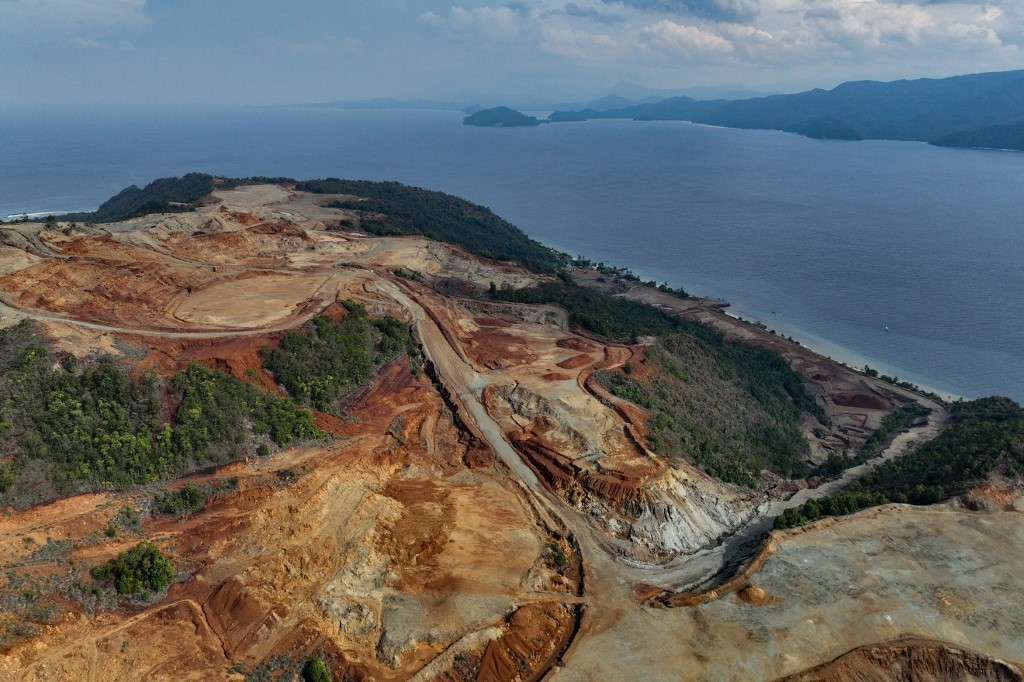 Deforestation on Kawei Island in Raja Ampat, Southwest Papua, is clearly visible on Dec. 21, 2024. (AFP/Handout)
President Prabowo Subianto on Apr. 8 instructed the accelerated revocation of hundreds of “questionable” mining business permits (IUPs) within a one-week deadline, a move that raises concerns over rushed implementation. The directive comes in the aftermath of severe flooding in Sumatra in December, widely linked to environmental degradation exacerbated by natural resource extraction. While the policy could curb illegal mining and deforestation, its effectiveness will depend on follow-up actions and careful execution.
Prabowo said he had received reports identifying hundreds of mining operations holding “questionable” IUPs within forest areas, including protection and conservation zones. He tasked the Energy and Mineral Resources (ESDM) Ministry with reviewing these permits within a week and revoking those found to be non-compliant. He also commended Forestry Minister Raja Juli Antoni for reportedly refraining from issuing new logging permits.
The push to revoke forest-area IUPs follows the December 2025 floods in northern Sumatra, which were believed to have been exacerbated by forest misuse. In response, the government, through the Forest Area Law Enforcement Task Force (Satgas PKH), had earlier moved to revoke 28 natural resource licenses. High-profile cases included the Martabe gold mine operated by Agincourt Resources, a subsidiary of Astra Group, and the Batangtoru Hydroelectric Power Plant run by North Sumatra Hydro Energy, backed by SDIC Power Holdings.
However, the ESDM Ministry opposed outright revocations, citing the risk of international arbitration and potential damage to investor confidence. Meanwhile, the Satgas PKH argued that affected companies had caused measurable environmental harm, pointing to past cases where foreign firms’ contracts were terminated due to criminal violations. A compromise was eventually reached, requiring Agincourt Resources and North Sumatra Hydro Energy to pay environmental fines of Rp 200.9 billion (US$11.71 million) and Rp 200.6 billion, respectively, in addition to covering forest restoration costs.
The current focus on “questionable” IUPs aligns with the ESDM Ministry’s broader target to reclaim 4.2 million hectares of illegal mining concessions in forest areas, in coordination with the police, the Indonesian Military, the Attorney General’s Office, and the Satgas PKH. A recent enforcement milestone includes the seizure of PT Asmin Koalindo Tuhup’s 1,699-hectare concession, which had continued operating despite the revocation of its coal contract of work (PKP2B) in 2017.
Heightened scrutiny of IUPs may also reflect efforts to address illicit practices in the mining sector. In 2025, Publish What You Pay (PWYP) Indonesia reported that illegal miners in Balikpapan used permits belonging to legitimate IUP holders to disguise their activities and transport illicit output. Similar concerns have emerged elsewhere, such as Bangka Belitung and Papua, including allegations of protection by law enforcement and security personnel in illegal mining operations.
Mining in forest areas, already contentious in the wake of the Sumatra floods, is permitted under Government Regulation No. 23/2021, which allows certain activities under strict conditions. Article 92 stipulates that underground mining, rather than open-pit operations, may be conducted in protection forests, provided it does not cause land subsidence, permanently alter forest functions, or damage aquifers. Even then, operators are required to minimize environmental harm.
Addressing deforestation and its role in intensifying climate-related disasters will require more than permit revocations. In the near term, the government should consider halting mining activities in protection forests, given their critical role in mitigating risks such as floods and landslides. Beyond extractive industries, particularly outside strategic minerals like rare earths and uranium, Indonesia could draw from international experience to prioritize sustainable forestry within production forests as a more balanced path for economic and environmental resilience.
What we've heard
A politician familiar with the directive said that Prabowo’s order was triggered by reports of permits lacking clarity or violating governance principles. “The permits are unclear,” he said.