
News
Domestic bottlenecks in RI’s electricity export strategy
Tenggara Strategics July 24, 2026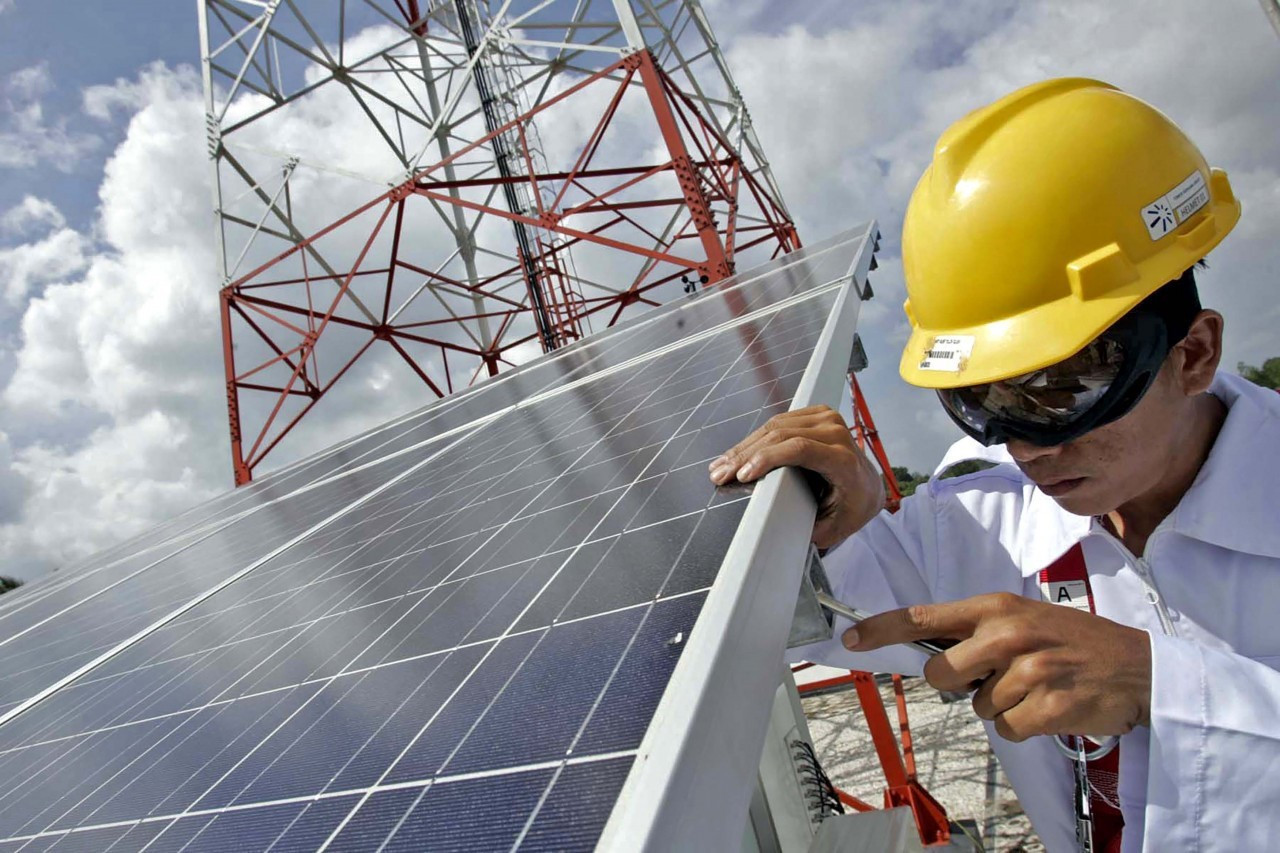 A technician performs maintenance work on a solar power system in Minas, Riau. (Photo:/R. Berto Wedhatama) (Photo:/R. Berto Wedhatama)
State asset fund Danantara recently signed two memorandums of understanding (MoUs) with Singapore's Keppel Electric, Sembcorp Industries and Singapore Energy Interconnections for a cross-border renewable electricity project, marking another milestone in the long-running effort to export Indonesia’s renewable power to the island state. Despite the progress, Energy and Mineral Resources (ESDM) Minister Bahlil Lahadalia said the two countries had yet to reach an agreement on the electricity pricing framework.
According to Bahlil, the proposed export arrangement must provide balanced benefits for both Indonesia and Singapore. Because electricity prices in Indonesia are regulated by the government, exporting power to an external market requires a pricing framework that reflects the interests of both countries.
He also explained that under the existing regulatory framework, the government determines the applicable pricing mechanism.
Indonesia is therefore seeking an agreement that not only enables renewable electricity exports but also ensures that the resulting economic benefits are shared fairly between the two countries.
However, framing the remaining negotiations as simply a matter of "pricing" understates the complexity of the project.
From a commercial perspective, Singapore's willingness to purchase renewable electricity under a market-based pricing mechanism already presents an attractive opportunity for Indonesia. Singapore's liberalized electricity market offers prices that are substantially higher than Indonesia's regulated tariffs, allowing export-oriented renewable projects to generate considerably stronger returns than projects that serve the domestic market.
The central issue therefore extends beyond the price of electricity and concerns how the economic value created by these projects should be distributed within Indonesia.
This question has been at the heart of the Indonesia-Singapore electricity export initiative since 2024, when Singapore's Energy Market Authority (EMA) granted conditional approval to import up to 3.4 gigawatts of renewable electricity from Indonesia.
The approval was awarded to five Indonesian-led consortiums: Pacific Medco Solar Energy, Adaro Green, Batamindo Green Energy, Vanda RE and a consortium led by ACWA Power. Together, these projects represent an estimated Rp 308 trillion (US$17.14 billion) in investment and form the backbone of Singapore's strategy to import low-carbon electricity from neighboring countries.
Over the past two years, the initiative has continued to advance despite the absence of final export approvals. Developers have moved forward with project planning, site preparation and permitting activities across the Riau Islands, where the proposed utility-scale solar facilities will be located.
Preparatory work has also progressed on the supporting transmission infrastructure, including the subsea interconnection needed to deliver electricity to Singapore. As a result, much of the project's technical and commercial foundation is already in place, and the principal remaining hurdle is the Indonesian government's approval of the final export framework.
While the commercial opportunity has been widely recognized, the proposed export framework quickly became the subject of domestic debate. At its core is a simple but important question: Who should capture the premium generated by renewable electricity exports?
Indonesia's power sector is dominated by state electricity firm PLN under a regulated pricing regime. Against this backdrop, the prospect of private renewable developers exporting electricity directly to Singapore at international market prices represents an unprecedented commercial opportunity.
As discussions evolved, PLN sought to establish a role within the export framework, arguing that cross-border electricity trade should remain closely integrated with the national power system. This position is also consistent with Indonesia's regulatory framework, under which electricity may be exported only by state-owned enterprises or government-authorized entities.
Consequently, although the five Indonesian consortiums have secured conditional import approvals from the EMA, they cannot proceed with exports without obtaining the necessary authorization from the government.
This in turn raised concerns among private developers that introducing an intermediary could fundamentally alter the commercial structure envisioned when the EMA granted approval. Last year however, Bahlil indicated that renewable electricity exports would not necessarily have to be conducted exclusively through PLN, suggesting that private companies could play a direct role in export activities.
Viewed in this context, the remaining bottleneck is not whether Singapore is willing to pay a commercially attractive price for Indonesia’s renewable electricity; rather, it is a domestic governance and value sharing challenge.
The unresolved question is how the value created by these exports, including export rights, commercial margins and the broader economic benefits, should be allocated among the government, PLN and the private consortiums developing the projects.