
News
The anti-LGBTQ push and the securitization of identity
Tenggara Strategics July 24, 2026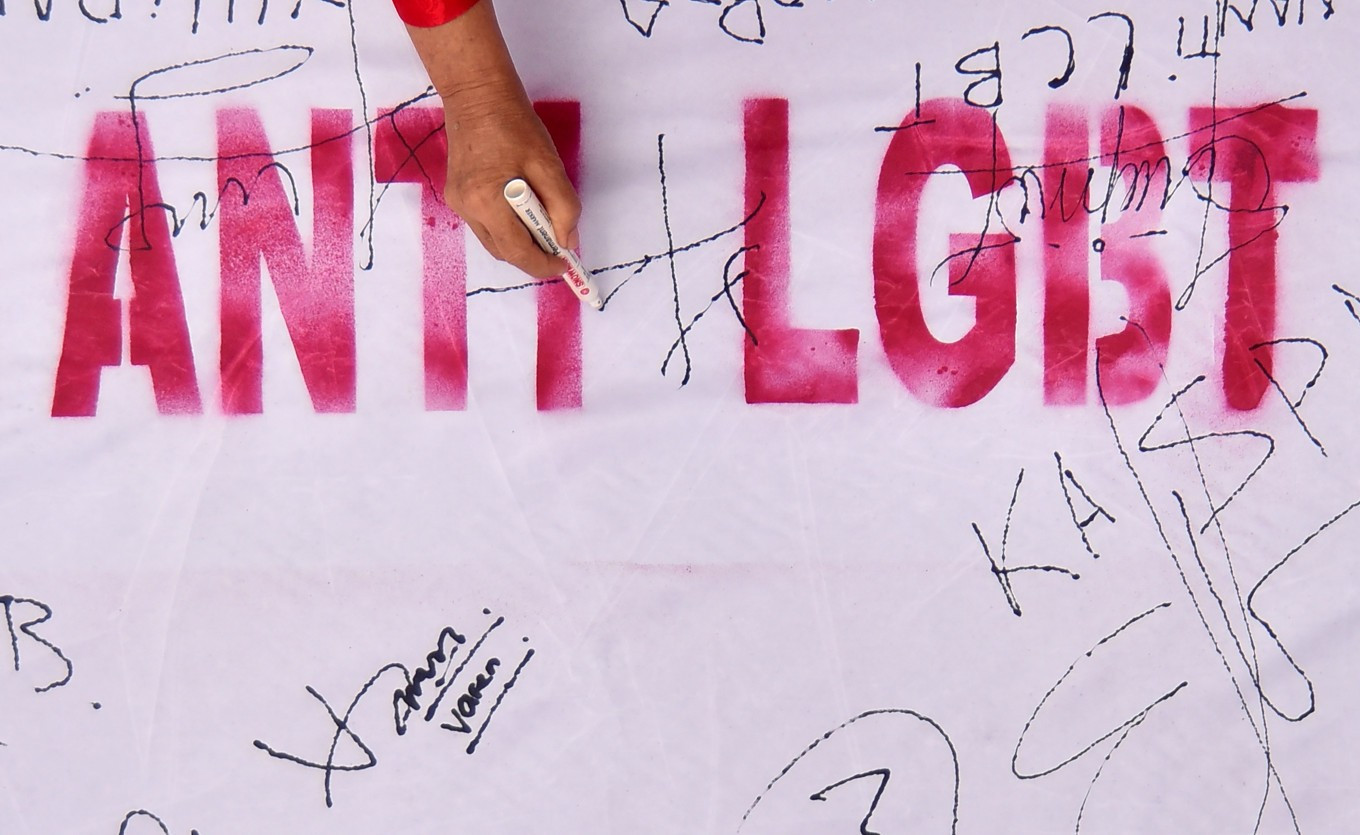 Residents sign a white banner during an anti-LGBT rally on June 21 in Padang, West Sumatra. The event, organized by the West Sumatra administration, the West Sumatra Police and the Minangkabau Traditional Council (LKAAM), invited participants to sign a one-kilometer-long white banner as part of a declaration opposing the LGBT community. Organizers also pledged to take action against LGBT individuals through customary law and called for them to be “eradicated” or expelled from Minangkabau land. (Antara/Fitra Yogi)
Lesbian, gay, bisexual, transgender and queer (LGBTQ) issues have once again surged to the forefront of Indonesia's political and social discourse. Two recent, overlapping developments warrant close examination: the formal classification of the "spread of LGBTQ culture" as a nonmilitary threat under the national defense policy, and a concerted legislative push to introduce criminal sanctions targeting LGBTQ people and advocacy.
While these systemic tensions have existed for years, they gained renewed momentum following the global observance of Pride Month in June. Public discussions have since intensified across national media and digital platforms, prompting a critical reevaluation of the state's role in policing identity, the boundaries of national security and the preservation of constitutional liberties.
The first major controversy centers on Presidential Regulation (Perpres) No. 111/2025 on the 2025-2029 national defense policy, signed by President Prabowo Subianto on Oct. 24, 2025. Although the regulation has been in place for nearly nine months, its implications started drawing widespread public scrutiny only after specific provisions began circulating online recently.
Crucially, the regulation categorizes the "spread of LGBTQ culture" as a nonmilitary threat, which is defined as unarmed activities that potentially jeopardize state sovereignty, territorial integrity or public safety. Under this framework, ministries, government agencies and regional administrations outside the defense sector are mandated to coordinate joint responses to mitigate the threat.
Constitutional law experts and human rights advocates argue that this classification directly challenges Indonesia’s existing legal architecture. Article 28I, Paragraph 4 of the 1945 Constitution explicitly places the responsibility for protecting, promoting, enforcing and fulfilling human rights squarely on the state, particularly the government. Furthermore, Article 28E, Paragraph 2 guarantees every citizen the right to freedom of belief, conscience and the expression of opinions and beliefs.
Critics contend that framing personal identity as a national security issue risks institutionalizing social stigma and legitimizing extrajudicial discrimination. Furthermore, legal scholars point out that Indonesia's criminal justice system already possesses adequate mechanisms to prosecute offenses regardless of an individual's sexual orientation or gender identity, rendering classifications related to national defense unnecessary and highly inflammatory.
Simultaneously, the Indonesian Ulema Council (MUI) is spearheading a legislative initiative to criminalize LGBTQ-related activities. The conservative clerical body says it wants the House of Representatives to include the bill it is drafting in the National Legislation Program (Prolegnas). The move has found alignment with the Religious Affairs Ministry, several key lawmakers and Islamic political parties.
MUI deputy chairman M. Cholil Nafis insists that moral appeals alone are no longer sufficient to curb increasingly visible sexual deviance in public spaces. Echoing this stance, the Religious Affairs Ministry noted that LGBTQ communities had become significantly more visible in recent years. In tandem, Singgih Januratmoko, a member of House Commission VIII overseeing religious affairs, proposed strict regulations to prohibit LGBTQ-related content on social media, arguing that unrestricted online exposure risked normalizing such behavior among children.
Politicians from religious parties have framed the issue through both the cultural and demographic lens. Almuzzammil Yusuf, president of the Prosperous Justice Party (PKS), argued that LGBTQ identities were fundamentally incompatible with the core religious, cultural and social values of Indonesia. Marwan Jafar, a politician from the National Awakening Party (PKB), characterized same-sex relationships as a direct demographic threat due to their nonreproductive nature.
On social media, this demographic anxiety has frequently intersected with unverified conspiracy theories. Prominent narratives claim that international advocacy for LGBTQ rights is part of a deliberate global depopulation agenda orchestrated by foreign elites. These theories allege that sexual orientation is being covertly manipulated through imported food, vaccines, pharmaceuticals or targeted foreign funding.
However, these claims have been consistently debunked by global health organizations, scientific institutions and independent fact-checkers. No credible empirical evidence exists to support the theory that sexual orientation can be artificially engineered or that LGBTQ advocacy is tied to a global depopulation strategy.
The proposed measures have met with fierce resistance from civil society. The Civil Society Network, a coalition of dozens of legal aid and human rights organizations, has condemned both the securitization narrative and the proposed criminalization. The coalition warns that such policies will shrink civic space, erode constitutional guarantees and signal a concerning regression in Indonesia's democratic journey.
Legal scholars have also questioned the jurisprudential validity of the MUI's proposed bill. Constitutional and criminal law experts emphasize that criminal law should strictly regulate objective, harmful conduct that violates the public interest rather than codifying the subjective moral or religious doctrines of specific groups. Using the penal code to enforce private morality, they argue, compromises the fundamental legal principle of certainty.
The controversy extends far beyond the immediate debate over LGBTQ rights, and touches upon a foundational question for the nation: How does Indonesia balance its constitutional commitment to human rights and democratic governance with the diverse, often majoritarian, religious and moral values that influence its policymaking?
One thing is certain: targeting the LGBTQ community as a nonmilitary threat endangers Indonesia’s foundational diversity.
What we've heard
A senior military officer familiar with the drafting process of the regulation stated that discussions on the matter began in 2023 and involved multiple defense and security institutions. According to the source, consultations included the National Defense Council, the Home Ministry, the Foreign Ministry, and the Indonesian National Armed Forces (TNI) headquarters.