
News
The corruption risk at the heart of Prabowo's free meals program
Tenggara Strategics July 14, 2026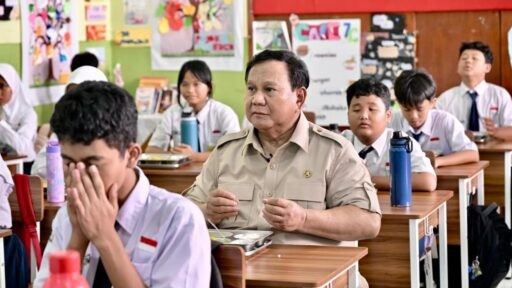 President Prabowo Subianto inspects the implementation of the free nutritious meals program on June 2, 2026, at State Junior High School (SMPN) 111 Jakarta. (Courtesy of/The Palace's Press Bureau (BPMI))
President Prabowo Subianto's free nutritious meal program was conceived as a transformative social policy to improve child nutrition, strengthen human capital and demonstrate the state's ability to deliver tangible benefits to millions of Indonesians. It is also the policy most closely associated with his presidency. More than any other initiative, its success or failure will shape public perceptions of his administration.
Yet the growing wave of corruption scandals engulfing the National Nutrition Agency (BGN), the institution responsible for implementing the program, suggests the problem may run deeper than individual misconduct. Prosecutors have accused former senior BGN officials of using foundations connected to meal-production kitchens to obtain unlawful benefits, and of manipulating procurement through budget markups and other irregularities.
Recent arrests and investigations have transformed what initially appeared to be isolated allegations into a broader governance crisis. The most important question is no longer whether corruption occurred, but whether the program's design itself makes corruption unusually difficult to prevent.
The allegations against former BGN leaders illustrate this vulnerability precisely. Prosecutors allege that foundations operating nutrition fulfillment service units (SPPG) - the kitchens producing meals under the program - were used to generate illicit profits, while procurement was allegedly manipulated through inflated contracts and interference in purchasing decisions.
The significance lies not only in the money involved but in the fact that the alleged misconduct spans multiple levels of the program's operational structure. When irregularities appear simultaneously in kitchen management, foundation oversight, procurement planning and contract execution, it becomes hard to argue the problem is merely a few bad actors.
The deeper concern is that the program's governance architecture appears to blur the distinction between operators and overseers. The government has repeatedly emphasized that the program is subject to strict monitoring by major state institutions, including the Attorney General's Office (AGO), the National Police and the Indonesian Armed Forces (TNI). Yet institutions linked to these same organizations have also become involved in establishing, managing or supporting the kitchens that form the program's backbone.
The police, for example, have publicly participated in expanding free meals program kitchens, with law-enforcement and security institutions playing prominent roles in supporting implementation - even boasting about the quality of the kitchens they run. From a governance perspective, this creates a fundamental conflict of interest.
Effective anti-corruption systems depend on a clear separation between those who implement programs and those who monitor them. When institutions are simultaneously participants and supervisors, accountability mechanisms risk losing their effectiveness. Even if every actor behaves with integrity, the mere perception of compromised independence can undermine public confidence.
This is why simply replacing the BGN's leadership is unlikely to fix the underlying problem. The government has already carried out a reshuffle following mounting criticism, but management changes alone rarely solve structural governance failures.
New leaders inherit the same institutional incentives, the same procurement architecture and the same oversight weaknesses. If opportunities for conflicts of interest, opaque contracting and political influence remain embedded in the system, corruption risks will persist regardless of who holds senior positions. Focusing on individuals rather than institutions is politically understandable, but it risks obscuring the larger issue. Corruption flourishes not only because individuals break the rules but because systems are built in ways that make abuse easy, profitable and hard to detect.
Because the free meals program is Prabowo's signature policy, its reputation is inseparable from his own. Every new allegation becomes a test of presidential leadership. If the public comes to believe corruption is endemic to the program, criticism will not stay confined to BGN officials or contractors - it will increasingly target the administration that designed, promoted and defended the initiative. This risk is compounded by what many observers see as a reluctance by the president to fully acknowledge the structural nature of the problem.
Framing corruption scandals as isolated incidents despite mounting evidence of broader governance weaknesses can make a government appear more concerned with protecting a program's image than fixing its vulnerabilities - a perception that may ultimately cause more reputational damage than the scandals themselves.
The long-term sustainability of the free meals program depends not merely on prosecuting wrongdoers but on redesigning the system of oversight: independent audits, full transparency of contracts and kitchen operators, public disclosure of procurement decisions, parliamentary scrutiny and stronger civil-society monitoring. Above all, oversight institutions must be genuinely independent from the entities they supervise.
Without such reforms, the scandals will continue to erode confidence - not only in the free meals program, but in Prabowo's capacity and willingness to ensure accountability within his most important policy initiative.
What we've heard
The AGO is pressing ahead with its investigation into alleged corruption surrounding the government's free nutritious meal program. Prosecutors have named seven suspects in the case, the latest being Brig. Gen. Lalu Muhammad Iwan Mahardan, who serves as secretary to the deputy for promotion and cooperation at the BGN.