
News
Deforestation ignored as Sumatra faces its worst flood disaster
Tenggara Strategics December 16, 2025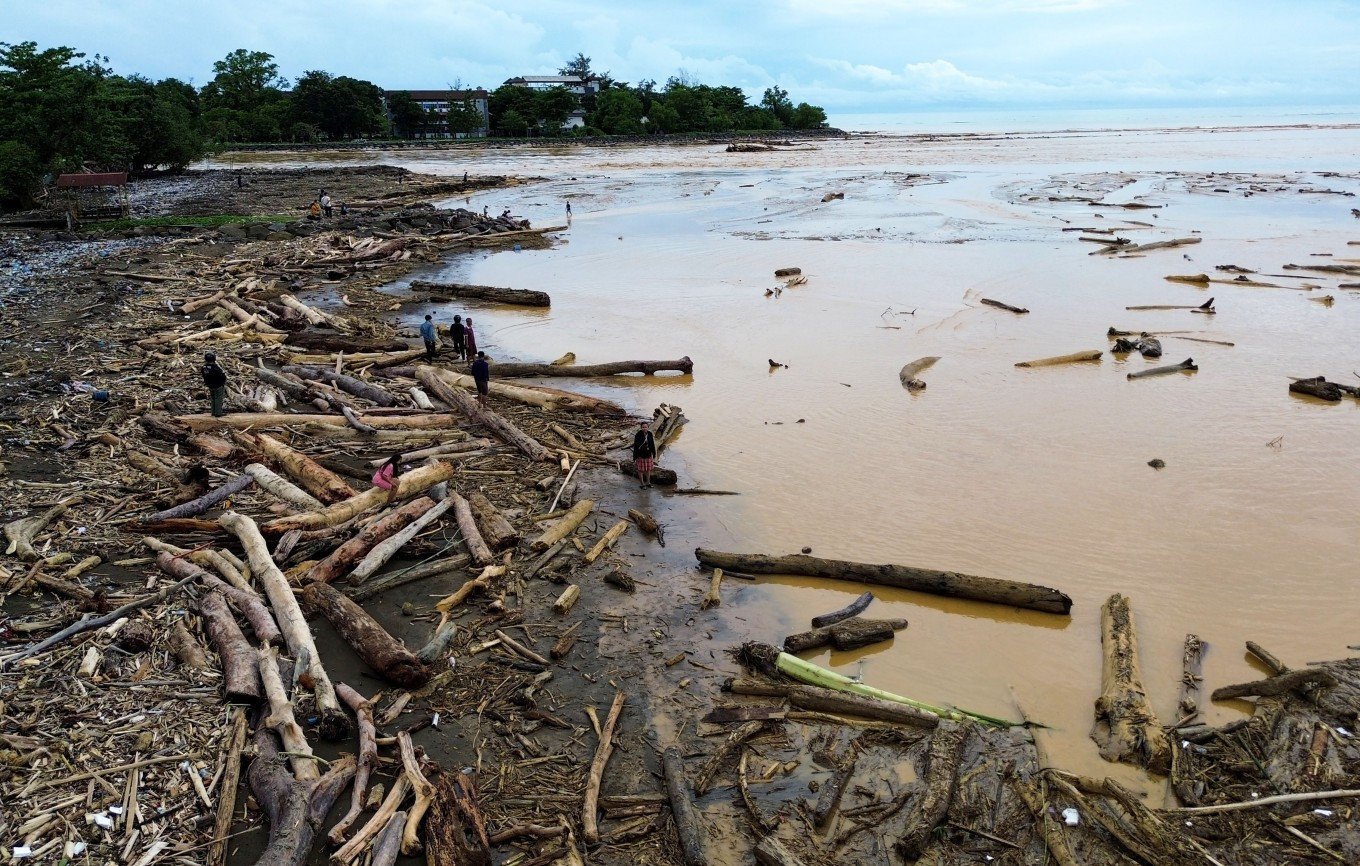 Residents walk among piles of large timber washed ashore on Air Tawar Beach in Padang, West Sumatra, on Friday, Nov. 28, 2025. The logs accumulated along Padang’s coastline following recent flash floods. (Antara/Iggoy el Fitra)
The flash floods and landslides that ravaged Aceh, North Sumatra and West Sumatra should prompt far deeper scrutiny than they have so far received. While Cyclone Senyar intensified the rainfall, the scale of destruction reflects decades of unchecked ecological degradation that have left communities acutely exposed.
As of Dec. 10, the National Disaster Mitigation Agency (BNPB) reported 969 deaths, 262 missing persons and more than 5,000 injured. The disaster also damaged 157,900 homes and 1,200 public facilities. Economically, the Center of Economic and Law Studies (CELIOS) has placed losses at Rp 68.67 trillion (US$4.1 billion), while BNPB expects recovery costs of at least Rp 51.82 trillion.
Given these figures, it is increasingly difficult to treat the catastrophe as a purely natural event. Since the floods struck on Nov. 25, videos circulating on social media have shown neatly cut logs swept downstream, a stark indication of extensive upstream logging activity and a reminder that severe ecological degradation magnified the impact of extreme weather.
Data from the Environment Ministry, Forestry Ministry and Statistics Indonesia underscore the pattern. In 2024 alone, net deforestation reached 11,208 hectares in Aceh, 7,035 ha in North Sumatra and 6,634 ha in West Sumatra, together accounting for 24,877 ha, or 14.2 percent of Indonesia’s total net forest loss that year. Just five years earlier, the combined figure in these provinces stood at 3,926 ha, or 3.4 percent of the national total.
Not only are these provinces losing trees rapidly, they are experiencing one of the steepest upward trends in deforestation nationwide. Reforestation efforts lag far behind: over the past five years, forest rehabilitation in the affected areas has never exceeded 20 percent of the land cleared. The gap points to systemic failures in forest governance and long-standing neglect of Sumatra’s ecological vulnerabilities.
The government has acknowledged the environmental dimension of the disaster. Forestry Minister Raja Juli Antoni said at least 12 companies in North Sumatra were suspected of violating environmental regulations, and the ministry is preparing to revoke 20 Forest Utilization Business Permits (PBPH) covering 750,000 ha across the three provinces. He has also asked National Police Chief Gen. Listyo Sigit Prabowo to investigate the origins of the logs filmed drifting through towns during the floods, raising the possibility of widespread illegal logging.
In parallel, Environment Minister Hanif Faisol Nurofiq has taken action by stopping the operation of four firms accused of intensifying ecological pressures in upstream areas: PT Agincourt Resources, PTPN III, PT North Sumatera Hydro Energy and one unnamed company.
Despite these moves, President Prabowo Subianto has so far avoided linking the tragedy to deforestation. His public comments have centered on reconstruction, farmland rehabilitation and microcredit relief for smallholder farmers, priorities aligned with his administration’s food security agenda. But he has offered no indication of whether he intends to confront the environmental drivers that worsened the disaster.
The timing is politically awkward. Prabowo’s recent trip to Islamabad, where he discussed climate cooperation, coincided with growing domestic calls for environmental accountability. While climate change contributes to the severity of hydrometeorological disasters, Indonesians are demanding answers about the deforestation that directly amplified the floods’ impact. The absence of a clear presidential stance risks reinforcing perceptions that the Palace is sidestepping the issue.
Complicating matters further are renewed questions about the President’s own concession holdings. In the 2024 presidential debate, Prabowo acknowledged managing hundreds of thousands of ha in forest concessions. Reports have also linked him to PT Tusam Hutani Lestari, which holds a 97,000-ha concession in the upstream area of hard-hit Central Aceh and is currently led by former Gerindra deputy chairman Edhy Prabowo. In July, President Prabowo said that he had entrusted all of his forest concessions in Central Aceh to the World Wide Fund for Nature (WWF) for elephant conservation.
Taken together, these associations raise potential conflict-of-interest concerns that could weaken the President’s credibility in confronting Sumatra’s environmental crisis.
The scale of the tragedy should mark a turning point in Indonesia’s approach to environmental governance. As long as deforestation remains unaddressed, disasters of this magnitude will recur. Physical reconstruction may restore damaged infrastructure, but without political resolve to tackle problematic concessions, strengthen oversight and recognize the link between policy choices and ecological vulnerability, Indonesia risks being caught unprepared once again when nature exacts its next toll.