
News
Indonesia's fiscal strains deepen as deficit rises, revenue underperforms
Tenggara Strategics December 11, 2025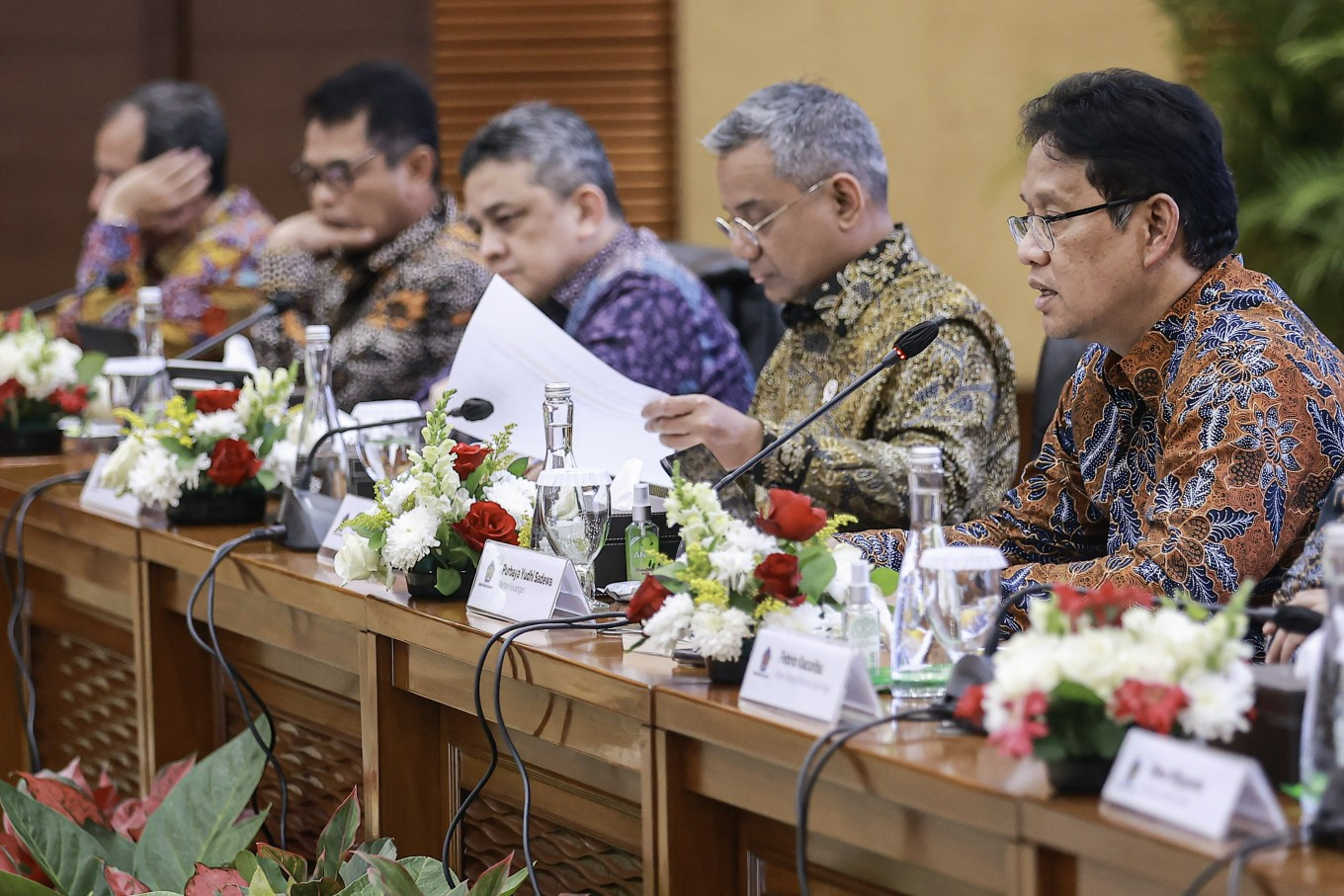 Finance Minister Purbaya Yudhi Sadewa (right) delivers a presentation during the monthly budget update press briefing on Oct. 14, 2025. (Antara/Dhemas Reviyanto)
Indonesia's budget deficit widened Rp 479.7 trillion (US$29.98 billion) or 2.02 percent of GDP in October 2025, heightening concerns about the country's fiscal health. This marks a sharp increase from the Rp 309.2 trillion deficit, or 1.37 percent of GDP, recorded during the same period last year. The shortfall has been further pressured by sluggish state revenues as the government had collected only Rp 2.1 quadrillion by Oct. 31, equivalent to 73.7 percent of this year's revenue outlook.
Several structural and policy factors have contributed to the current fiscal strain. Early in the year, the government implemented an efficiency policy that trimmed routine expenditures by Rp 306.7 trillion. While this move aimed to preserve fiscal space, it also delayed the rollout of several programs, including two major priorities: the Free Nutritious Meal (MBG) initiative and the Red and White Village Cooperatives program. Delays in budget execution across ministries and agencies added to the bottlenecks.
On the revenue side, tax collection has underperformed amid a period of slowing global economic activity and weak prices for Indonesia's major export commodities, with gold being the sole exception. The full transition to the Coretax software system also has yet to deliver optimal results, with collection performance remaining below target throughout the year as system revamps were not finished until the end of October.
In addition, the government is also undergoing an adjustment period in its fiscal policy. In a bid to curb illegal cigarettes, it cancelled its usual annual plans for an excise tax increase, which has reduced excise revenue in the short run but is intended to optimize revenue collection in the long run, given that cigarettes account for a large majority of Indonesia's excise income, around 96.2 percent based on data from previous years.
Another important example of the government's broader fiscal adjustment can be seen in the recent changes to the micro, small, and medium enterprises (MSMEs) income-tax regime. Since 2018, Indonesia has allowed MSMEs with annual turnover below Rp 4.8 billion to pay a 0.5 percent final income tax on gross revenue. This scheme was originally designed as a temporary incentive to help very small businesses formalize, reduce their tax-compliance burden, and support entrepreneurship during the early years of operation.
Recently, the government decided to make this 0.5 percent MSME tax rate permanent. However, this "permanent" status applies only to individual business entities and sole proprietorships, while corporate MSMEs such as PTs, CVs, firms, and cooperatives will still be required to transition into the regular income-tax system, which uses net taxable income and progressive rates.
This distinction reflects growing concerns that some businesses deliberately limited their expansion to remain eligible for the low, final tax rate, thereby weakening tax-base development. As a result, many small incorporated firms operating near the Rp 4.8 billion threshold will now enter the regular tax system earlier than expected. While understandable frustrations have emerged from affected businesses, policymakers view the shift as a necessary step in tightening and rationalizing MSME tax incentives.
The widening deficit underscores the challenges Indonesia faces as it consolidates fiscal adjustment to keep up with its ambitious programs. Weak revenue performance, transitional policy adjustments, and delays in budget execution have converged at a time when the government is trying to expand priority initiatives. As year-end approaches, the effectiveness of its ongoing tax reforms and budget realization acceleration will set the tone for investor confidence entering 2026 and onwards.