
News
Death of peacekeepers forces Prabowo to rethink Middle East strategy
Tenggara Strategics April 13, 2026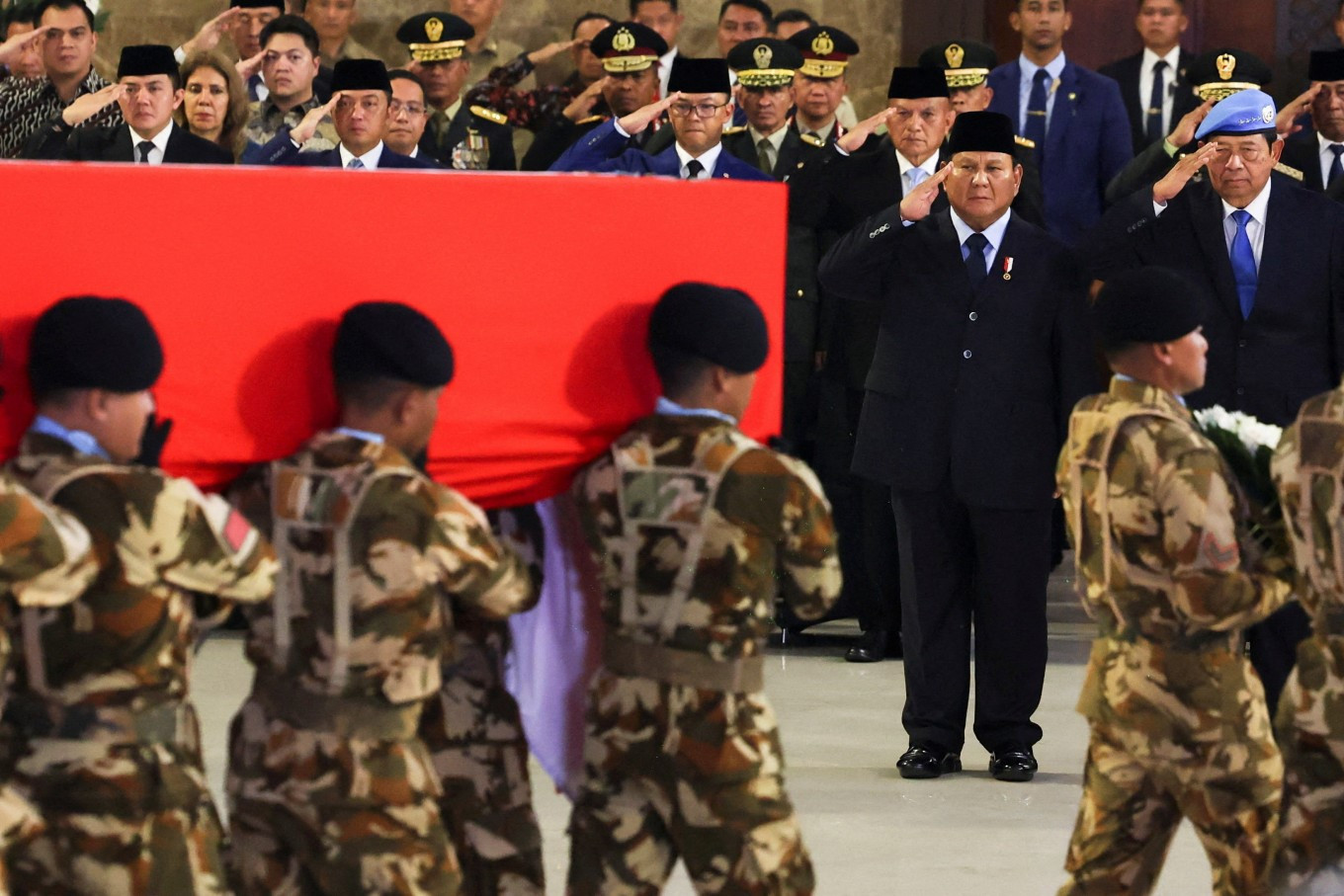 President Prabowo Subianto (right) salutes the coffins of Indonesian soldiers killed while serving with the United Nations Interim Force in Lebanon (UNIFIL) on April 4, at Soekarno-Hatta International Airport in Tangerang, Banten. (AFP/Yasuyoshi Chiba)
For months, President Prabowo Subianto has been crafting his own strategic approach to the Middle East, often departing from some of Indonesia’s traditional foreign policy principles, including on the question of establishing relations with Israel. Central to this strategy was joining the Board of Peace (BOP) set up by United States President Donald Trump in January, a move widely criticized at home as abandoning Indonesia’s long-held support for Palestinians in their long struggle for an independent state.
When Israel and the US launched coordinated attacks against Iran in late February, Prabowo remained adamant about Indonesia’s BOP membership. He even ordered the Indonesian Military (TNI) to ready some 8,000 soldiers to join the US-led International Stabilization Force (ISF) for deployment in Gaza to enforce peace in the tiny Palestinian enclave which had been devastated by more than two years of constant bombings by Israel.
Now the deaths of three TNI members who were part of the United Nations’ peacekeeping force in Lebanon may force Prabowo to rethink his entire approach to the Middle East.
Early investigations by the United Nations point the finger to Israel’s attacks in Lebanon as the cause of their deaths. Sending troops to Gaza could be a futile exercise, even described as suicidal by one critic, since this mission does not have the usual UN mandate.
Opposition to Prabowo’s novel approach to the Middle East is now growing among the general public when previously it had been confined to a small clique of Indonesia’s foreign policy community. He can no longer afford to ignore public opinion.
Prabowo, a former Army general, knows full well the risks that he is exposing Indonesian troops to if they are sent to Gaza. Before he commits more troops to the Middle East, the Indonesian public are demanding explanation and accountability for the deaths of three TNI members. Some have even called on the government to move out of harm’s way the remaining Indonesian troopers working for the UN Interim Force in Lebanon (UNIFIL), given Israel’s intensifying attacks in Lebanon.
The US war in Iran also exposed a major flaw in Prabowo's Middle East strategy. His initiative to offer to mediate peace immediately when the war started went largely ignored. In spite of his frequent trips to the Middle East to raise Indonesia’s profile in the region as peacemaker, he had completely ignored Iran. Instead, Tehran and Washington chose Pakistan, also a BOP member, to broker the two-week truce last week to avert a more catastrophic war.
Indonesia under Prabowo has also refrained from condemning the US attack on Iran, just as it did with the earlier US invasion of Venezuela, as a violation of international laws. Instead, Indonesia’s statement went only as far as expressing deep regrets. Prabowo needs to appease Trump, certainly avoid upsetting him, to have any chance of a mediating role in the Israel-Palestinian conflict, which seems central to his Middle East strategy.
Where Prabowo departed from Indonesia’s traditional policy in the Middle East is on the question of ties with Israel. Although he has insisted that Indonesia will not open diplomatic relations with Israel until Palestinians gained their independent homeland under the two-state solution, critics say joining the BOP would inevitably means sitting on the same table with Israel’s Prime Minister Benjamin Netanyahu, or his representative as was the case at the inaugural BOP meeting in Washington in February.
In his debut speech at the United Nations General Assembly in September, Prabowo went furthest on the issue than any Indonesian leader has when he stated that Indonesia is ready to recognize Israel and provide security guarantee if it accepts the two-state solution.
Supporters of Prabowo’s Middle East strategy say that several other Muslim-majority countries, including Egypt, Jordan, Turkey and Morocco, have diplomatic relations with Israel to afford them direct communication and express concerns or convey protests. The absence of such direct contacts, so they argue, prevent Indonesia from playing a more active role in the search for peace between Israel and Palestine.
Prabowo has defended his decision to join the BOP, apparently against the advice of his top diplomats, as the only way to stop Israel killing Palestinians in Gaza. Critics however say that the killings have continued in spite of Israel agreeing to President Trump’s Gaza peace plan in October. More than 700 Palestinians have been killed in the Gaza Strip since then, bringing the total to over 70,000 deaths, including many women and children, since Israel launched the military operation in October 2023.
At any rate, the war in Iran has put the BOP work in Gaza on hold, including the deployment of the ISF to enforce the peace agreement. The pause gives Prabowo time to rethink his entire Middle East strategy, which may include exiting the BOP, since three Indonesian soldiers have been killed, most likely by Israel.
What we've heard
President Prabowo gathered various stakeholders, including former presidents and Islamic scholars, to discuss Indonesia’s involvement in the BOP. During these meetings, he emphasized that Indonesia’s participation in the US-led initiative serves as a vital bridge toward achieving lasting peace in the Middle East, with a specific focus on Palestine.