
News
BPJS Kesehatan under strain as claims outpace revenues
Tenggara Strategics April 27, 2026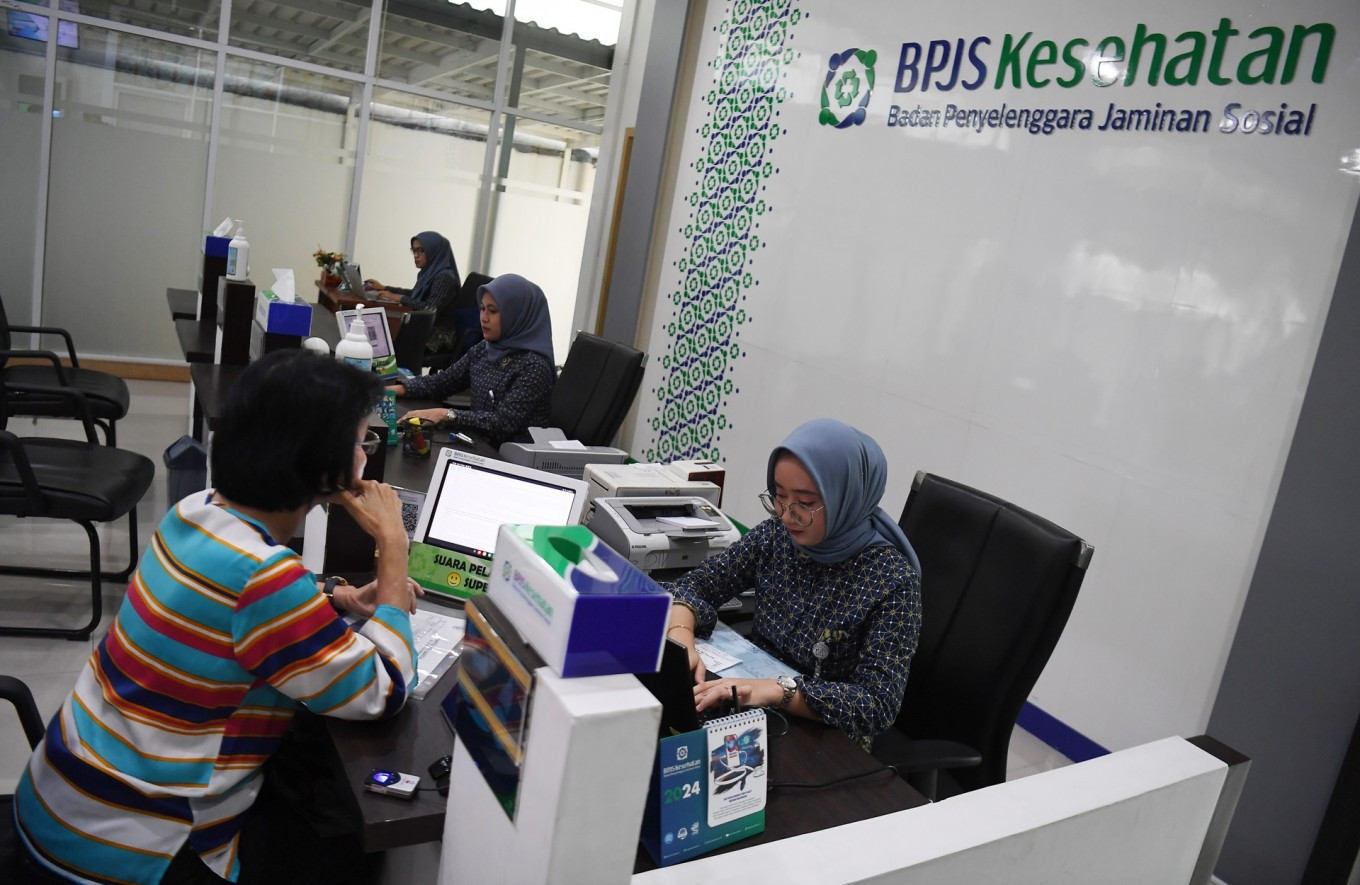 A Health Care and Social Security Agency (BPJS Kesehatan) official helps a customer on May 14, 2024, at the agency's South Jakarta office. (.Antara/Akbar Nugroho Gumay)
Indonesia’s universal healthcare program is coming under renewed strain as the Health Care and Social Society Agency (BPJS Kesehatan) revealed that claims have begun to outpace premium revenues. With the claim ratio reaching 111.86 percent as of February 2026, the imbalance signals growing pressure on the financial sustainability of the National Health Insurance (JKN) system.
BPJS Kesehatan president director Prihati Pujowaskito said the imbalance reflects structural weaknesses in JKN’s funding model and could lead to a sustained deficit. As of February 2026, premium revenue reached Rp29.26 trillion (US$1.71 billion), while claims expenses stood at Rp32.73 trillion, resulting in a Rp3.47 trillion shortfall and pushing the claim ratio above 100 percent.
Prihati noted that financial pressure has persisted since JKN’s launch in 2014, with only a brief period of stability between 2019 and 2022, when the claim ratio fell below 100 percent. Since then, the ratio has steadily increased from 104.72 percent in 2023 to 105.78 percent in 2024, 107.69 percent in 2025 and 111.86 percent this year.
A key driver of the program’s strain is declining active membership. As of February 2026, inactive participants reached 58.32 million, comprised of 13.48 million members in arrears and 44.84 million who have deactivated their memberships. This trend is partly driven by non-salaried workers (PBPU), particularly freelancers in the informal sector, opting out of the program. It is also linked to adjustments in local government budgets, which have reduced subsidies for low-income and vulnerable groups (PBI).
The issue of declining government coverage for PBI participants has been one of the key drivers of this trend. According to Social Affairs Minister Saifullah Yusuf, the ministry deactivated around 13.5 million members of the PBI program between April 2025 and January 2026 as part of broader efficiency measures aimed at improving targeting accuracy.
Nevertheless, these measures have had unintended consequences. While the objective of improving targeting is fiscally justified, the large-scale deactivation of subsidized members has not been matched by a corresponding increase in new or returning contributors. Instead, many of those removed from the PBI scheme have transitioned into inactive status, contributing to the growing pool of nonpaying participants and further narrowing the program’s effective contribution base.
As cash inflows from members decline, healthcare costs continue to rise. Total benefit costs increased by 11 percent between 2024 and 2025, while spending on serious illnesses grew by 12 percent over the same period.
Operational challenges further compound the issue. BPJS Kesehatan members frequently report difficulties accessing services, long waiting times, limited availability of medicines and concerns about the responsiveness of healthcare staff. For some participants, especially those with the option to exit, these issues weaken the perceived value of remaining in the program, potentially leading them to opt out.
Taken together, these structural and operational pressures raise broader questions about Indonesia’s readiness to sustain universal health care at JKN’s scale. International experience suggests that such systems depend on high participation rates, typically secured through mandatory enrollment and strong compliance mechanisms to ensure consistent premium payments.
Equally important is effective cost containment. Many universal healthcare systems rely on measures such as price controls, negotiated tariffs and centralized procurement to align expenditure growth with available funding, thereby maintaining financial viability.
Japan, for example, operates one of the most tightly controlled cost-containment systems through its nationally uniform fee schedule. Under this system, the government sets and revises a single price list for all medical services, pharmaceuticals and procedures every two years. This centralized approach allows policymakers to directly manage healthcare spending by adjusting reimbursement rates for services that are overutilized or becoming too costly.
These elements form the basic foundation of a sustainable system, even before addressing the next layer of challenges: service quality, accessibility and efficiency. Without them, universal healthcare programs risk persistent financial strain and eroding public confidence, as reflected in JKN’s current trajectory.