
News
An economy that isn’t hiring: Why policy is failing the labor market
Tenggara Strategics April 30, 2026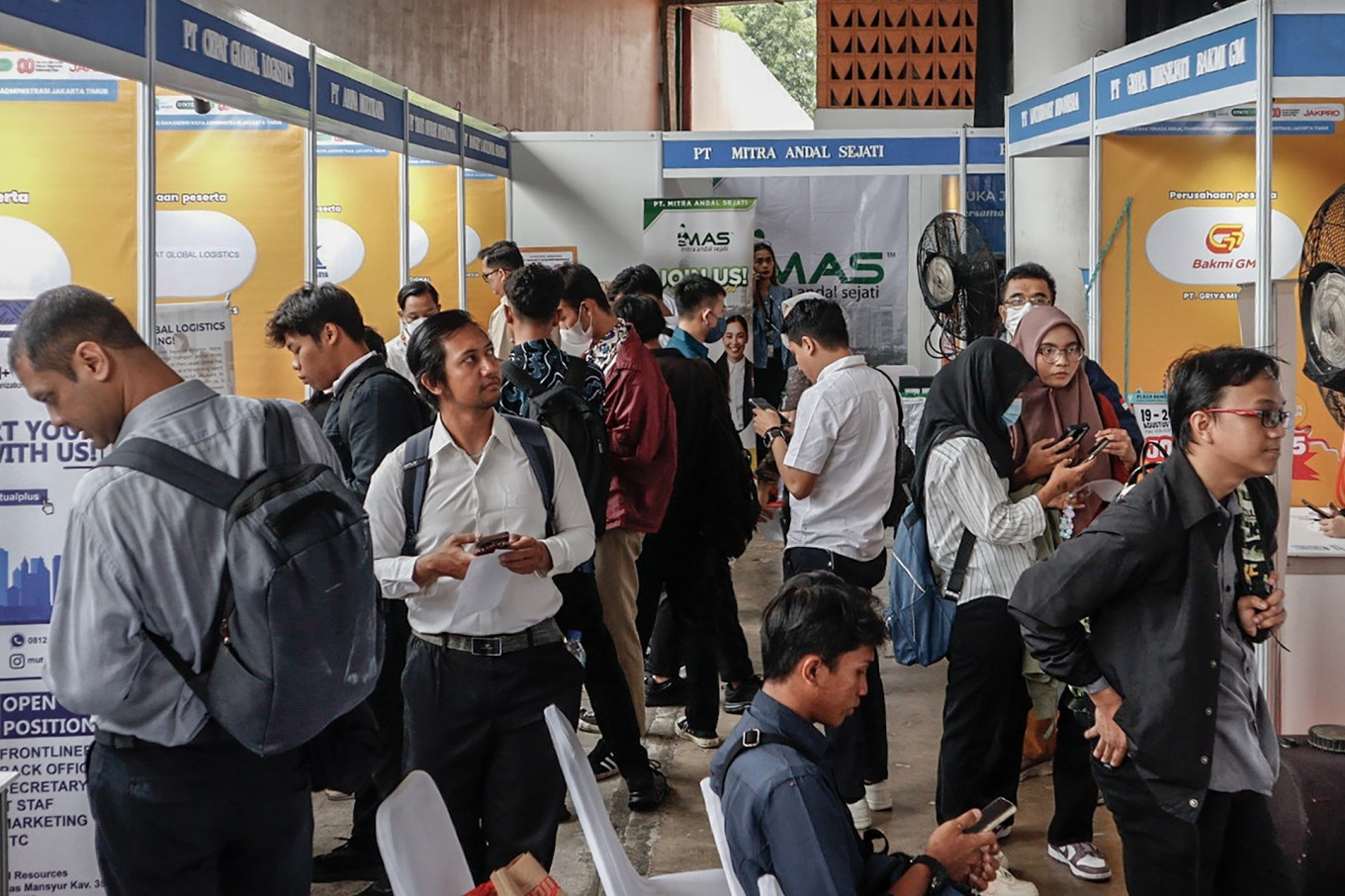 People visit the booths of participating companies on Aug. 19, 2025, during a job fair in Jakarta. (Antara/Muhammad Rizky Febriansyah)
The job creation engine is showing signs of strain. Despite steady economic growth and rising investment, businesses are increasingly reluctant to expand their workforce, raising concerns over the economy’s ability to absorb millions of new job seekers each year. The emerging disconnect between growth and employment is no longer cyclical but structural, pointing to deeper challenges in how investment, labor policy and skills development are aligned.
According to the Indonesian Employers Association (Apindo), most of its members have no plans to hire new employees in the near future. An internal survey shows that around 50 percent of firms do not intend to expand in the next five years. In a country where millions enter the labor market each year, the question is pressing: Who will create jobs if businesses don’t?
The arithmetic is unforgiving. Each year, around 3.5 million new job seekers enter the labor market, yet every percentage point of economic growth generates only 200,000 to 400,000 jobs, according to Apindo. Job creation tends to reach the upper range only when investment is concentrated in labor-intensive sectors; otherwise, the number is significantly lower.
Even under an optimistic growth scenario of 5 percent, the economy absorbs at most 2 million workers, leaving at least 1.5 million people without a clear pathway into formal employment each year. Many are pushed into the informal sector, which already accounts for nearly 60 percent of the workforce and continues to expand. The informal sector has become a slow-moving pressure valve, quietly absorbing the strain of a deepening job crisis that headline growth figures fail to capture.
The hesitation among formal sector businesses runs deeper than a mere confidence slump. Apindo’s survey shows that around 67 percent of companies do not intend to recruit new employees, underscoring a broader shift in sentiment. Bob Azam, head of manpower at Apindo, points to a structural change in investment patterns, where capital is increasingly moving away from labor-intensive manufacturing.
This is compounded by a persistent cost competitiveness problem. The Indonesian Chamber of Commerce and Industry (Kadin) has highlighted that severance pay obligations can reach up to 19 months’ salary, compared to roughly five months in Vietnam for workers with comparable years of service, making both hiring and layoffs significantly more costly. The result is a quiet but consequential reorientation as investors increasingly turn to Vietnam and Cambodia when deciding where to build their next factory.
The problem does not rest solely with investors, however. A structural disconnect has quietly taken hold within the labor market. Data from the Mandiri Institute show that around 72.3 million people were caught in a vertical mismatch in 2025. More troubling than overqualification is the economy’s failure to generate enough productive, high-quality jobs to absorb the growing number of graduates entering the labor market.
The education system continues to produce graduates, but job creation is lagging in higher-quality sectors. The result is a labor market pulled in two directions: Firms struggle to find technically skilled workers, while unemployment persists because the available jobs do not match workers’ capabilities. In economic terms, this reflects a structural unemployment trap, where low-productivity employment coexists with a shortage of relevant technical skills.
The deeper failure lies in policy design. President Prabowo Subianto has set an ambitious growth target of 8 percent and the creation of 3-4 million jobs annually. Yet recent outcomes suggest a widening gap between ambition and reality. Despite investment reaching Rp 1.931 quadrillion (US$112 billion) in 2025, only around 2.7 million jobs were created. This gap reflects a structural issue: Investment is not translating into employment at the scale required.
Much of the capital flowing into the country remains capital-intensive and thereby limits labor absorption, while many of the jobs created are either part-time or concentrated in the informal sector. As analysts have noted, policy responses remain fragmented, without sufficient coordination between fiscal initiatives, labor regulations and industrial strategy. The challenge, therefore, is not a lack of targets but the absence of a coherent strategy to meet them.
The issue is not economic growth but whether it translates into jobs. Under the current policy mix, that link is weakening steadily. As long as hiring remains costly, skills development drifts away from industry needs and investment is not steered toward labor-absorbing sectors, job creation will continue to lag. Targets alone will not fix this.
While governments can create jobs at the margins, employment at scale is ultimately generated by firms, and their willingness to hire depends on both incentives and constraints. Without a realignment between policy and business realities, Indonesia risks entrenching a model in which the economy expands but employment does not.