
News
When Independence Day meets a nation’s discontent
Tenggara Strategics August 31, 2026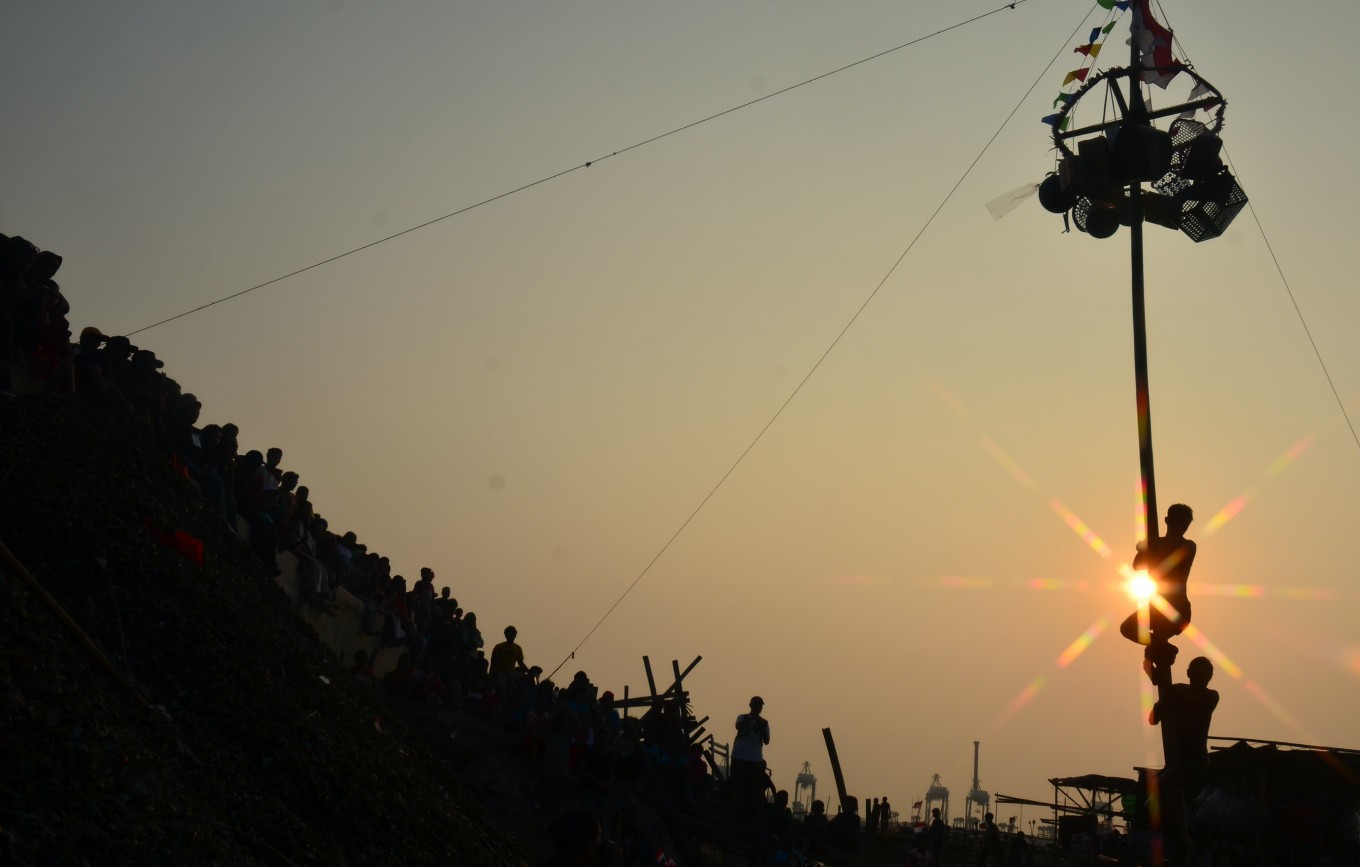 A silhouette of participants attempting to reach the top of a greased pole on Aug. 17, 2026, during an annual traditional pole-climbing competition held to mark Indonesia’s Independence Day in the Cilincing area of North Jakarta. (JP/Iqro Rinaldi)
Indonesia’s 81st Independence Day arrived with all the familiar trappings of patriotism, from polished state ceremonies to spirited neighborhood fun games. Yet beneath the celebratory veneer lay an uneasy reality. Punctuated by sharp political satire, street protests, a devastating earthquake in Flores, and ongoing violence in Papua, the occasion prompted a nagging question: Who is actually experiencing the promise of independence?
The official commemoration took place on Aug. 17 at the Merdeka Palace in Jakarta. While dignitaries and state officials filled the stands, everyday citizens vied for seats through a high-stakes "war ticket" system. Demand was fierce, the State Secretariat offered 5,500 public slots, drawing roughly 336,000 registrations. This enthusiasm showed that the state ceremony still resonates well beyond elite circles.
Even so, the contrast between the choreographed spectacle at the Palace and life across the archipelago was impossible to ignore. While many neighborhoods hung red-and-white bunting and cheered on traditional community contests, others seized the holiday as a platform to voice mounting frustration.
In Pati, Central Java, a grassroots coalition of farmers, residents, and civil society groups, including representatives from the Shadow Cabinet, Conference of the Republic, the Interdisciplinary Intellectual Forum (FIAD), and New Indonesia Cooperative, rallied to demand structural reform after more than eight decades of self-rule.
In the digital world, political satire captured that same disillusionment. One viral visual of the "81" logo replaced the "8" with a well-fed caricature of President Prabowo Subianto and the "1" with a frail, emaciated figure representing ordinary citizens. In a single image, a token of national pride was turned into a biting critique of the wealth and welfare divide separating the political class from the public.
Disquiet even pierced the official program. During the state ceremony, Religious Affairs Minister Nasaruddin Umar raised eyebrows by citing a 77.85 percent religious harmony index, framing it as an all-time high. The figure felt jarring alongside persistent threats to religious freedom on the ground, such as the recent pushback against a church build in Citraland, Surabaya, and SETARA Institute’s tally of 221 freedom-of-religion violations over the past year.
A parachuting exhibition drew further scrutiny when Indonesian Military (TNI) skydivers descended from 10,000 feet carrying a massive banner of Prabowo’s portrait. While framed as festive entertainment, the stunt triggered debate over personality-driven state symbolism and the blurring line between the presidency, the military, and the nation itself.
The clearest pushback came the following day. On Aug.18, hundreds of university students led by University of Indonesia Student Executive Board (BEM UI) took to Jakarta’s streets under the banner “Merebut Kemerdekaan” (Reclaiming Independence). Marching toward the Bundaran HI traffic circle before being halted by police cordons along Jakarta’s thoroughfare of Jalan Sudirman, demonstrators accused the Prabowo–Gibran administration of backtracking on campaign promises and presiding over a climate of "decaying freedom".
The demonstration put forward eight key demands, urging the government to curb military encroachment into civilian governance and safeguard democratic participation. Protesters also called for a freeze on flagship initiatives like the free nutritious meal program and the Red and White Cooperatives. Parallel rallies echoed across Yogyakarta.
These protests reflect a continuum of public friction stretching back through the past year, spanning grievances over lavish lawmaker housing allowances, the surging cost of living, unchecked state spending, and creeping militarism. The persistence of street mobilization signals that these concerns remain largely unaddressed.
Reports have it that more rallies against the government will follow and peak on Aug. 27, involving various elements of society.
Tragedy also cast a heavy shadow over the celebrations. Just two days before the anniversary of independence, a magnitude 7.7 earthquake struck Flores, East Nusa Tenggara. By Aug. 19, the National Disaster Mitigation Agency (BNPB) had confirmed 71 fatalities, with thousands left displaced amid destructive aftershocks and strained relief efforts.
Meanwhile, unrest in the country’s eastern tip of Papua was a grim reminder of long-standing conflict. On Independence Day itself, an armed group attacked a security post in Jila district, Mimika, killing one soldier and injuring two others. The next day, authorities opened an investigation into the abduction of nine local women in the same area, with reports indicating that one woman was killed and her child injured.
In Aceh, people lowered the red and white national flag and raised Free Aceh Movement (GAM) banners in a show of protest against what they called the central government’s neglect of the westernmost province. They even called for independence from Jakarta, a withdrawal from the 2005 peace agreement signed by GAM leaders and the government to end three decades of armed conflict.
Viewed together, these events complicate the triumphant narrative of Indonesia’s 81st anniversary. The rallies demanded economic fairness and democratic protection; the satire highlighted elite detachment; the Flores disaster exposed persistent gaps in emergency response; and the bloodshed in Papua laid bare unresolved structural conflicts.
Optimism is a natural part of any national milestone, but genuine progress requires looking these contradictions in the eye. Eighty-one years on, the most urgent question is no longer whether Indonesia is independent, but whether its people can feel that freedom in the fabric of their daily lives.
What we've heard
Police are preparing for the potential escalation of demonstrations that have intensified in recent weeks.